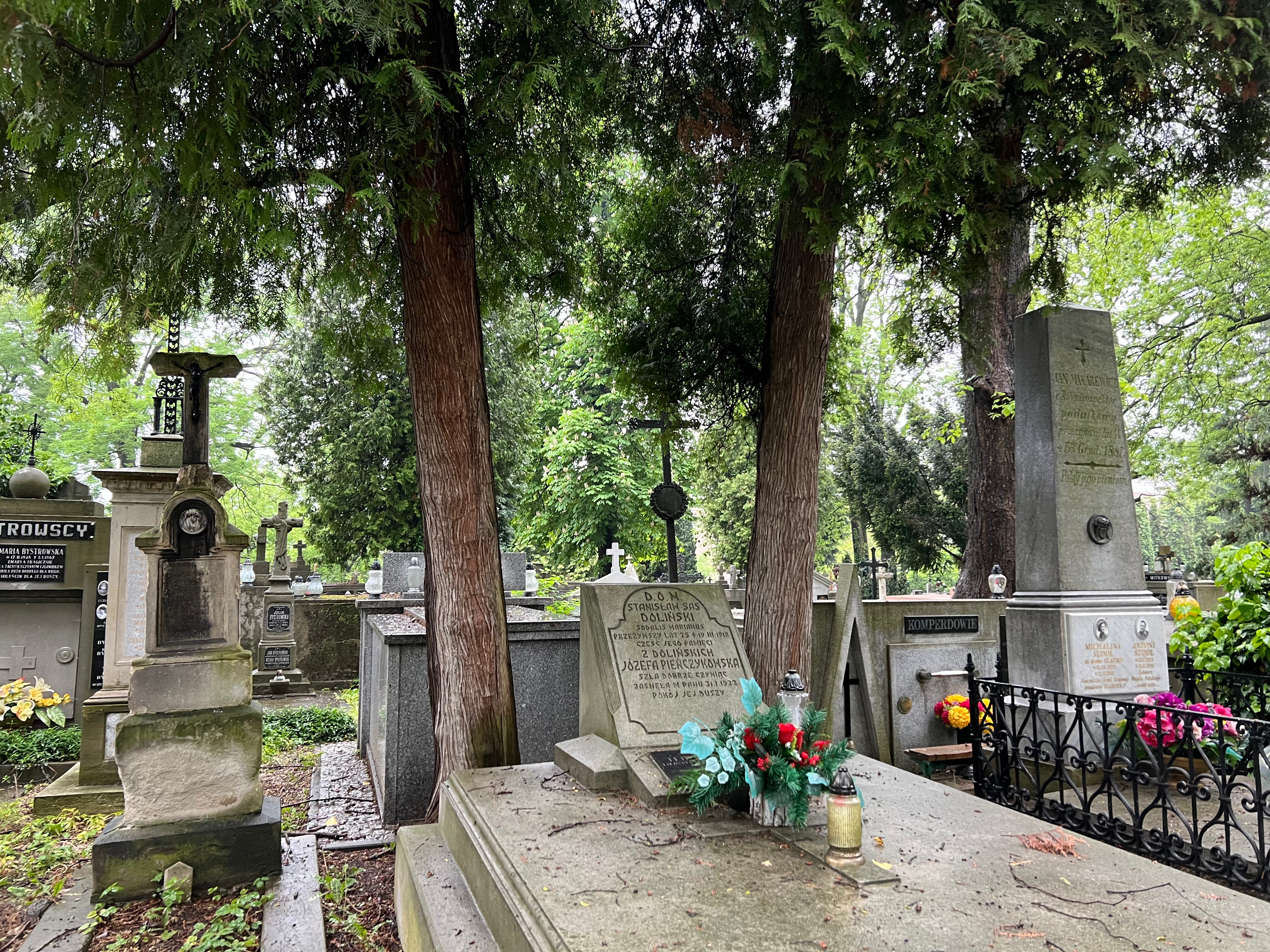
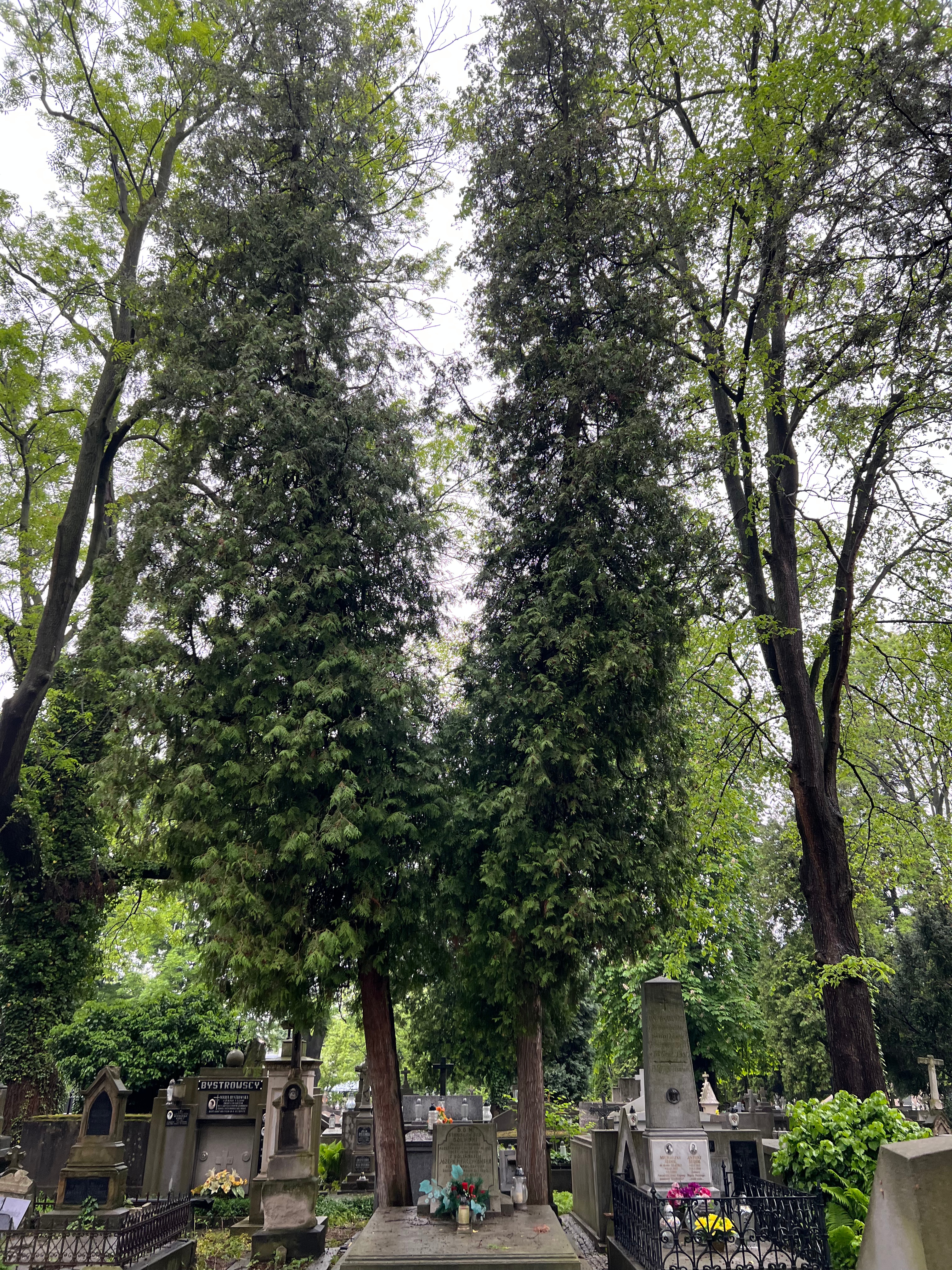
The past 100 years of Polish history have been anything but tranquil. For that matter, Polish history over the last millennium hasn’t exactly been a walk in the park. But it’s the last century, give or take, that’s on my mind. The years that came and went as the twin trees at the top of this post grew in Stary Cmentarz, literally “old cemetery,” in Tarnów, Poland.
I came upon the tombstone beneath these trees after walking around the cemetery for most of an afternoon. The whole place was an accidental destination (a description of my approach to travel in general), but a rewarding one. Its avenues and alleys of the dead were alive with stories—people perhaps born in the Hapsburg Empire, when Poland had been wiped off the map, but who lived to see the country reborn into independence after one world war and reclaimed from the Soviet influence that followed another. They lived quiet lives in noisy times.
Still, by the time I got to the stones at the center of this story, I was mostly thinking about how to make my way back to the main gate. Except something in the back of my head kept telling me to slow down, that I was missing something.
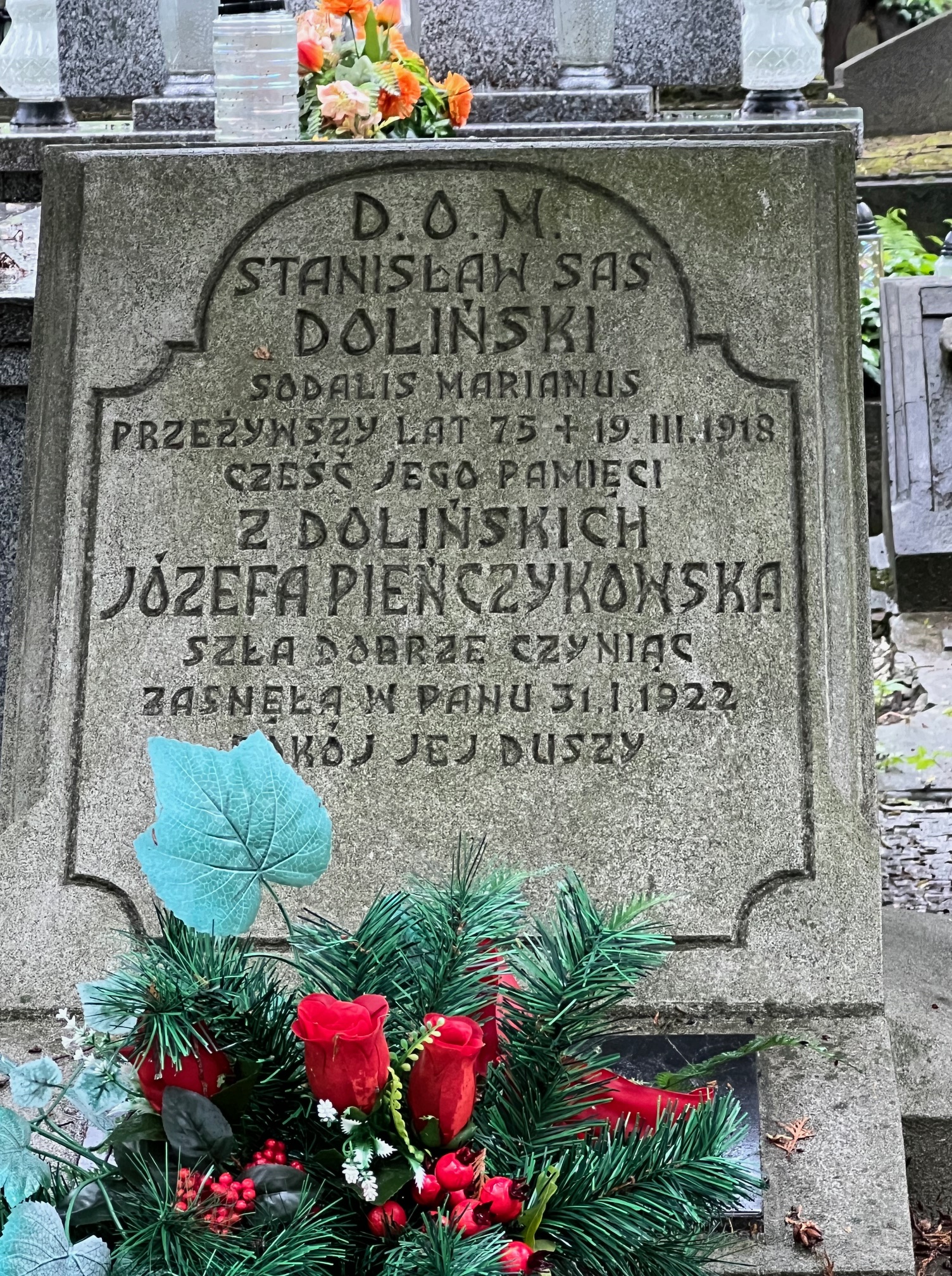
At first, I couldn’t see anything out of the ordinary about Stanislav Sas Dolinski (1918) and Józefa Pienczykowska (1922). Finally, I looked up and understood what some part of my brain had already recognized: the trees.
There were lots of trees in the cemetery, and the day’s persistent rain sounded like percussion on the green canopy. But they rarely overlapped with the plots the way these two did. They rarely appeared in pairs, for that matter. I’m no arborist, but craning my neck to see the tops, they looked like you might expect trees to look after a little more than 100 years. Like trees that had started to grow around the start of the 1920s.
Were these trees planted with a purpose? Or was there placement purely a coincidence?
Running the text on the stones through a couple of translation apps didn’t provide much context. The words seem to suggest Józefa is of the Dolinski family. Was she Stanislav’s wife? The cemetery is full of family tombs, parents and siblings. But later on, I found a few references online to a Józefa Dolinska (Pienczykowska) from the right period, so maybe?
If he was 75 when he died, as suggested, Stanislav was a boy during the uprisings of the 1840s, when enserfed peasants in and around Tarnow slaughtered many of the same Polish nobles who were trying to use them to throw off the Habsburgs. Sort of a no-win situation for the peasants either way. After Stanislav’s death in the final months of World War I, Józefa would have seen Poland restored to the map, eventually solidifying that independence by fending off the Red Army shortly before her death in 1922.
For Poland, only more turmoil and greater evil awaited—Hitler and the Holocaust, Stalin and decades behind the Iron Curtain, before the none-to-easy return to democracy and our own increasingly unsettled times. But for Stanislav and Józefa, there was none of that. In the cemetery, there was only quiet. And in a place synonymous with death, two trees grew.
I don’t know who Stanislav and Józefa were or what linked them. But I’d like to think that whatever that bond was, it still speaks to us today. That it got me to stop and take a step back, that it got me to notice the trees for the forest that surrounded them.
That some things live on.
Note: For anyone interested in this part of the world and its history, I’ll share some of the titles that resonated with me in advance of this trip (and apologies to the authors for any and all history I got wrong).
Central Europe: The Death of a Civilization and the Life of an Idea, by Luka Ivan Jukic
Goodbye, Eastern Europe: An Intimate History of a Divided Land, by Jacob Mikanowski
The Reconstruction of Nations: Poland, Ukraine, Lithuania, Belarus 1569-1999, by Timothy Snyder
The Curse of Empire: Ukraine, Poland and the Fatal Paths in Russian History, by Martin Schulze Wessel
Poland: The First Thousand Years, by Patrice Dabrowski
Lost Fatherland: Europeans Between Empire and Nation-States 1867-1939, by Iryna Vushko
The Middle Kingdoms: A New History of Central Europe, by Martyn Rady


