Did I come to Maastricht for a bookstore? It depends on our starting point.
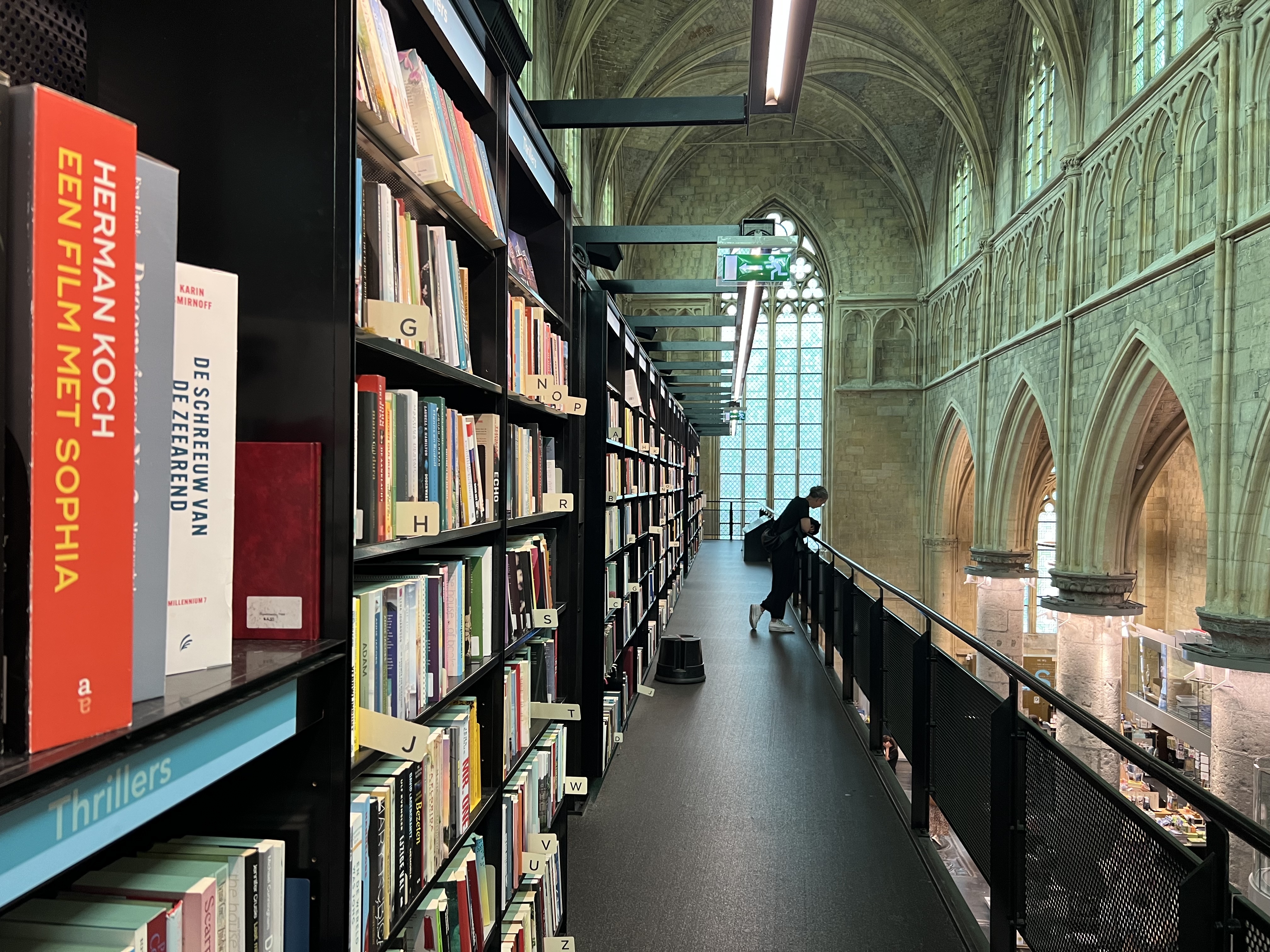
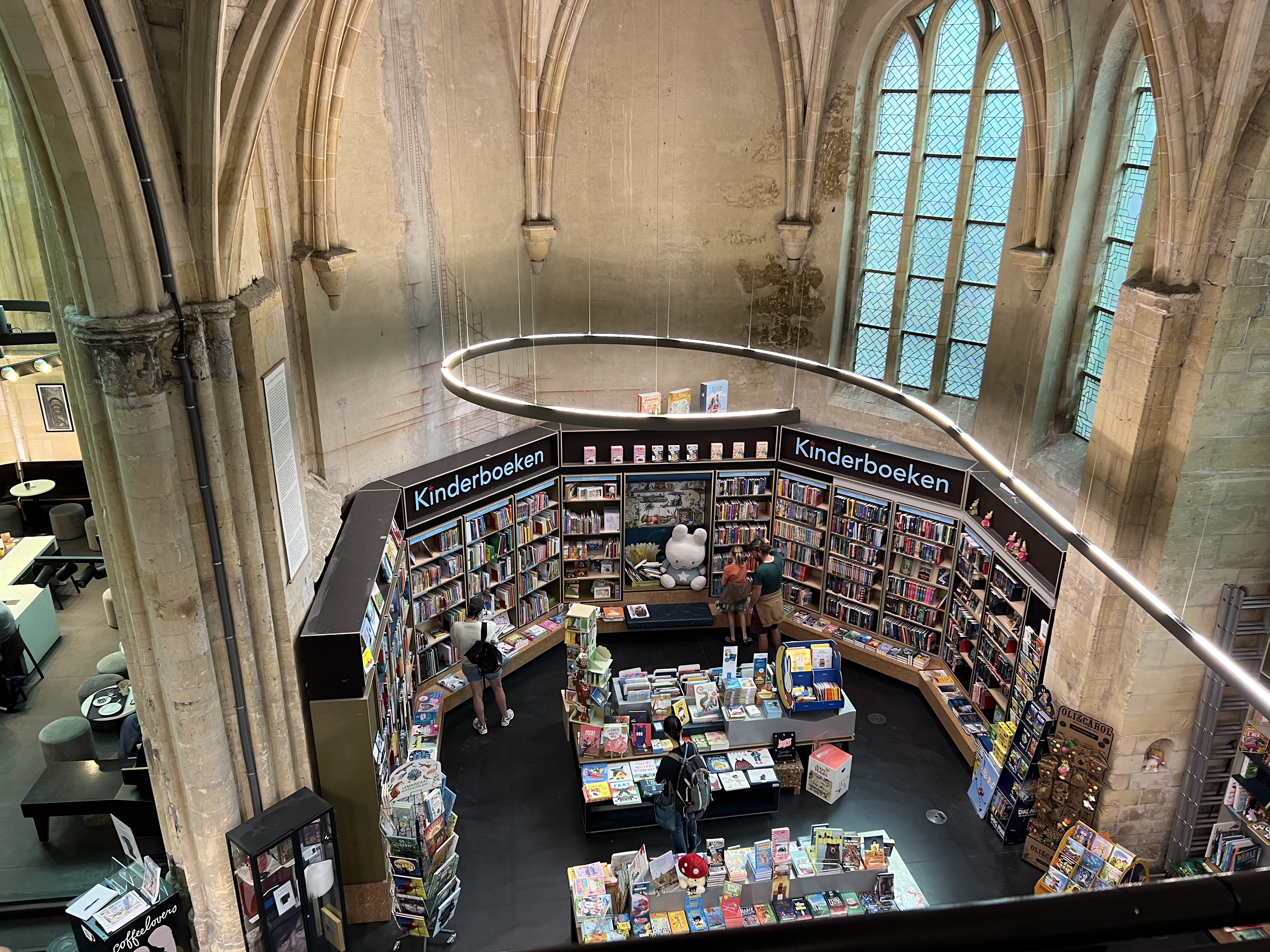
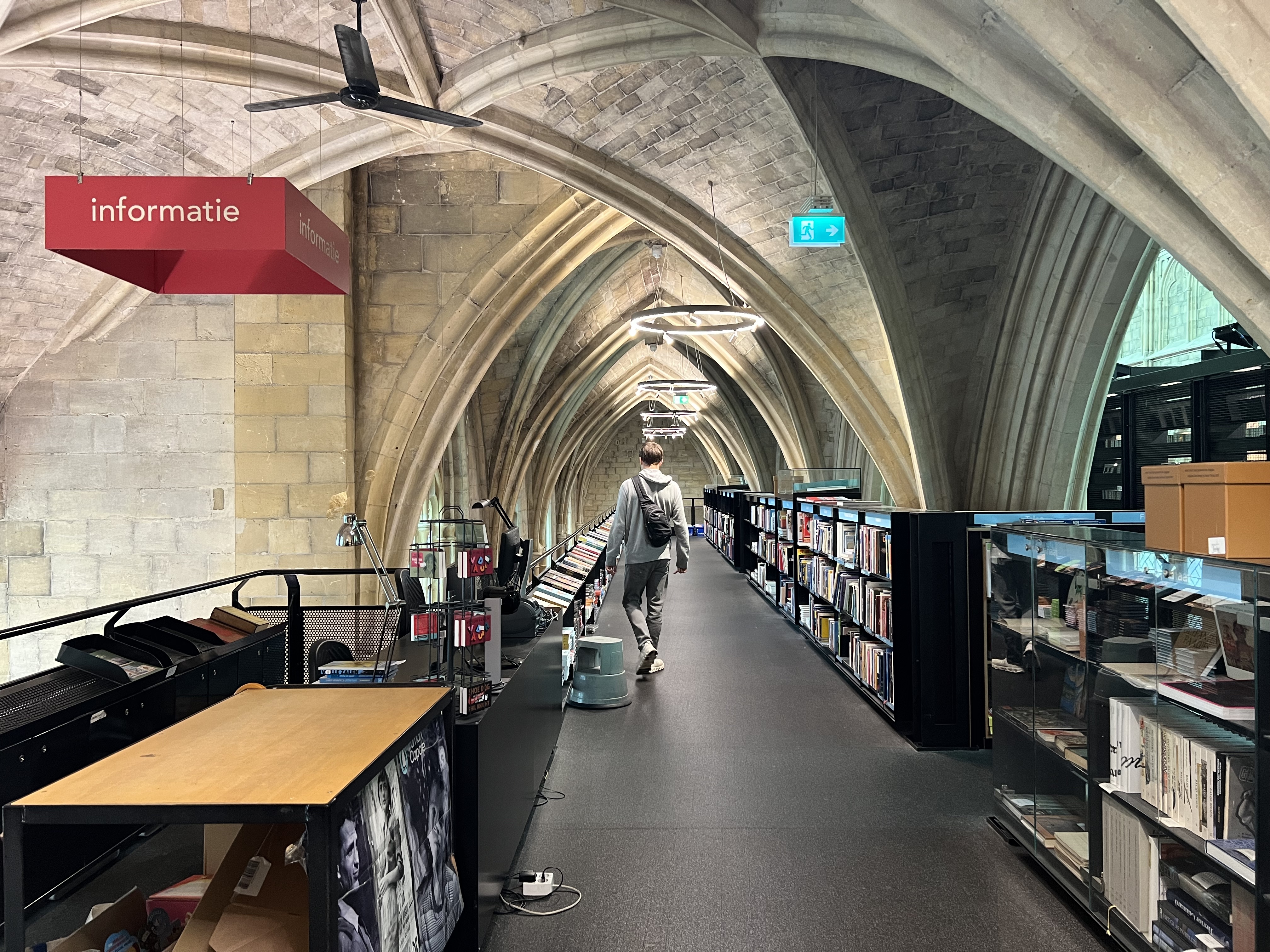
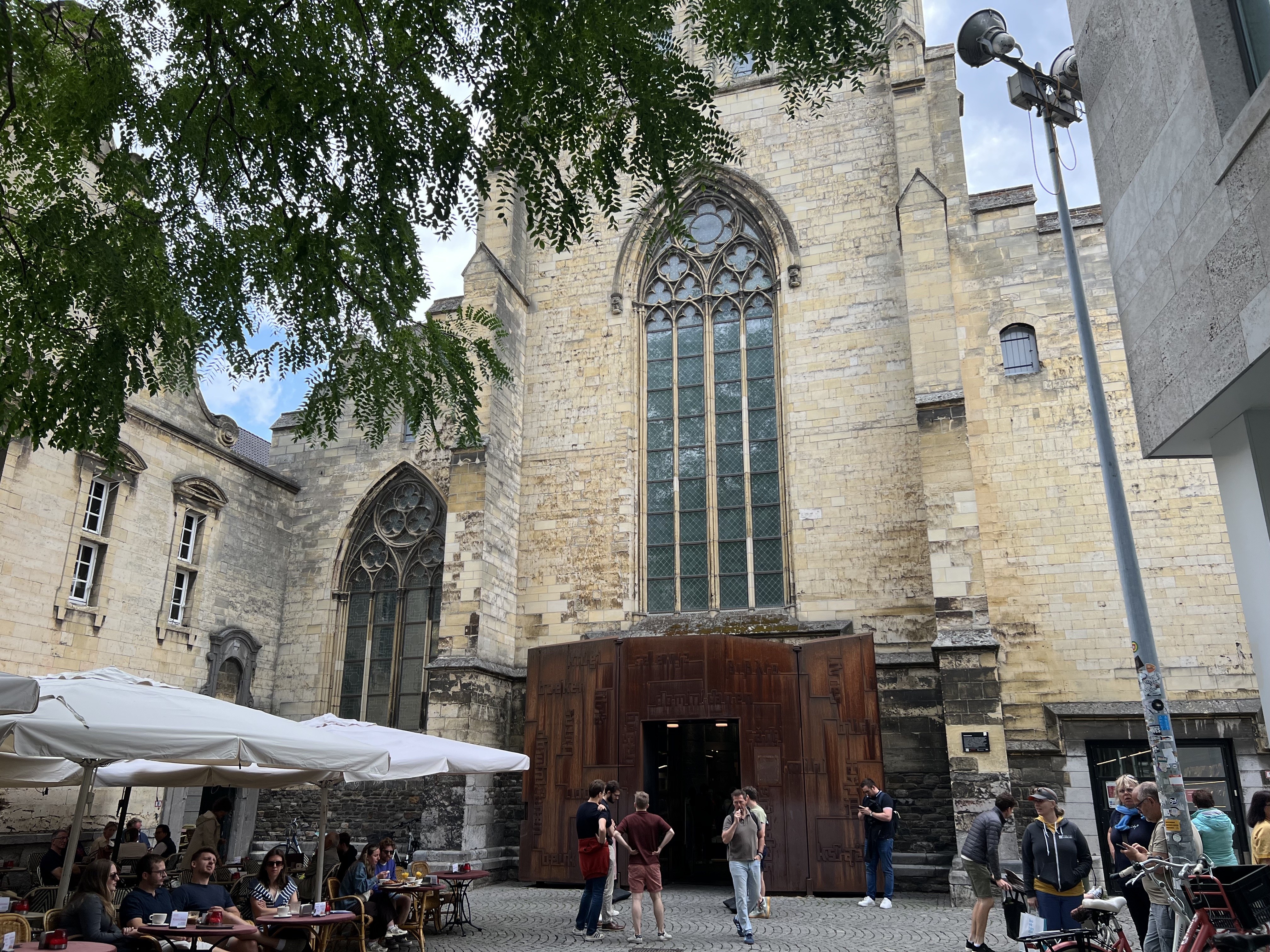
No, I didn’t trek all the way to Europe to visit the Boekhandel Dominicanen, which is inside a church originally constructed in 1294, more than a century before Johannes Gutenberg invented his moveable-type printing press to make that future possible. But I’m not sure I would have added Maastricht to my itinerary if not for its one-of-a-kind bookstore (it hasn’t been a functioning church since the French Revolutionary Wars spilled over into the Low Countries and the French used it for horse stables).
The bookstore sealed the deal when, looking for an appealing place to spend a couple of days before moving on to Dusseldorf, I learned about it as a point of interest in the small geographically quirky city (in a spit of the Netherlands wedged between Belgium and Germany) that earned positive reviews for walkability, atmosphere, history and scant tourist hordes.
Now, as it turns out, the Bookstore Dominicanen is not an unforgettable bookstore for the purpose of finding books to read. This wasn’t all that surprising. I don’t think it would qualify as a great bookstore even if you read Dutch, which understandably appeared to account for about 75 percent of the inventory. Perhaps because most of its square footage is vertical, it doesn’t have a huge selection. It makes up for that lack of quantity in the quality of the selection, to a point. It’s decidedly less reliant on a handful of best-sellers than the typical airport bookstore, for instance. But it’s not a temple of deep cuts and staff picks. And because of the narrow aisles and people (like me) taking photos, even on a Monday morning, it is not super conducive to browsing.
But it’s a good enough traditional bookstore to come away happy from a once-in-a-lifetime bookstore experience.
Because the Bookstore Dominicanen isn’t really about finding something to read (I walked out with Gareth Rubin’s Holmes and Moriarity). It’s an endearing tribute band of a bookstore, a celebration of books—look where we can put a bookstore! Take your Index Librorum Prohibitorum and shove it, Pope Paul IV, here’s a fantasy novel about a kickass demon-keeping teenage witch. In that, it succeeds wildly. I walked away happy because it brought me back to all of the amazing (and, yes, better) bookstores in which I’ve gotten lost over the years.
When I lived in the Pacific Northwest, Powell’s in Portland and Elliott Bay Book Company in Seattle. When I returned to visit over the years, Cloud and Leaf, the perfect vacation bookstore in the out-of-the-way beach town of Manzanita, Oregon—three blocks from the ocean, a tiny store somehow always full of books I wanted to read.
Or Powell’s secondhand bookstore near the University of Chicago, related through the eponymous family to the more famous Portland institution and always full of rare baseball titles when our family made summer trips to Chicago and games at Wrigley Field.
From an even younger age, so long ago that I don’t remember the names of the individual establishments, if I ever knew them at all, the bookstores in London and Cambridge that were full of Paddington, the Wind in the Willows, Frog and Toad and more.
The first Borders that opened in Indianapolis was a seemingly miraculous development in an area that was a bookstore desert. Long before it moved to a much larger superstore location with music, café and all the other accoutrements of its war with Barnes and Noble, it was just books. The nooks and crannies turned each section into its own principality, like some Holy Roman Empire of history, literature and more near one of our many, many malls.
Even abroad, I’ll wander into bookstores that, unlike the Dominicanen, don’t have any titles in English. The look and feel of the store is familiar. It’s still enjoyable to peruse a shelf.
I go to bookstores now and wince at the prices, contemplating what I need to cut out of the monthly budget to buy a couple of hardcovers. Yet somehow, to my parents’ everlasting credit, bookstores were places where we, as kids, didn’t need to beg or plead. Sure, they might draw a line when your tower of books grew too tall for you to carry, but they wielded the necessary accounting wizardry to make it work in their budget.
The rules of the real world never applied in bookstores, which in its own way, is at least as magical as anything you find through the back of a wardrobe.
In a bookstore, all the more before the internet, you could go anywhere and do anything. You could walk into a store and learn about people, placed and times you never knew existed until that moment. Try finding anything that revelatory at Bed, Bath and Beyond.
That’s what is special about the Bookstore Dominicanen. It’s celebrates the idea of bookstores—that here anything is possible. Even a bookstore in a church built before the printing press.
Welcome to Opening Day. As a new season gets underway, I’ve parted ways with the outlet where you could find my softball writing the past four years. You’ll see me pop up from time to time this season with the good people at Softball America. Maybe other places, too. We’ll see. If you believe in telling this sport’s stories and have need of words, I’d always love to chat.
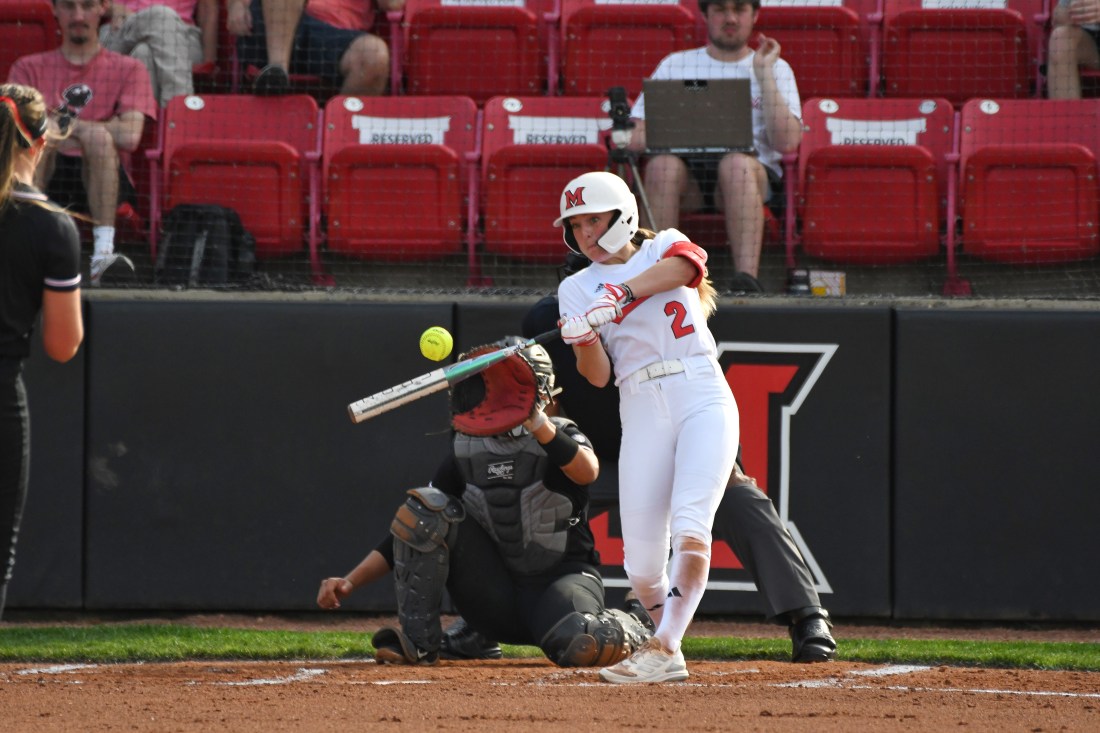
In the meantime, here’s my first story of a new season. There’s no paywall, just follow the link to Softball America. I’m grateful to Miami’s Jenna Golembiewski and Chloe Parks for letting me share their story. They make it a powerful one, so I mostly tried to get out of the way.
It’s a story rooted in numbers—the marvelous athleticism of Golembiewski’s staggering offensive season in 2024—and curiosity about the human behind them. Which is to say, it’s a story about a sport I love.
Jenna Golembiewski still has her mom’s instructions tucked away. She brings the letter with her to Oxford, Ohio, each year, packed alongside the softball glove, clothes and bedding. It reminds her how to handle the challenges ahead—collectively for a Miami MAC dynasty replacing starters all over the diamond and individually for a player replacing one of the most prolific power hitters in NCAA history atop every opponent’s scouting report.
Not that her mom could see the future. At least not in that much detail. LeAnn Kazmer Golembiewski didn’t get to see her daughter win three consecutive MAC tournaments or play in three consecutive NCAA regionals. She never knew Karli Spaid, for that matter, the All-American who was the Ruth to Jenna’s Gehrig a season ago. But the letter contains everything Jenna needs to meet the current moment, not to mention the far more consequential obstacles that inevitably await in a life beyond the softball field. …
I’m no more fluent in philosophy than Norwegian or Swedish. I signed up for a philosophy course in college, but if a lecture falls at 8 a.m., does it make a sound? Not that I recall.
Aristotle, Descartes and the rest aren’t wholly unknown names, but I’m on much firmer footing when it comes to debating Mays and Aaron or differentiating Stiles from Catchings.
That also holds true for Søren Kierkegaard, who I’ve spent more time thinking about in the last month than the preceding four decades. The Danish philosopher came up often in the cultural histories of Scandinavians and the Nordic region that I read before a trip to Sweden and Norway. Previously, the name triggered little more than a vague connotation with the sort of melancholic bleakness that pervades Nordic crime fiction. As usual, a fuller picture of his times and work made me curious for more.
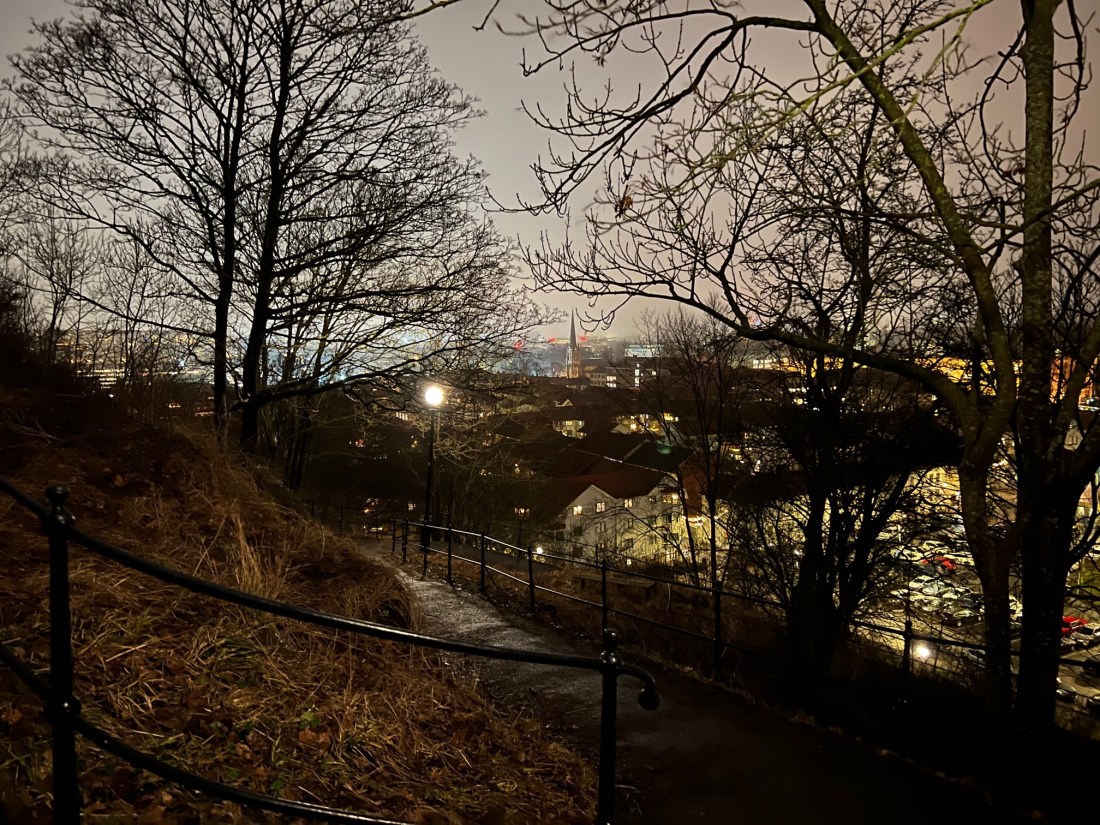
I just didn’t expect to run into him at Skansen Kronan, the 17th century fortress that sits atop a hill overlooking much of Gothenburg.
I never recall feeling uncomfortable with heights as a kid. Maybe that’s just memory editing, but I remember loving all towers, observation decks, gondolas, etc. I could—and did—ride roller coasters from the time an amusement park opened until last call. But somewhere along the way, increasingly over the past 10-to-15 years, I’ve grown decidedly skittish at even the suggestion of open, elevated spaces. In Edmonton a couple of years ago, I forced myself to walk across the Waterdale Bridge, which soars over a ravine. But I couldn’t bring myself to pause long enough to take a photo, unsure I could get my legs in motion again.
It’s an irrational fear (maybe most are). As best I can tell, it’s not specifically a fear of falling. Nor is it height alone—the steerage seats are the only part of flying that bothers me. It’s just an overwhelming sensation of openness on too many sides that leaves me frozen.
Those are the physical manifestations, but it feels somehow more all-consuming. Perhaps life feels naturally limitless when you’re young, so the boundlessness of height is the world as it should be. Whereas with age, as I become ever more aware of the limitations of time and possibility, those same open heights somehow feel more daunting, even threatening.
More to the point, perhaps the boundless physical space forces me to confront such a pure distillation of my own fears about the limits of time and possibility that I short circuit.
On this particular day, it hit me walking to the top of the path leading to the Skansen Kronan. The paved path was steep—the sort of path cut centuries ago when no one from health and safety needed to sign off. It was a cold, wet and windy morning, and as these things go in Gothenburg in January, still a long way from dawn offering any natural light. So, not ideal conditions for a stroll. But this also wasn’t the final ascent on Everest. It was maybe five minutes and half a dozen switchbacks. No big deal. But with each turn, and for reasons that had nothing to do with the incline, the next step was harder and harder to take.
Soon, even with the top in sight, it was too much. I knew I could push on. Ascending is always more manageable than descending. But I wasn’t sure I could force myself back down, and that was going to make it decidedly difficult to catch my train to Oslo later in the morning. Frustrated at missing a good view and a good picture, I turned around.
Maybe Kierkegaard had it right.
“Anxiety may be compared with dizziness. He whose eye happens to look down into the yawning abyss becomes dizzy. But what is the reason for this? It is just as much in his own eyes as in the abyss. … Hence, anxiety is the dizziness of freedom.”
Back on level ground, I set off in search of Café Husaren’s giant cinnamon rolls.
Because as philosophers go, I still find the greatest solace in Douglas Adams. There may be as many existential crises in the “long dark teatime of the soul” as there are in Kierkegaard’s universe. But the world feels more sensible with coffee and a bun.
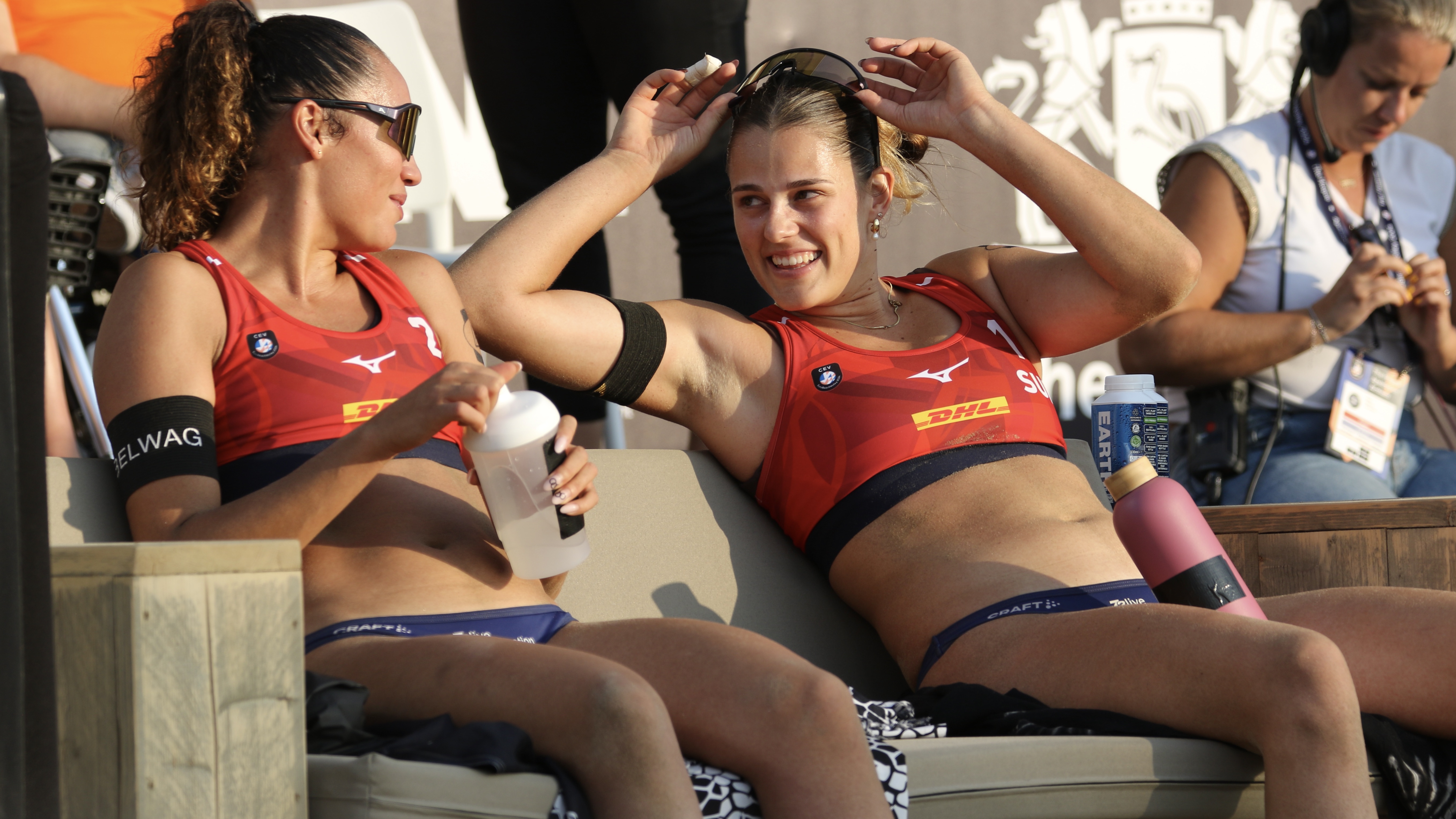
Maybe more than most of us, athletes grow accustomed to believing their fate rests in their own hands. Their talent. Their will. Their confidence. Maybe more than most of us, they also understand deep down that such control is forever an illusion.
They don’t control injuries. They don’t control a bad call in a big moment. They don’t control an unfavorable draw. They don’t control a pandemic. In beach volleyball, where a career can be defined by where someone is from, they don’t control who else in their age cohort happens to share a passport, complementary skills and compatible personalities.
All they really control, and it’s no small task to do so, is their own sense of self.
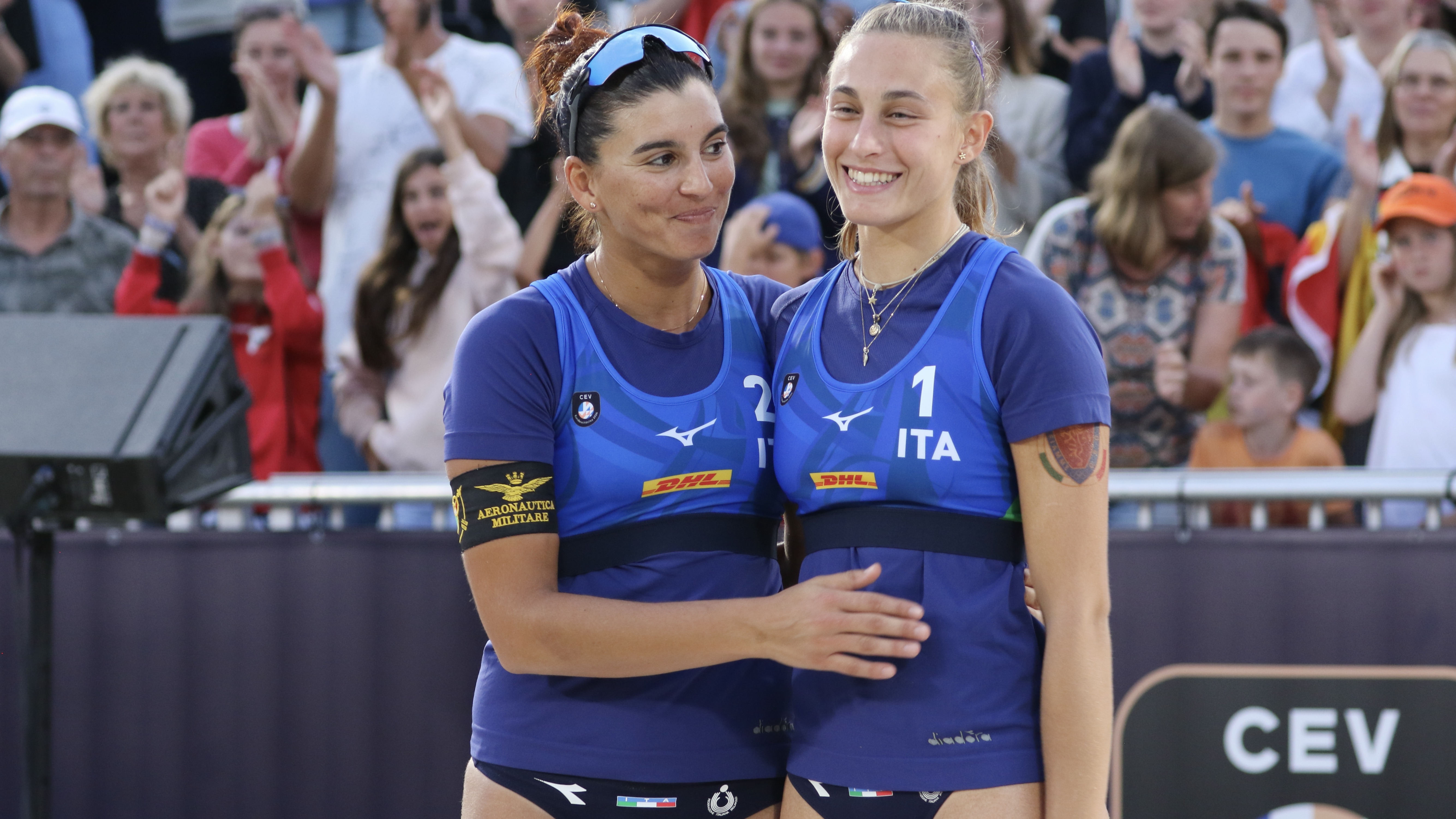
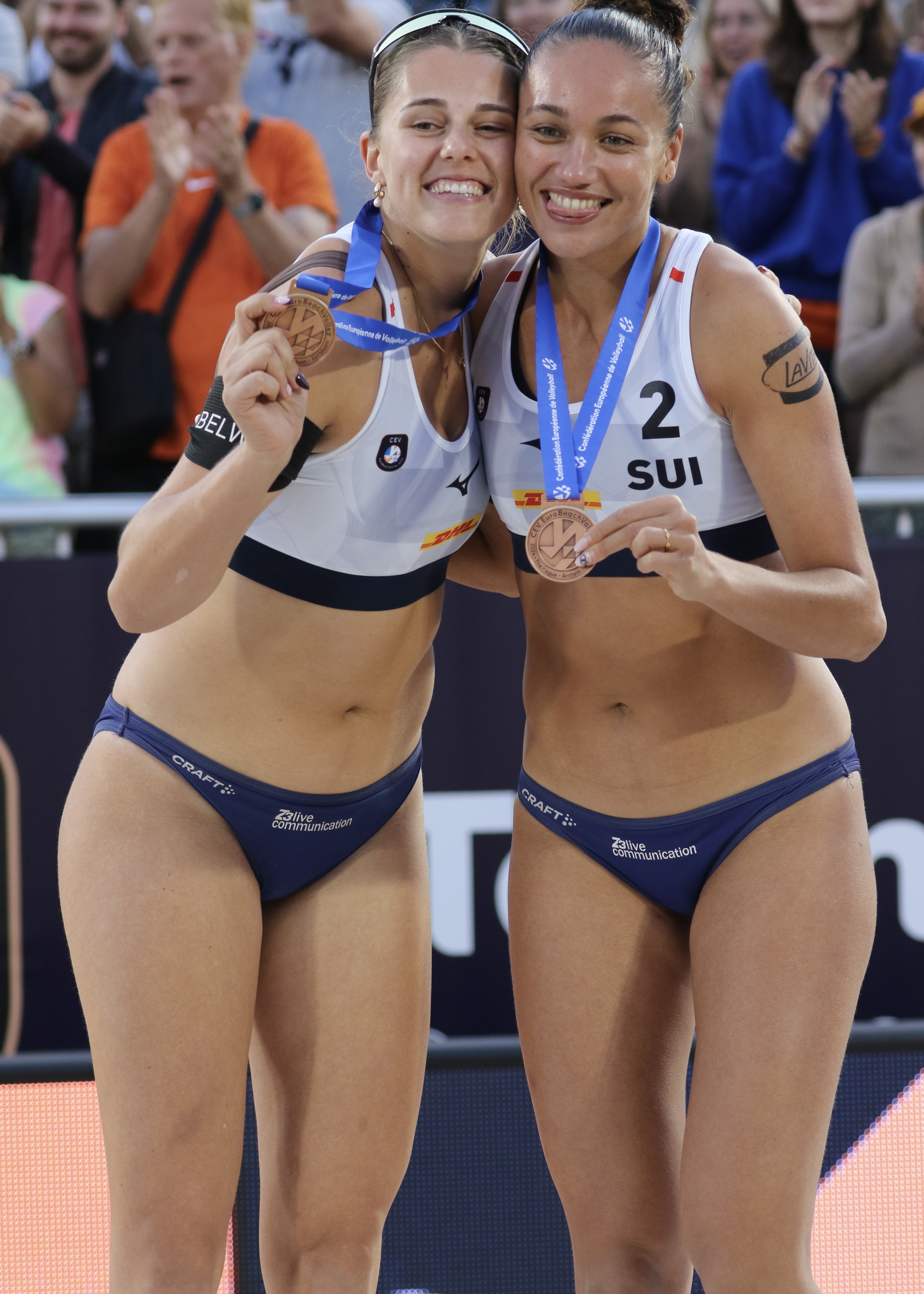
For Esmée Böbner, that meant the courage to walk away at 24 years old. For Laura Ludwig, that meant the grace to walk away after one more afternoon in the (proverbial) sun. And for Marta Menegatti, at least for another week and another round, it meant finding the drive to continue. All within the span of roughly 24 hours this weekend.
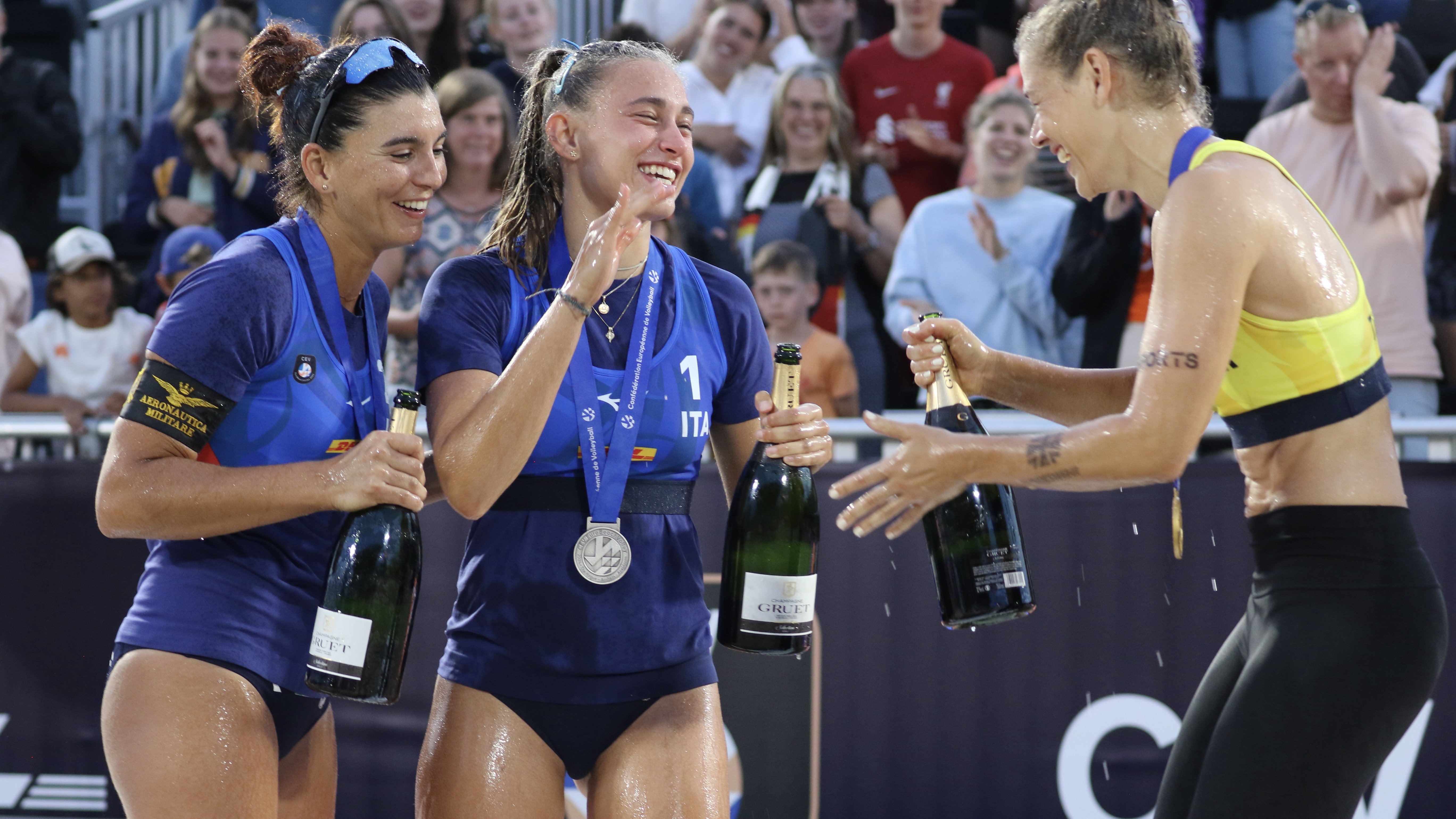
Saturday morning, early enough that bakeries were still doing brisk business for breakfast shoppers, Italy’s Marta Menegatti and Valentina Gottardi were already deep in the third set against Finland in Hamburg. At stake was a place in the quarterfinals of the Elite 16 event, the reward for an unrelenting schedule that few peers undertook—the Olympics, European Championships and Elite 16 in successive weeks.
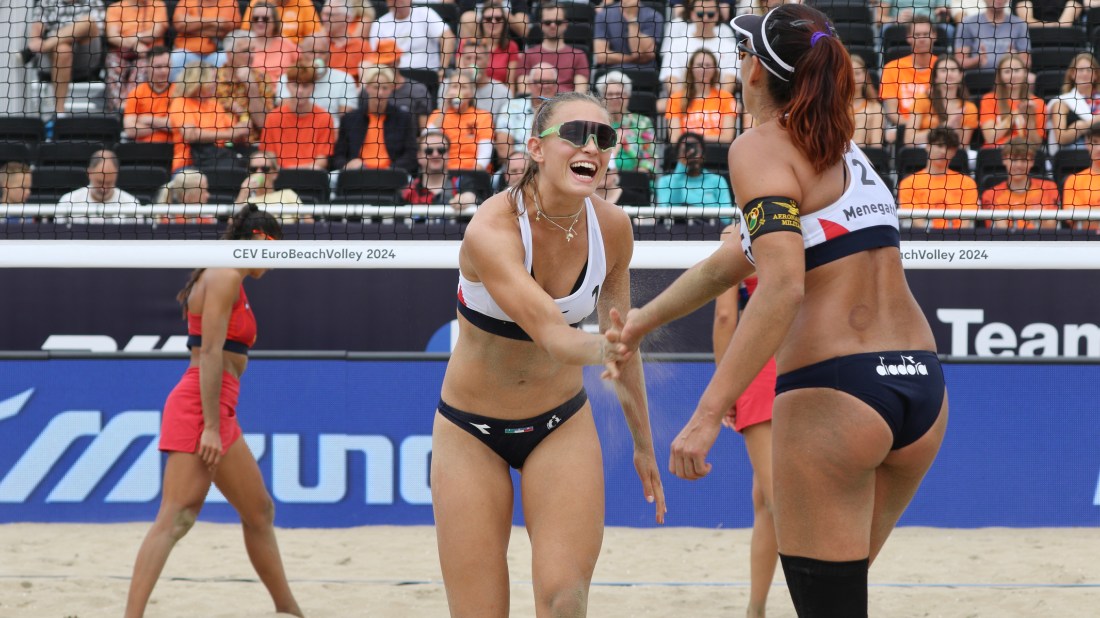
As they had in the Euros in the Netherlands, Menegatti and Gottardi lost their opening match in Hamburg—dropping a 19-21 third set marathon against Brazil. As was also the case en route to a silver medal in the Euros, they recovered and still made it out the pool. But against Finland, Italy flirted with disaster, losing 21-11 in the second set and then trading point for point in a third set that stretch beyond regulation. Match point after match point slipped away until Menegatti served at 18-17 to try and close it out for a fifth time.
Having celebrated her 34th birthday shortly before Hamburg, Menegatti is closer to two decades than one into a pro career spanning four Olympics. She picks her moments, the wisdom of all those points, sets and years—decidedly non-artificial intelligence— allowing her to calculate what’s worth chasing and how to finagle a few extra seconds of recovery time.
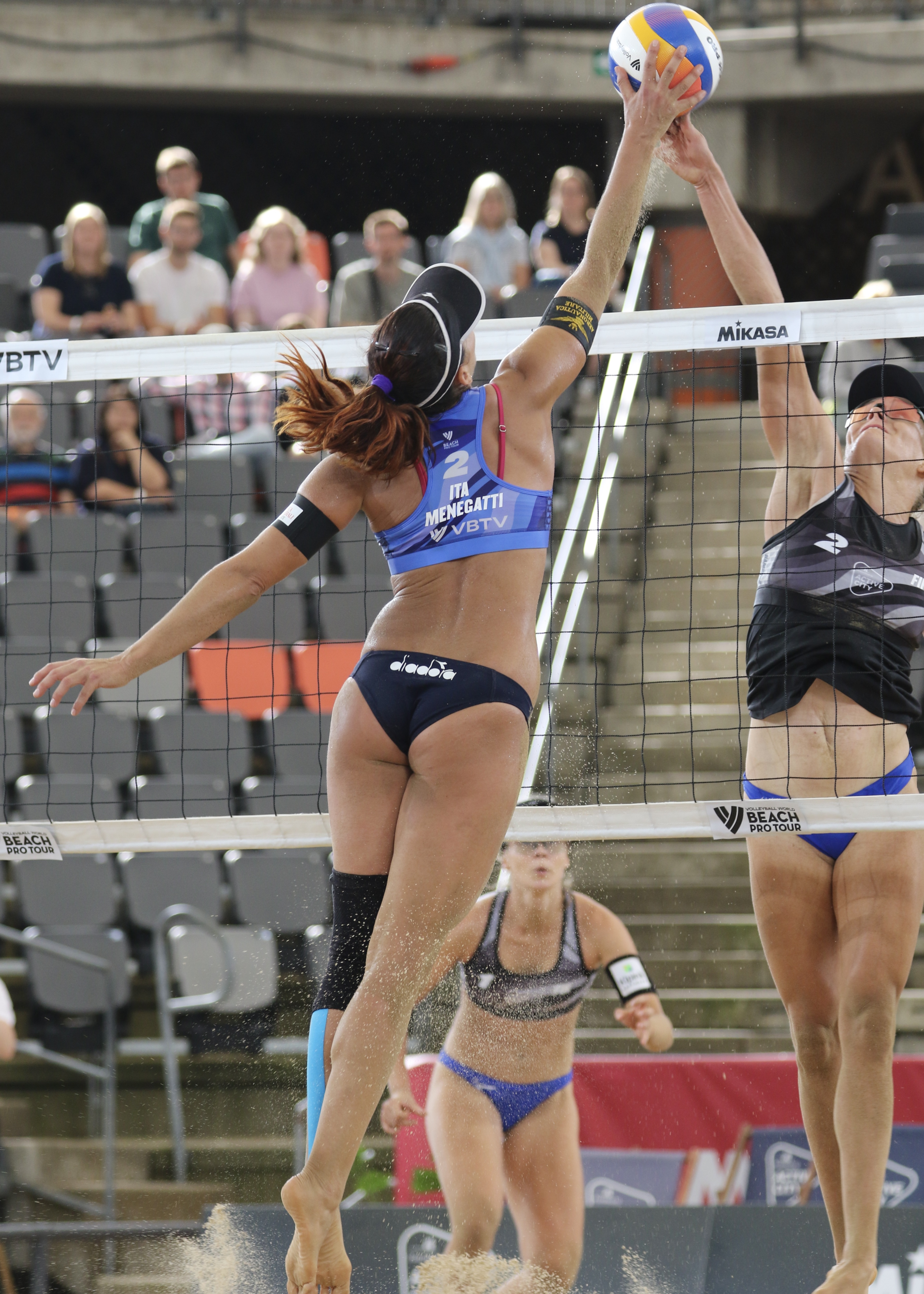
On match point No. 5, Menegatti served and had to move quickly toward the net, diving to defend a Finnish cut shot. After chasing down that dig to keep the point alive, Gottardi then got a fingertip on an attempted block when Finland tried again to end the point. The ricochet left Menegatti no choice but to launch her body at the ball for the second time in the point, this time propelling herself toward the sideline on the other side of the court.
The ball and the point still improbably alive, Gottardi somehow kept her bearings as she flicked the ball over her head for the winning point.
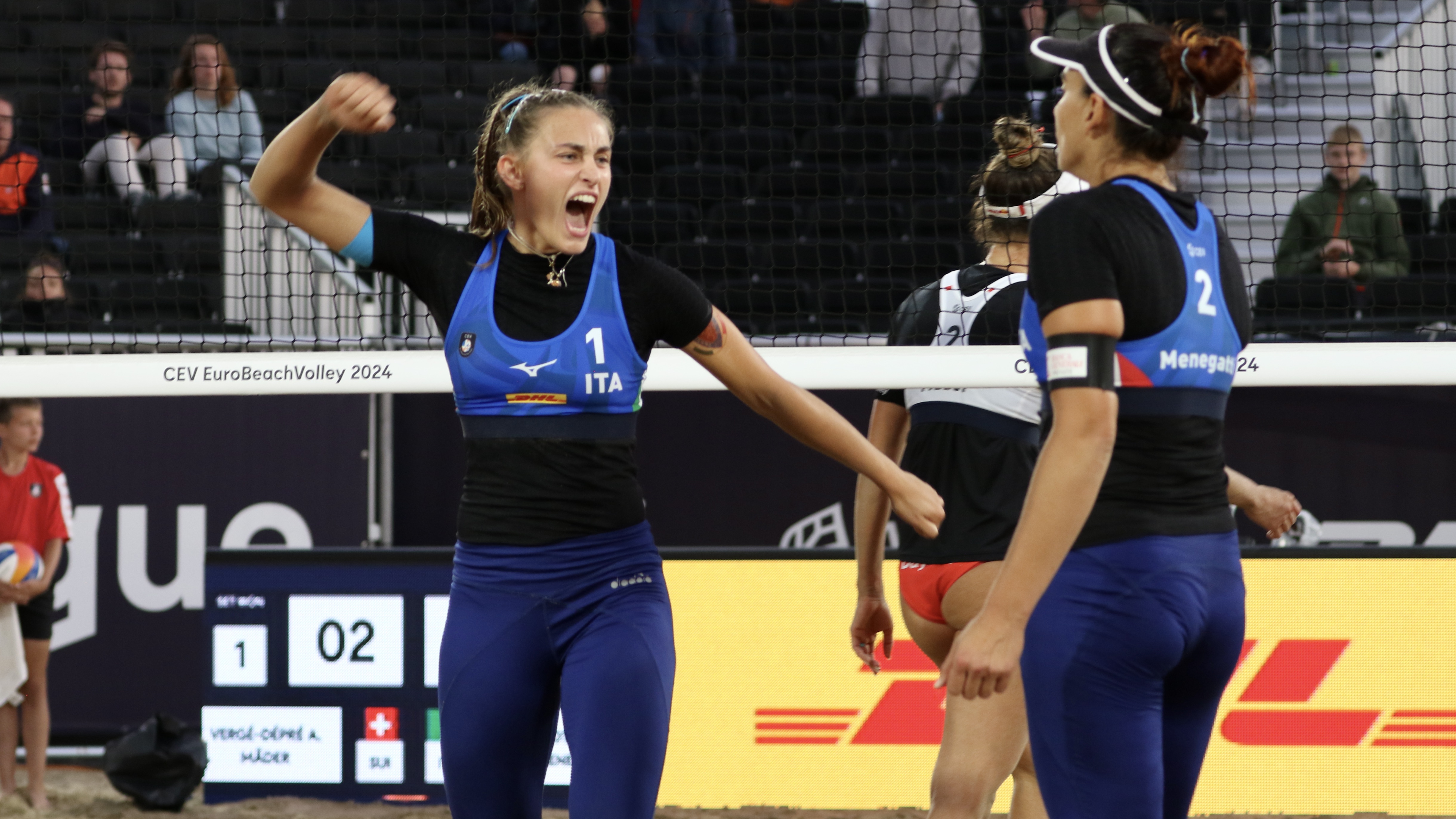
Sprawled on the sand where she had landed, Menegatti didn’t move. She just grinned—telling enough from someone who rarely wastes energy on such on-court frivolities.
Just a few hours later, under an unforgiving sun on far and away the hottest day of the week, the Italians outlasted the Dutch duo of Katja Stam and Raisa Schoon in three sets to reach the semifinals. As in the Euros, this one ended with Menegatti jumping up and down for joy.
For all I know, this could be Menegatti’s valedictory tour, culminating with the upcoming Italian Championships. Los Angeles, certainly, feels a long way off. At the same time, after something of a rotating cast of partners and a stretch of years as she neared 30 in which podiums were hard to come by, there must be something invigorating about playing with arguably the most talented young player in the world in 21-year-old wunderkind Gottardi.
The Euro silver was her first medal in that competition since winning it in 2011. The World Tour Challenge event she and Gottardi won last year was her first in five years. A medal of any sort in Hamburg would be her sixth on the world tour in the past three seasons with Gottardi. Menegatti’s long career has already been more than a tad star-crossed. Gottardi’s arrival on the scene offers her a tempting opportunity for a Hollywood ending.
Or as Menegatti put it on Instagram after the Euros, quoting Paolo Coelho, “It’s the possibility of having a dream come true that makes life interesting.”
She will have to decide, or far more likely already knows, if her next dream involves sand.
Meanwhile, Laura Ludwig’s life—certainly her biography—has been interesting since the beginning. She was born in a city and country that officially no longer exist—East Germany and East Berlin, three years before the fall of the Berlin Wall. It’s a short train trip from Hamburg to the capital these days. It was the other side of the world when she was born.
It’s strange to think of her as part of a past that feels so distant, mostly because she’s for so long helped define the present. Decades changed, world tours changed, partners changed, rules changed. Ludwig was always just there. She was named FIVB Most Improved Player in 2007, the same year Birgit Prinz led Germany to its second consecutive Women’s World Cup title and just five years after the likes of Gottardi and Spain’s Tania Moreno were born.
I remember watching her in the qualifying rounds in Gstaad in 2019, seemingly incongruous surroundings for the Olympic champion just three years earlier and world champion just two years prior. But with a new on-court partner, Margareta Kozuch, and a new child off court, she willingly retreated down the ladder to begin anew. Two years later, having outlasted even a pandemic, she was back in the Olympic quarterfinals.
It was the same story when I saw her again in Edmonton last year, the great champion again grinding her way through qualifying at a Challenge event. Again, she had a new partner, indoor great Louisa Lippmann.
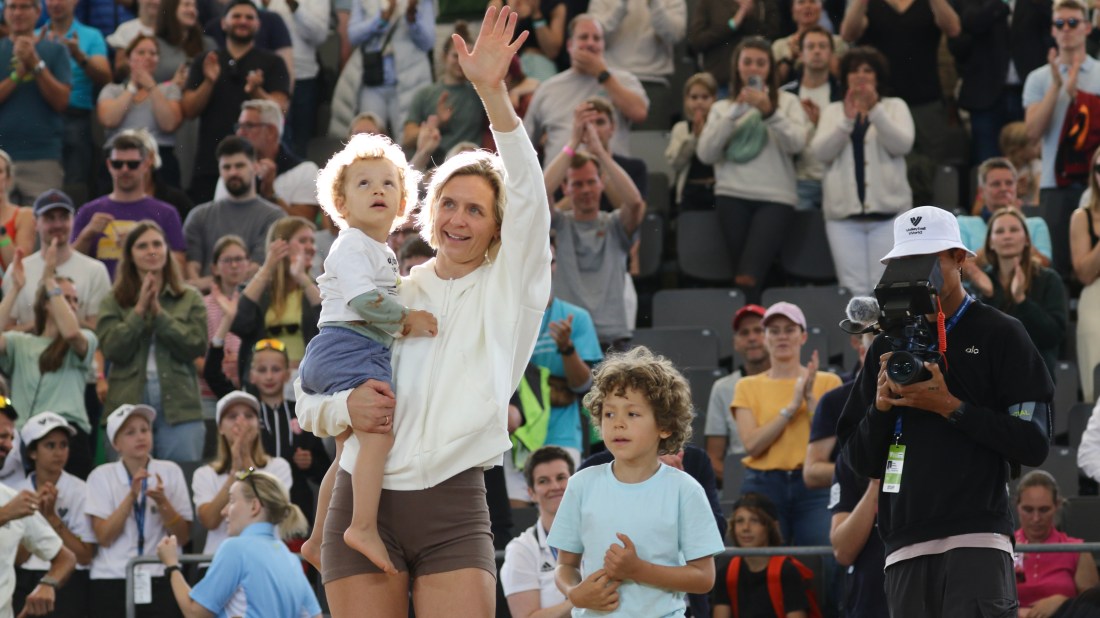
It isn’t easy to get to a North American latitude more northern than Hamburg, but there she was deep into Alberta, surrounded by a tournament field that collectively struggled to match her trophy case. With her son whizzing around the courts on a scooter and her partner in life Morph Bowes alongside, she coaxed, corrected and coached up Lippmann—celebrating with her when they won their qualifying matches to reach the main draw. A year later, they were there under the Eiffel Tower in Paris for Ludwig’s fifth Olympics.
So many aging athletes understandably seem to be trying to hold onto something. The field of play is where they’ve enjoyed their greatest success and felt most alive. As the end nears, they want to turn back the clock, to be who they were. Up to the final points she played Saturday in Hamburg at 38 years old, Ludwig was never hanging on. Something propelled her forward. She didn’t play or carry herself as if she was looking for that 2016 or 2017 version of herself. She was driven to discover what she could do next.
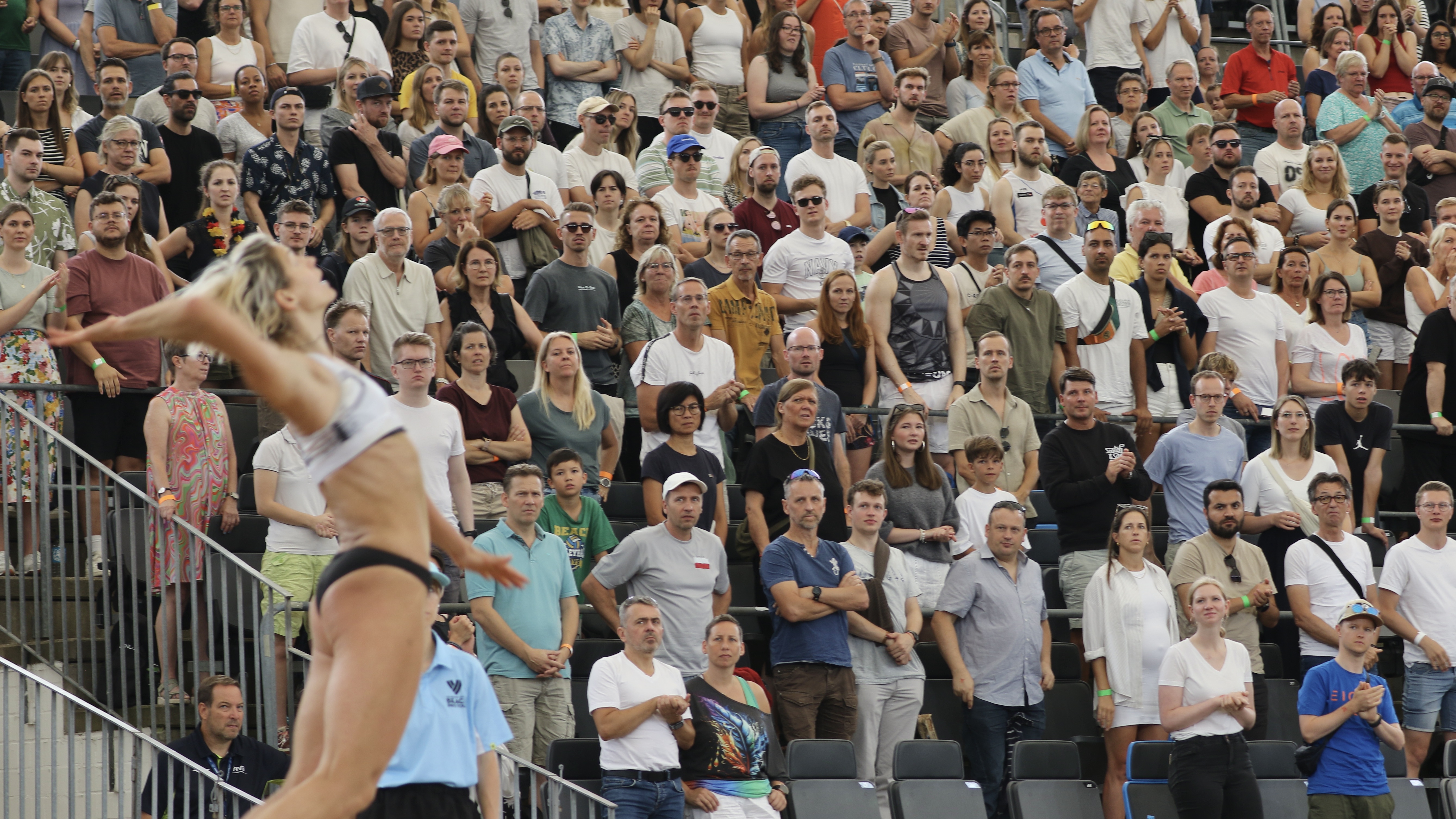
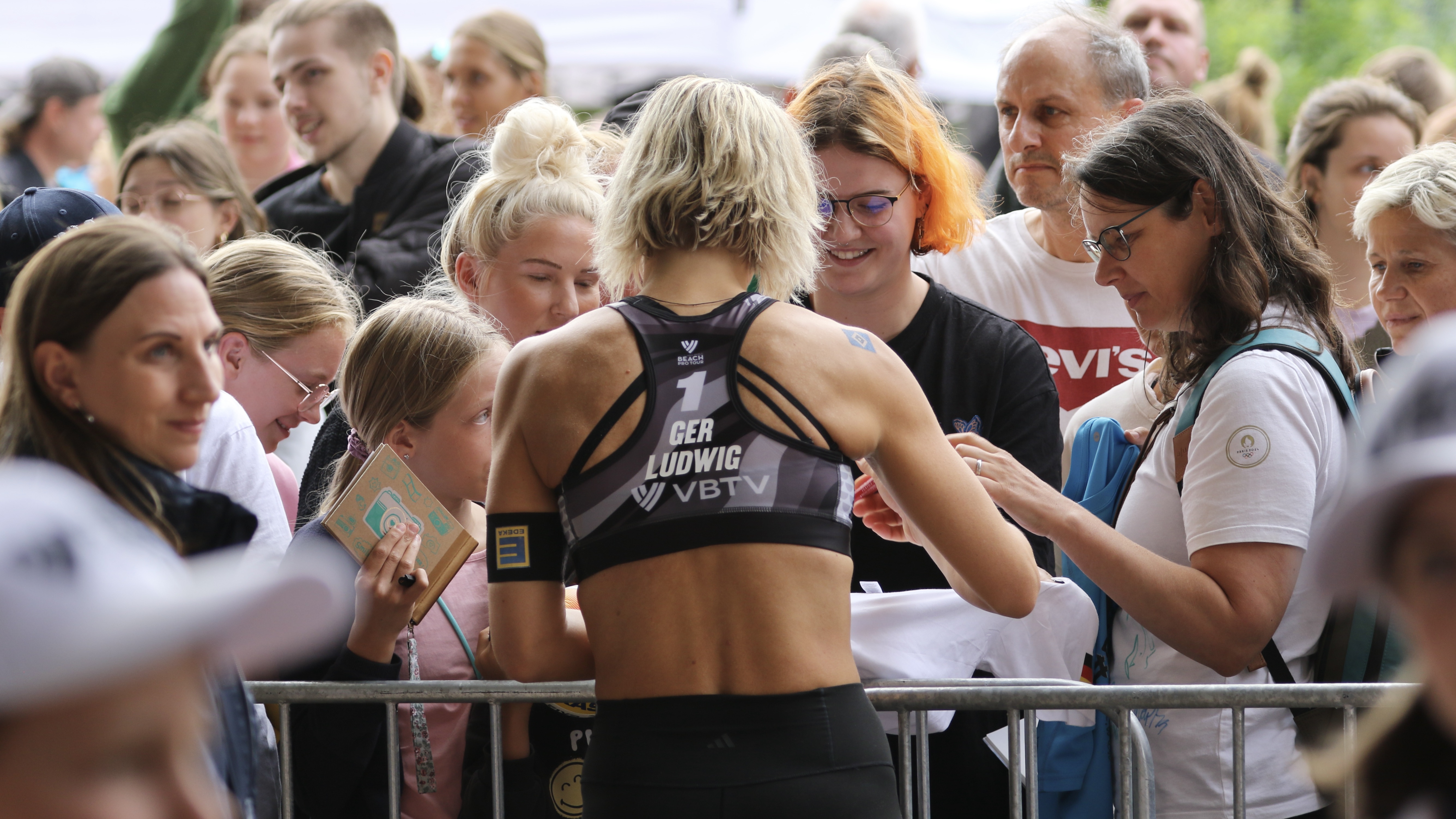
People came to see her for her final tournament. The crowds thronged the warm-up court before her matches. They forced organizers to reconfigure the mixed zone to stave off the crush of well-wishers seeking photos, selfies or simply to stand in her presence. They filled the lower bowl of the modified tennis arena the same way they would have for Steffi Graf all those years ago. And she acknowledged it, not exactly basking in the attention but clearly appreciating the affection and going along with the occasion with a smile and a wave.
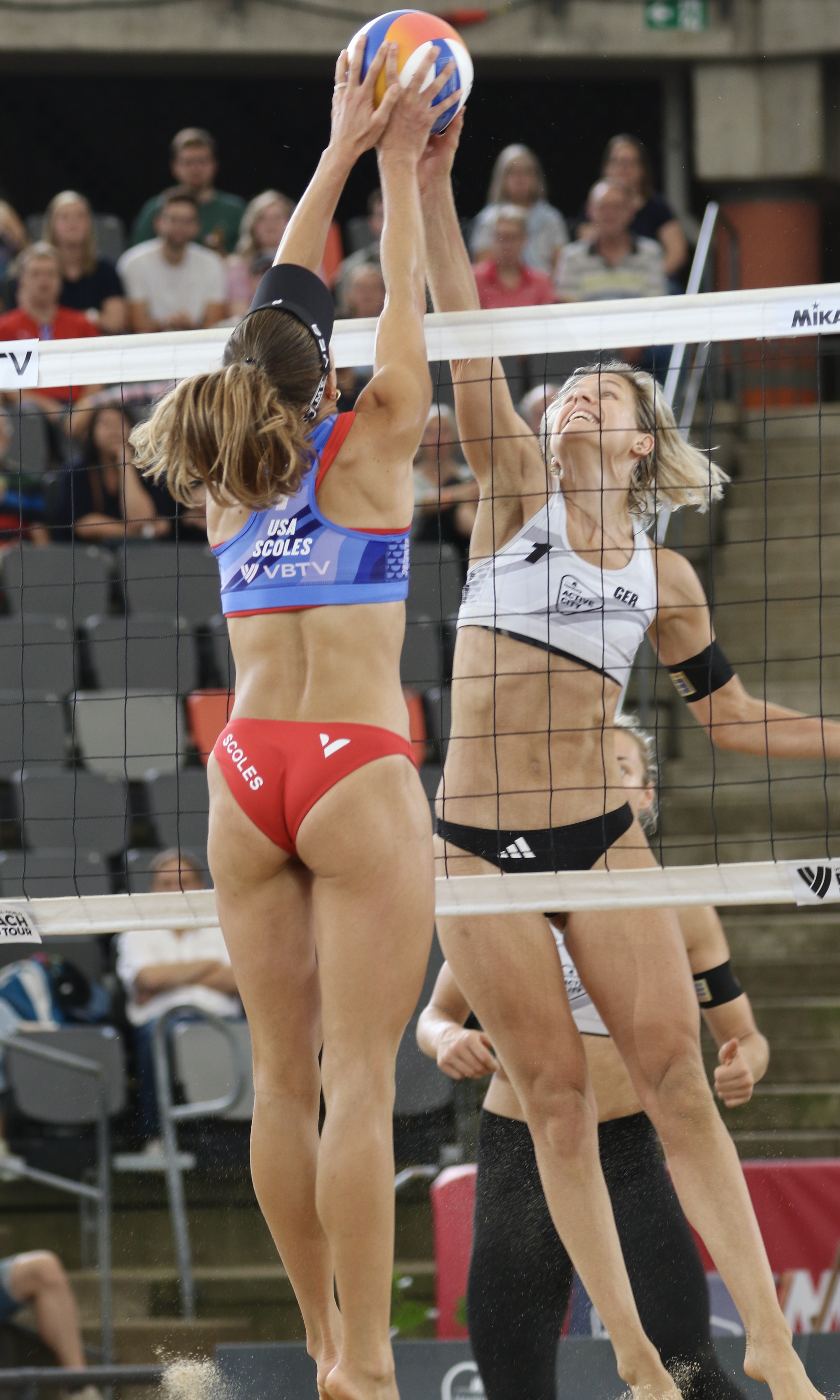
But facing elimination after losing her first two matches in pool play, she also won back-to-back matches to reach the quarterfinals, pulling out plenty of her trademark on-one Ludwigs along the way.
She had more past than anyone. She was better than everyone at living for the present.
It isn’t easy to keep playing volleyball, physically, emotionally or financially. But in any walk of life, it’s sometimes easier to keep doing what you’ve always done. It’s the path of least resistance. Perhaps the most remarkable thing about Ludwig at the end, and it’s a lengthy list, is that she still seemed to know exactly who she was and why she did what she did.
It’s no less remarkable to know yourself well enough at 24 to walk away from potential greatness in the thing that has defined so much of your young life. That’s the third part of the weekend triumvirate, the only one that left me staring at my phone in astonishment.
At 24, coming off the Olympic quarterfinals and a bronze medal in the Euros, Esmée Böbner retired. In an Instagram post, she described a growing realization over past weeks and months that she wanted something else. Elite beach volleyball players see more of the world than almost any of their peers, traveling from continent to continent. Yet in their own way, they also live in the confined space marked out by the tape on a sand court. It must be all too easy for the latter to begin to dominate the former, to want a world that is geographically more limited but emotionally more expansive and explorable.
Speaking briefly with Böbner in Edmonton last year, she put that in perspective that sounds almost prophetic in hindsight.
“For me, it’s not the traveling,” Böbner said. “That’s cool, but I also like to be at home. It’s the passion you can give to something. It’s important to me to keep that passion. As long as I’m having fun doing it, I think I’m the best part of myself.
“That’s really important. It’s what I enjoy about beach volleyball.”
From almost that moment on, Böbner and partner Zoé Vergé-Dépré were a rocket ship, hurtling toward the elite of the elite in the sport. You couldn’t watch a broadcast without an announcer describing them as the most improved team or the best young team—and all for good reason. Böbner was a brilliant server—go back and look at how much she did to win the pair’s first world tour title with her serve in Mexico last year. And she had a knack for coming up with runs of blocks in big moments.
The young pair, by their own and all other accounts good friends off the court, beat out former bronze medalists Joana Mäder and Anouk Vergé-Dépré for the second Swiss Olympic spot. They excelled in Paris. There was every reason to believe that they would grow into gold medal contenders in Los Angeles and even Brisbane, just as Nina Brunner and Tanja Hüberli had between the Tokyo and Paris Olympics.
How many athletes keep playing long past when their love for the game has faded, simply because they were addicted to chasing the success that was already in Böbner’s grasp?
How easy would it be to feel you owe it to someone else to keep going?
Far harder is to never lose sight of, as she put, what she enjoys about beach volleyball—about life, because that’s what it becomes.
At 24, she’s allowed to change her mind someday. And perhaps, after the toll of the past year fades, that passion might return. But Böbner didn’t express herself in a manner that suggested a decision impulsively made. She sounded like someone with a remarkably mature understanding of self.
Knowing when to go. Knowing when to push on. It’s only possible by knowing yourself.
As Esmée Böbner, Laura Ludwig and Marta Menegatti reminded this weekend, that knowledge—and the courage to act on it one way or another—is the rarest of qualities.
One of the first times I saw Valentina Gottartdi play in person, she ran through the advertising boards, off the raised court and into metal barricades below in pursuit of a ball. She managed to keep it in play before disappearing into the abyss. After a short medical timeout to patch her up, she kept playing—and diving after everything she could that afternoon in Edmonton.
Sometimes people just play the game differently.
It’s one of the wonderful things in sports, when an athlete at the highest level manages to stand out as something different. It’s not necessarily about dominance, although the two aren’t mutually exclusive. Katie Ledecky, Femke Bol, Sydney McLaughlin-Levrone—and in those long ago days when she was just getting started, Marta. They stood out from the start, partly because they were usually so far out in front.
But an athlete doesn’t have to dominate to captivate. Not right away. Allen Iverson was simply different in how he played the game. Not necessarily better than the best of his peers but unmistakably mesmerizing. The same for Rose Lavelle in her days on the soccer field at Wisconsin or Angel McCoughtry on the basketball court at Louisville.
To me, no expert, the epitome of this in volleyball is Brazil’s Ana Patricia. Watch her play a match and you’re almost guaranteed to see something you won’t see anyone else try. Usually, but not exclusively, that works out to Brazil’s benefit.
Any sport at the elite level breeds conformity. Even more in the age of data, there is an efficient way to play, a right way to play. There is flexibility only within that spectrum. To borrow an analogy from the world of wine, you can choose what kind of pinot noir you want to be. You can’t choose to be a gewürztraminer. On the other hand, Ana Patricia’s size, skills and languid creative genius allows her to play a game all her own.
In a quite different way, so, too, does Gottardi’s unbridled and unrelenting energy.
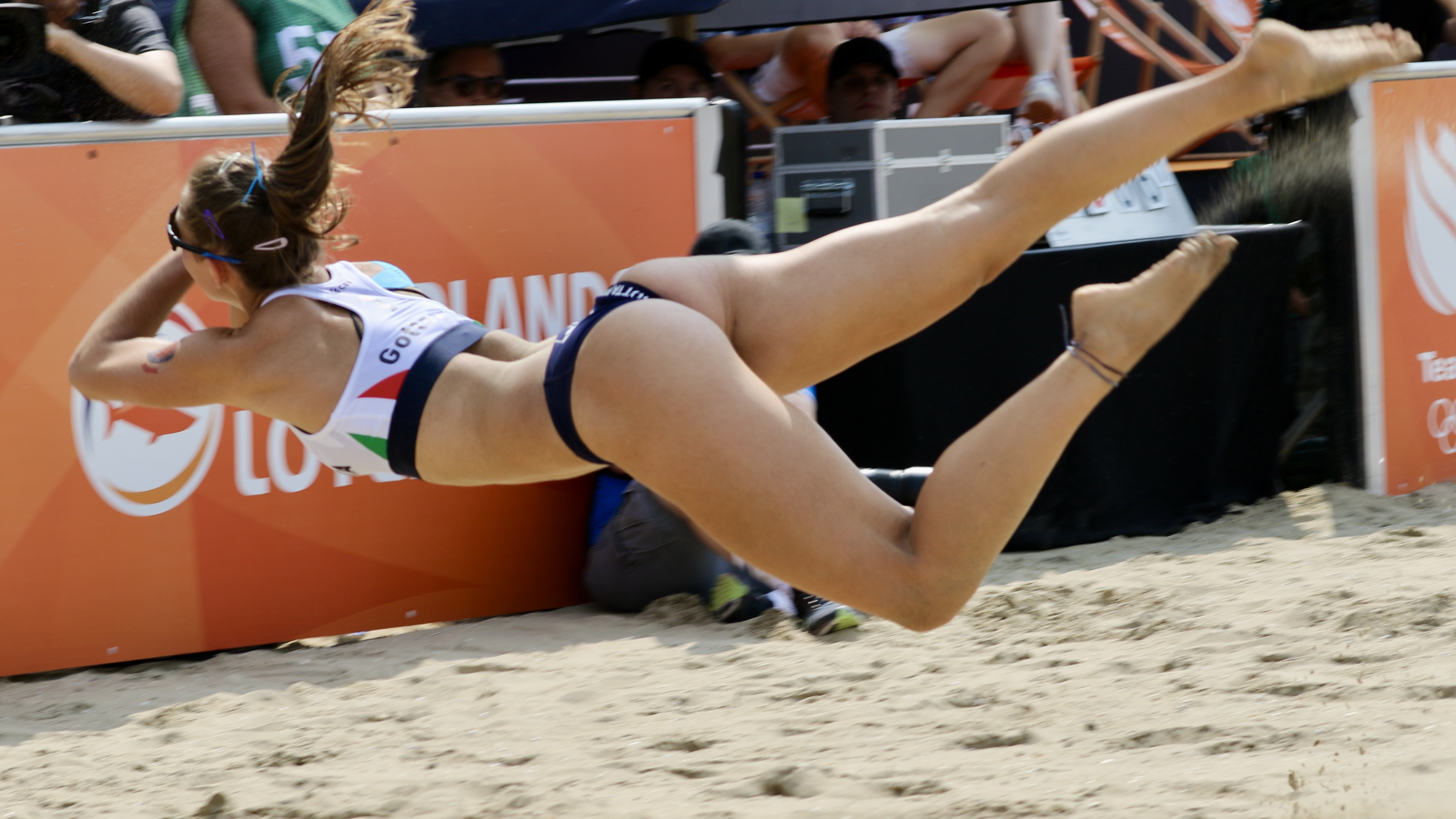
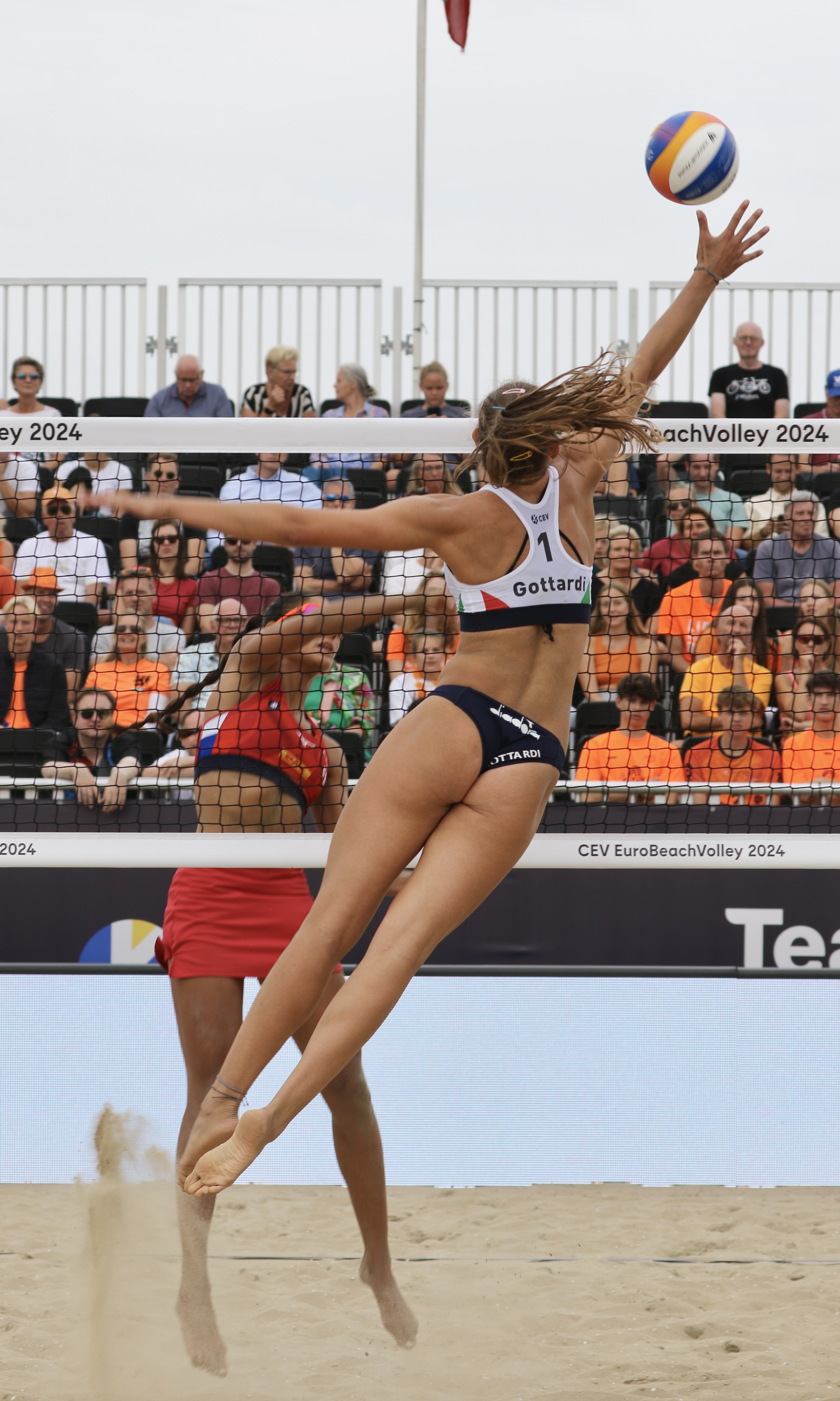
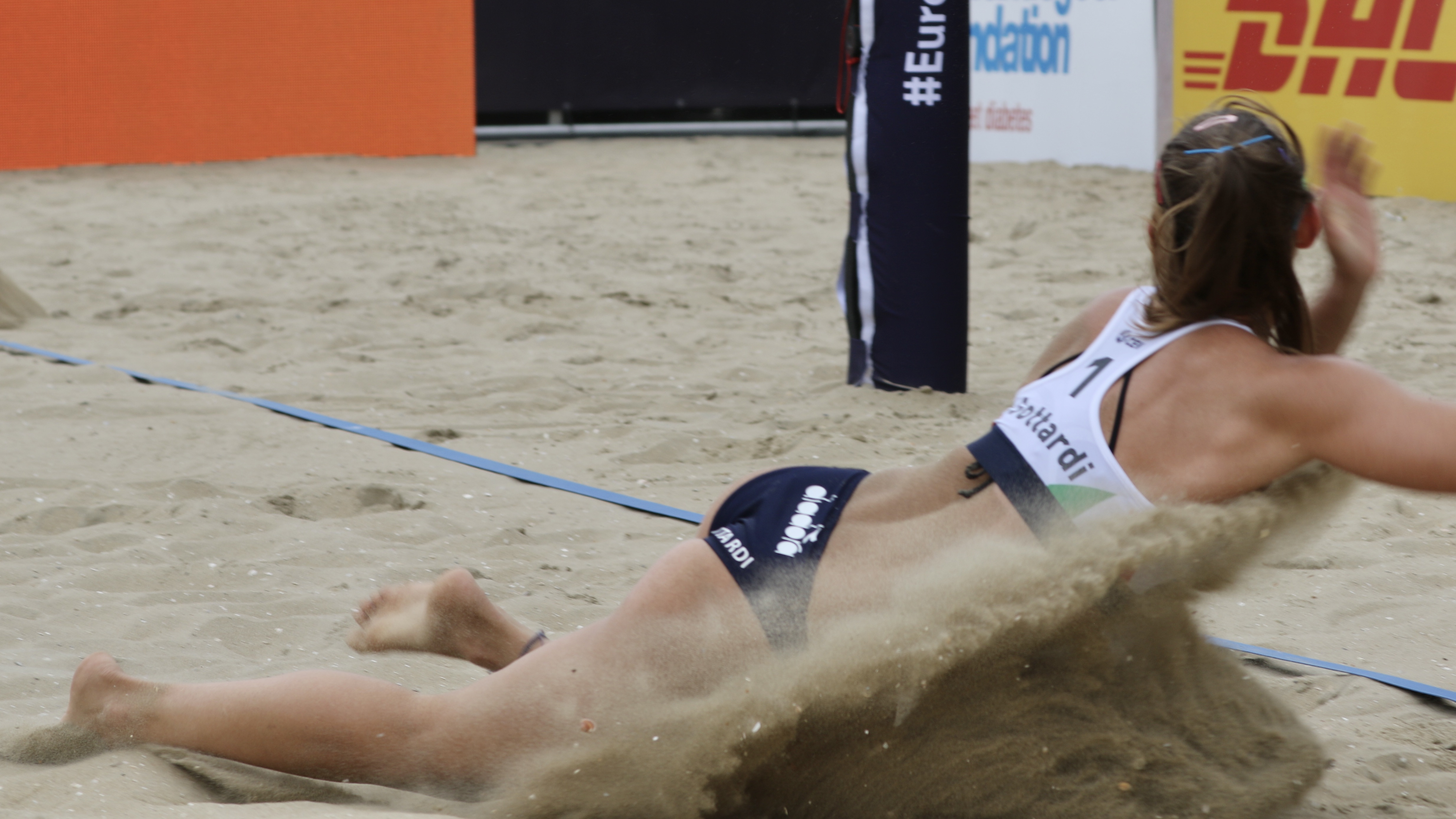
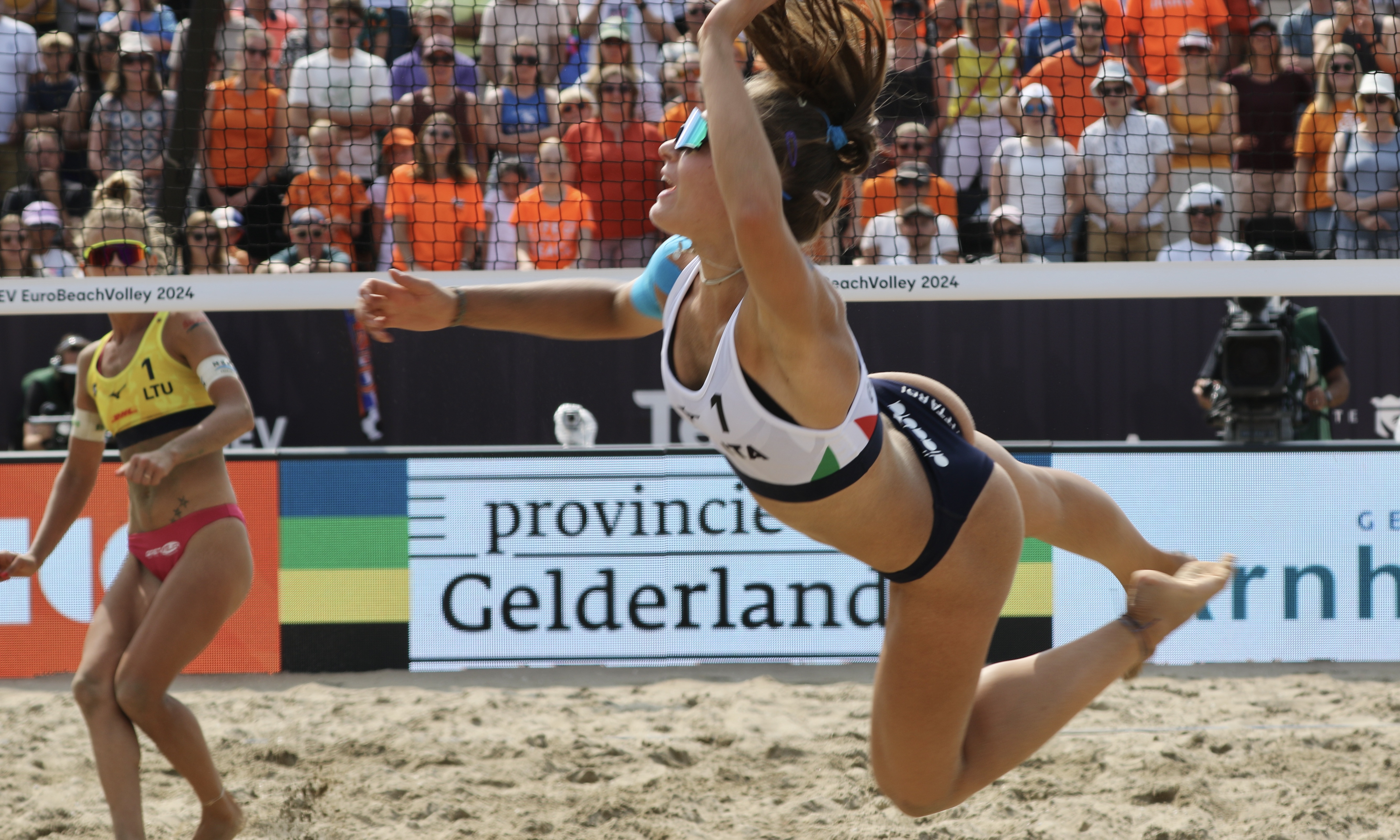
Gottardi will chase the ball into harm’s way. She’ll sprint under the net and dive almost to the opponent’s bench in pursuit of keeping the point alive. Where other players land on the sand when they dive, Gottardi comes back to ground with such force that sand explodes around her. She climbs higher for a kill and drives the ball harder and flatter with her serve. Everything that happens on a volleyball court happens a little bit more when she’s involved.
In the 21-year-old Italian’s case, some of this might come down to youth. Again, people who know the sport far better than I do may say that, however well intentioned, there’s really no need to chase a ball to the bench on the far side of the net. Save your energy. It’s all the more striking watching Gottardi play alongside four-time Olympian Marta Menegatti. At 34 and in occasional need of “magic spray” for her knee during breaks in play, Menegatti has turned the acts of wiping off sunglasses, bickering with referees and challenges into art forms in pursuit of a few extra seconds of rest. She’s all about controlled movement.
In the most complimentary way possible, Gottardi is like a young golden retriever bounding after her partner, wanting nothing more than to play. She jogs to the bench for timeouts. Her energy bubbles over after big points, released in primal screams of intensity or joy.
With time, maybe Gottardi will begin to play a bit more like everyone else. But I hope not.






 Graham Hays