While I was sitting alone in the media room at a volleyball tournament in Montreal, someone wearing a volunteer shirt entered the room and asked “vous travaillez ici?”
Fiddling with my camera, I felt the swell of irrational pride born of grasping the most mundane interaction in a foreign language. It was the same swell felt navigating the metro station earlier in the morning (the ubiquity of English training wheels everywhere notwithstanding).
In France, my French is, at best, survival level—adequate to (mostly) read signs, order things, ask questions, understand enough of a brief direct response to guess at the rest … and that’s about as far as it goes. In Quebec, it descends even further, to mostly useless.
But I understood this question! I was indeed working here, to a given value of “work.”
I smiled and replied “Oui, je travaille,” aware that this likely wasn’t the most grammatically nimble response but not confident enough in the conjugation (je suis travaillé?) of anything else.
Her brow furrowed slightly and she pointed at the floor and said … something. My run of comprehension ended abruptly. She beckoned me over, pointed again at a small puddle of water on the floor and repeated herself. I offered the universal helpless smile of ignorance.
Was she accusing me of spilling the water? It felt that way. J’accuse! After a morning in the hot sun, I could have assured her I valued every drop of water in my cup (although I would have struggled to assure her that in French).
“Mop,” she pantomimed in English.
Then she harrumphed, turned and left the room. A bit rude, I thought.
At which point it dawned on me that my shirt was the same light blue as those worn by the volunteers on site.
One domino tumbled into another.
If I asked someone “You work here?” I would almost certainly not be asking if they were, at that moment, engaged in the act of working in that space. I would be asking if they were employed there. Obviously.
But suffering from the heady combination of happiness to be at the tournament and understanding an unprompted question in French more complicated than “Ca va?” I had interpreted the words in the most literal manner possible.
It was a media work room, I was, more or less, media. I was working.
In reality, to her, I appeared to be a volunteer being a slacker in an empty room.
Vous travaillez ici, indeed.
I went back out to the courts. When I returned a few hours later, someone had mopped the puddle. Merci.
I don’t like writing in the first person. I’m more comfortable turning the words on strangers, peeling away the layers and, for better or worse, inevitably finding something familiar.
It’s just that in traveling to Edmonton for a few days of beach volleyball, the stranger I found was me.
In the days before departing for Alberta, I began to doubt the wisdom of going. At least for me, it’s all to easy to confuse travel with time travel. I’m constantly tempted to return places. Part of it is rational. It’s nice to already know where to find a good cup of coffee or a good sunset. Layering exploration atop exploration allows a deeper understanding of a place or people. But part of the urge is distinctly irrational, a hope of returning to a place as it was. And as I was.
I love beach volleyball events. I love the ear-worm melodies that follow the circuit from stop to stop — “monster block” chants and endless snippets of “Fireball.” I love the way an event fits into the landscape, courts stretching along the helpfully built-in sand along the beach in Fort Lauderdale or tucked next to a nearly ice cold mountain stream in the Swiss Alps. Or even in the most recent case, a decidedly less lyrical vacant lot next to the home of the Edmonton Oilers.
A tournament is a world within the wider world, which has always been my favorite kind of story. In books, movies and series, let me sink into a place. Give me a good enough map and let me explore its side streets and history, even if only in my own imagination. Beach volleyball offers all of that, in the literal on-site grid of courts and the figurative side streets, hidden trails and cul-de-sacs of its recurring characters. It’s where I’m happiest, where I feel a purpose to explore, learn, chronicle. Not for any editor or employer. Just because it’s there.
It’s a feeling I’ve missed in the four years since standing on a train platform leaving Gstaad, listening to the crowd roar a short distance away. The few opportunities to catch that feeling in more recent times, mostly involving softball, have been fleeting, rushed and constrained by other commitments. Losing myself in work used to sounds like an oxymoron. The work was me.
These days, while I’m fortunate in many ways, that phrase sounds different to my ear.
It’s never wise to try and travel back in time, but it felt good to encounter that stranger in Edmonton.
Maybe we’ll run into each other again one day.
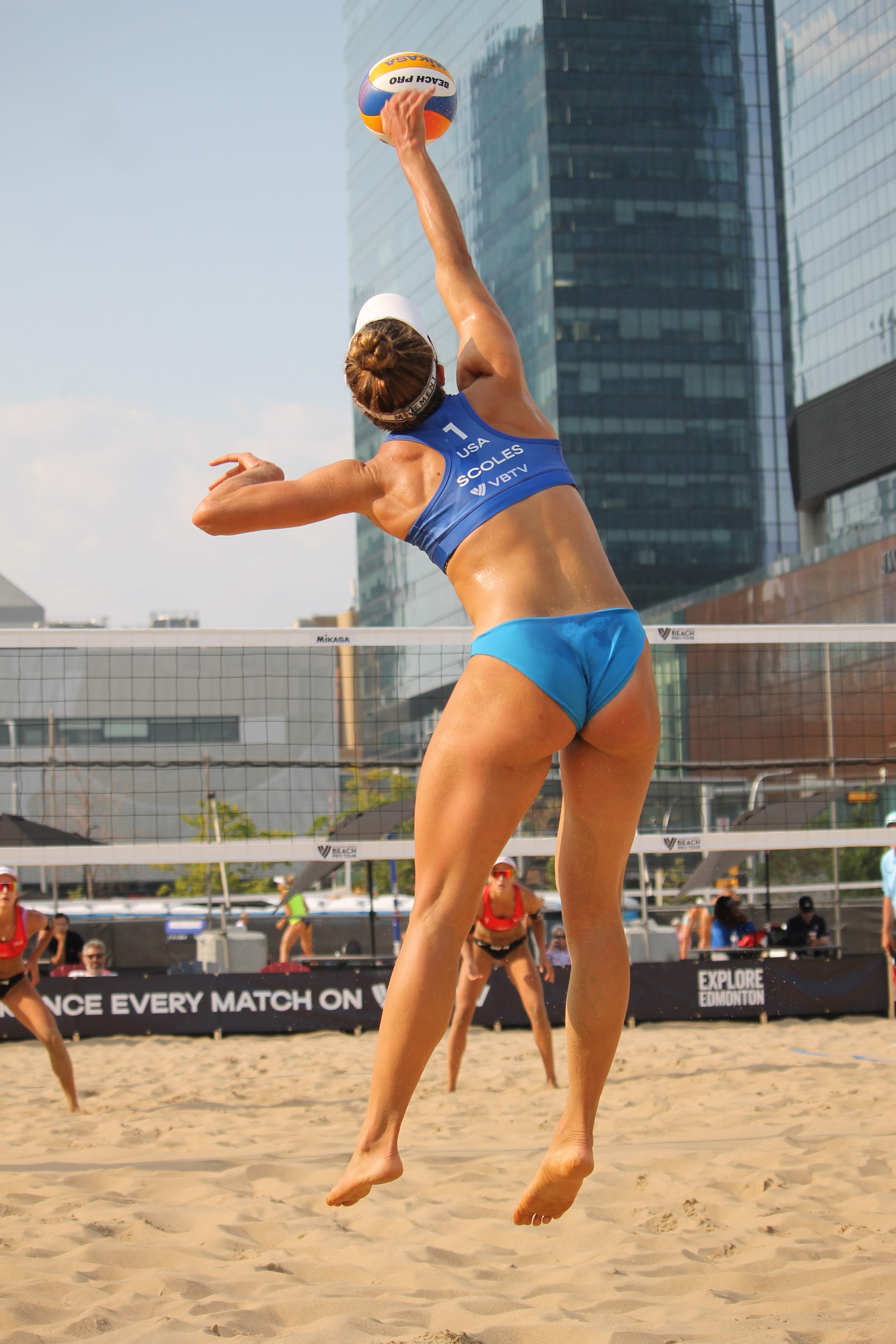
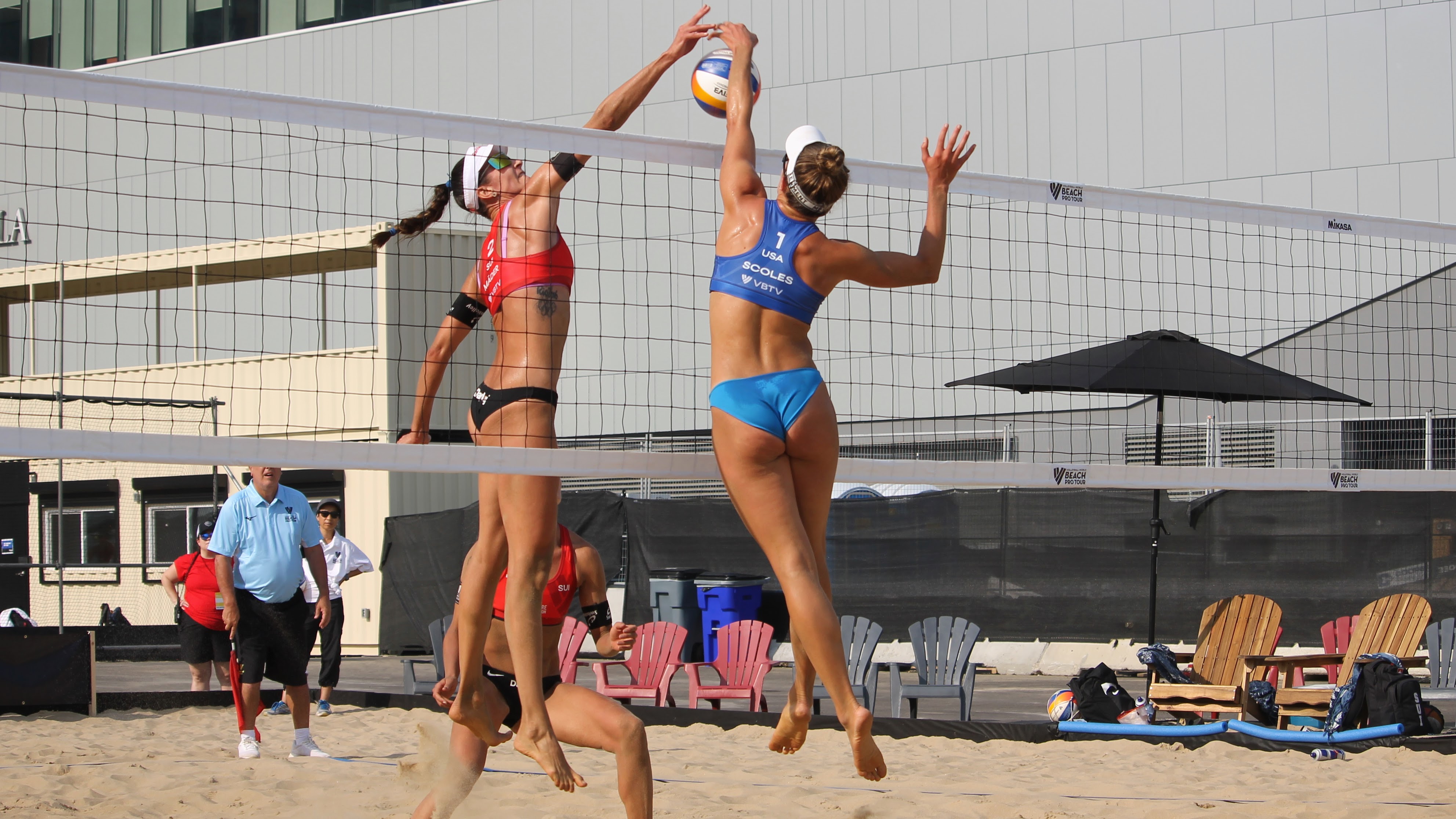
USA’s Julia Scoles serves.
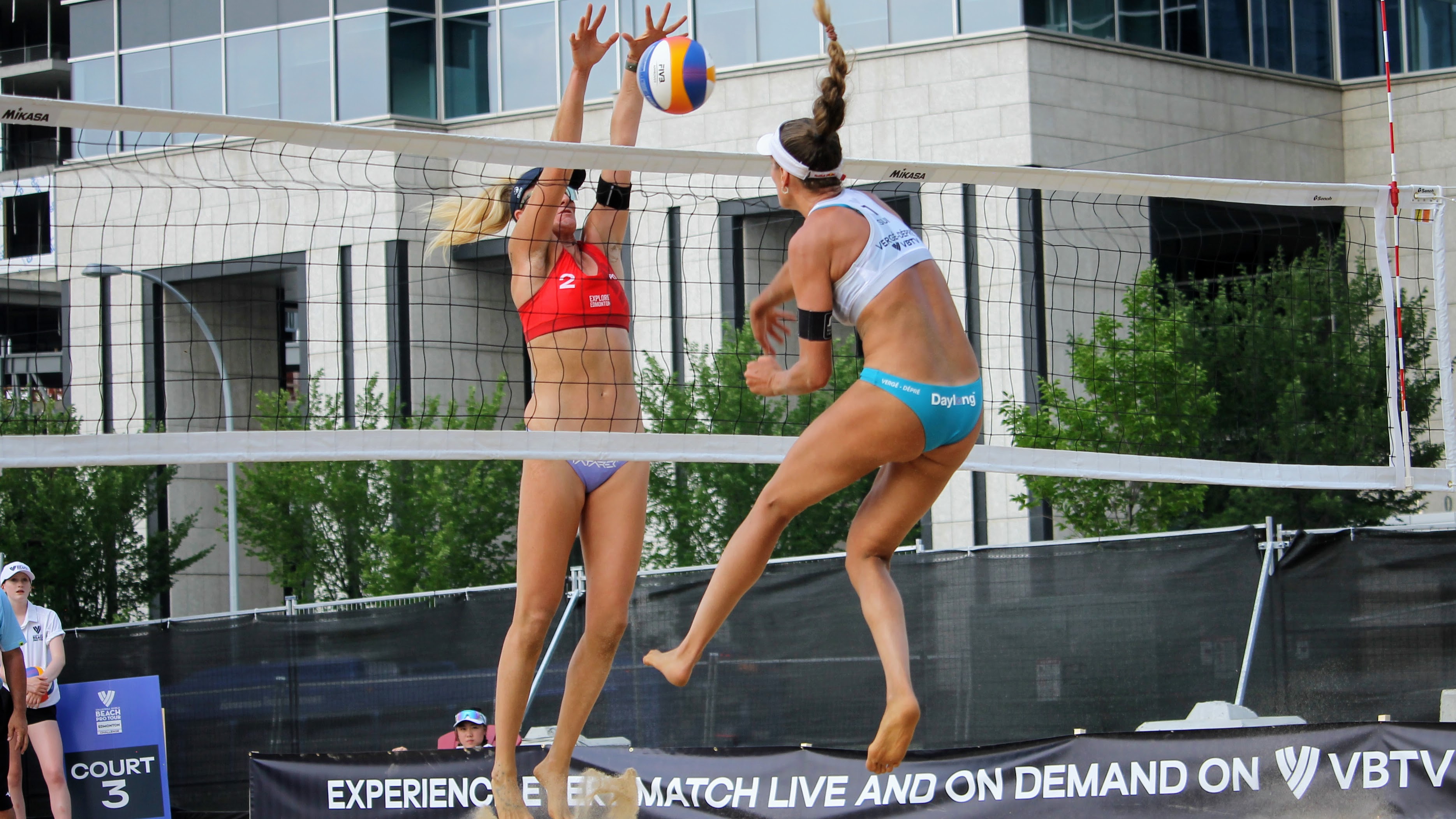
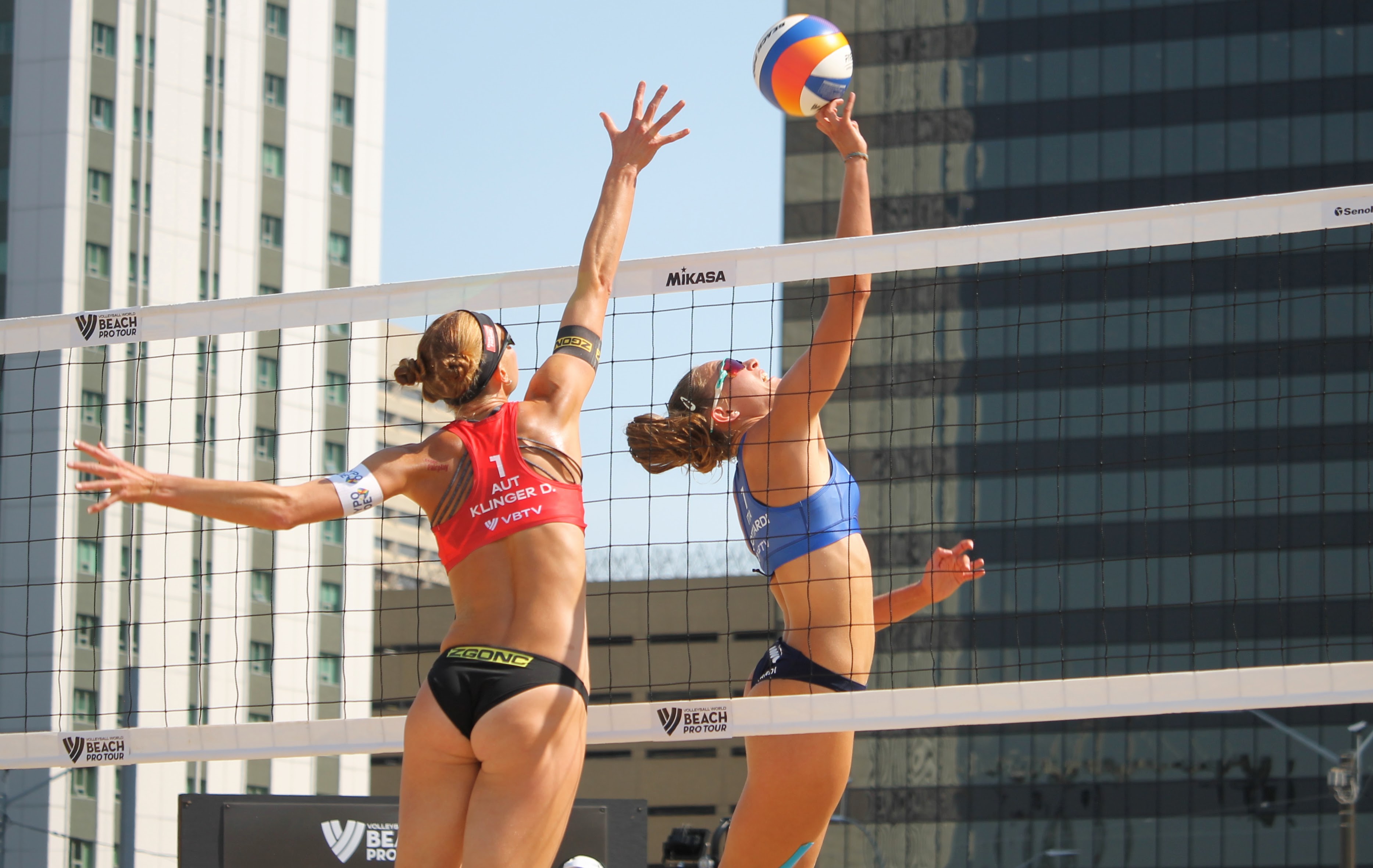
Switzerland’s Zoé Vergé-Dépré takes in the quarterfinal. A border battle between Italy and Austria.
Italy’s Marta Menegatti serves in pursuit of a fourth Olympic bid.
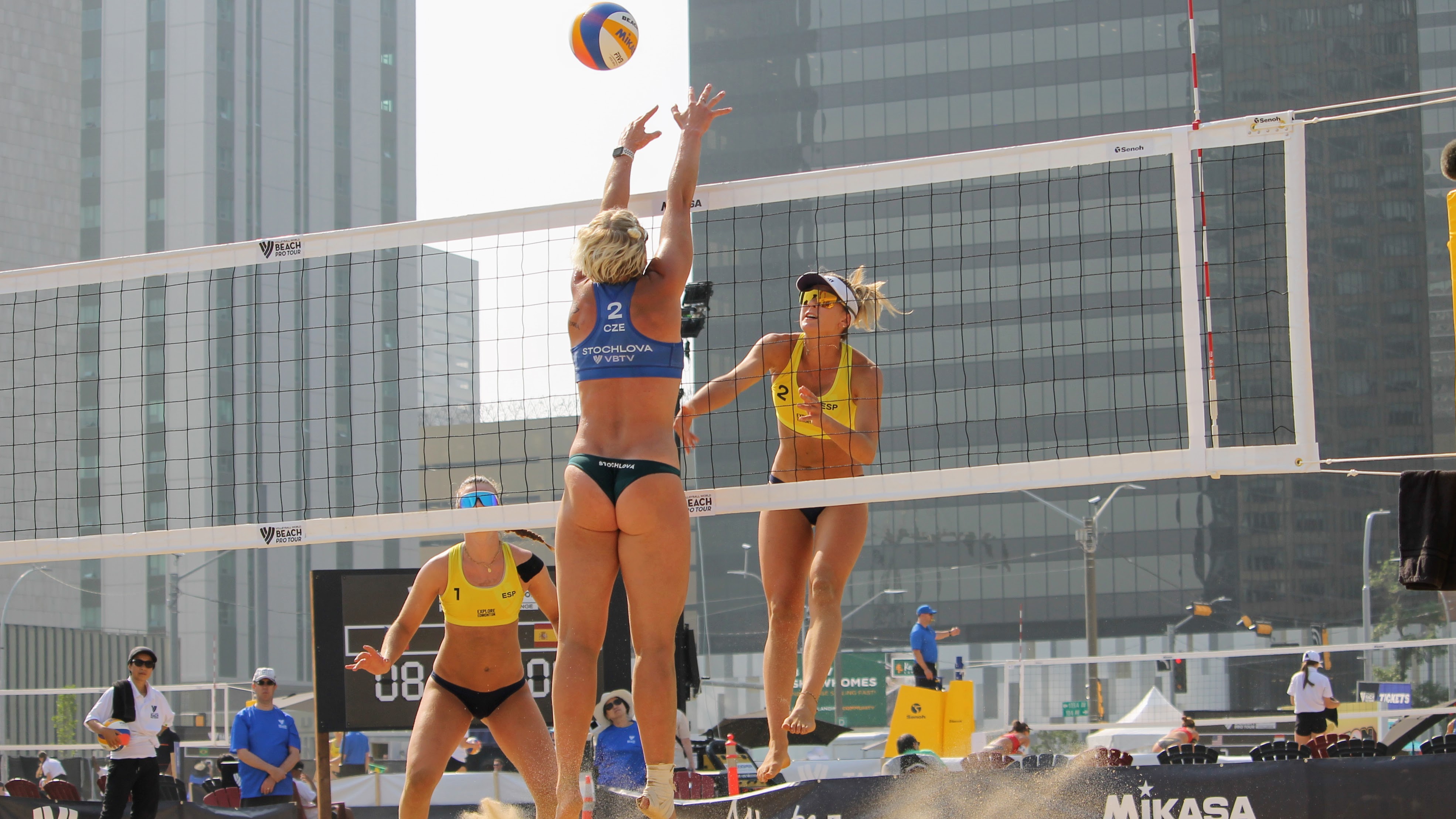
Spain (and TCU) partners Tania Moreno and Daniela Alvarez duel the Czechs.Anouk Vergé-Dépré against Poland.The ageless Laura Ludwig greets Anouk Vergé-Dépré.Switzerland’s Joana Mader battles USA’s Julia Scoles.
CanadiansHeather Bansley, left, and Sophie Bukovec, right, on center court.
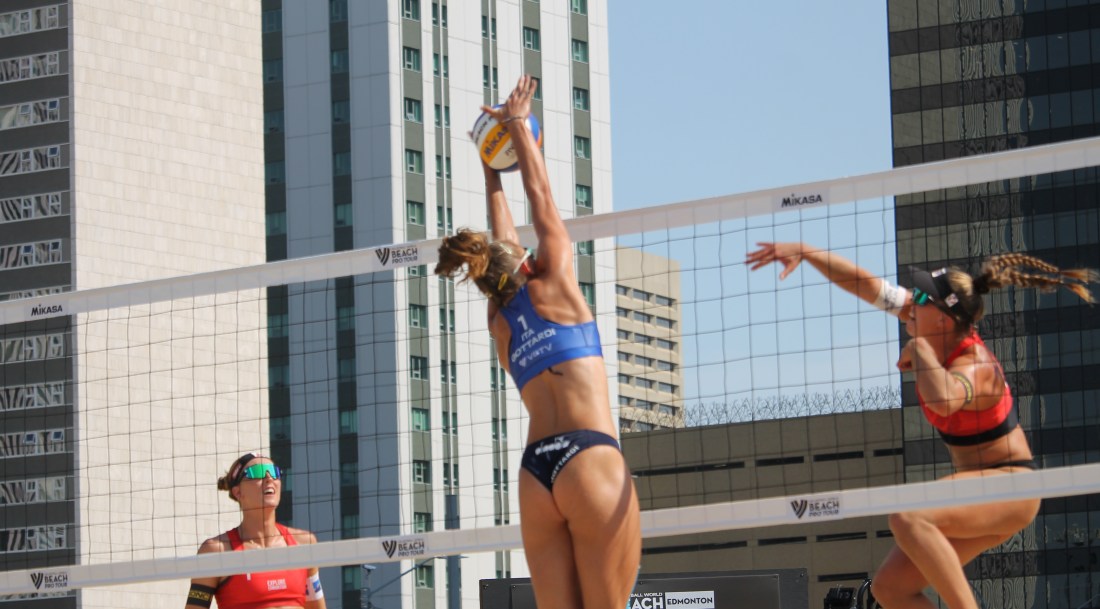
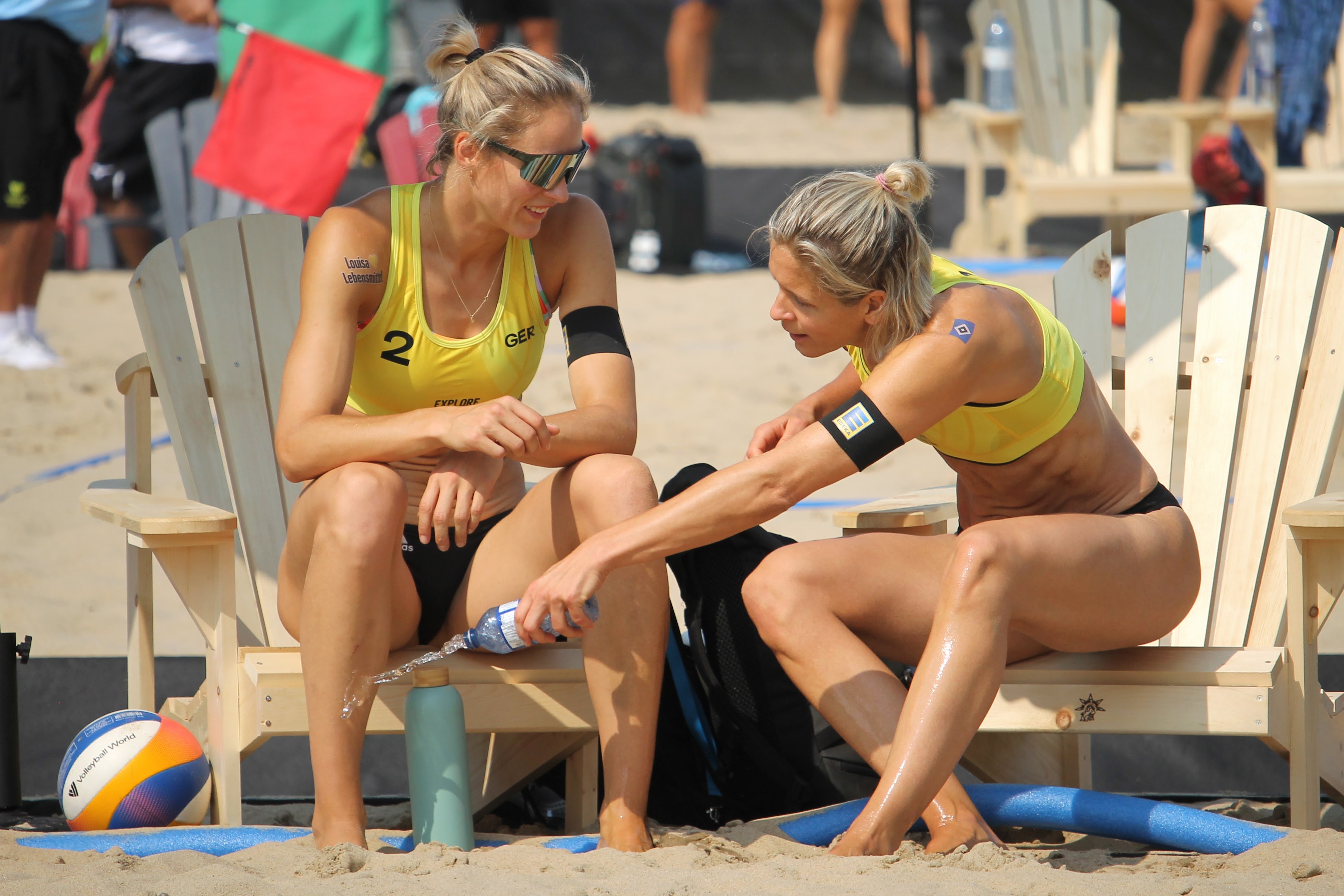
Rising Italian star Valentina Gottardi chases a ball off the court to save a point … And finds it a price worth paying en route to a silver medal. Laura Ludwig and new partner Louisa Lippmann came through qualifiers to make a 2024-sized impression.Still fresh out of retirement,Heather Bansley, 35, had a week to remember.
EDMONTON, Alberta — We don’t choose the story in which we’re cast. But we do sometimes control the script.
No one is born with great odds of becoming a professional athlete. But the odds of Esmée Böbner living out the life of an Olympic beach volleyball hopeful would have appeared particularly remote when she entered the world in the weeks before the new millennium.
She was born in Switzerland nearly eight months before the mountain resort town of Gstaad ever thought to host a professional beach volleyball tournament that grew over the next two decades into one of the sport’s signature events and a summer staple in the Alps. She was born nearly five years before Patrick Heuscher and Stefan Kobel earned bronze medals in the 2004 Olympics, the first Swiss medals in the sport (at the same Olympics in which a Swiss women’s team debuted).
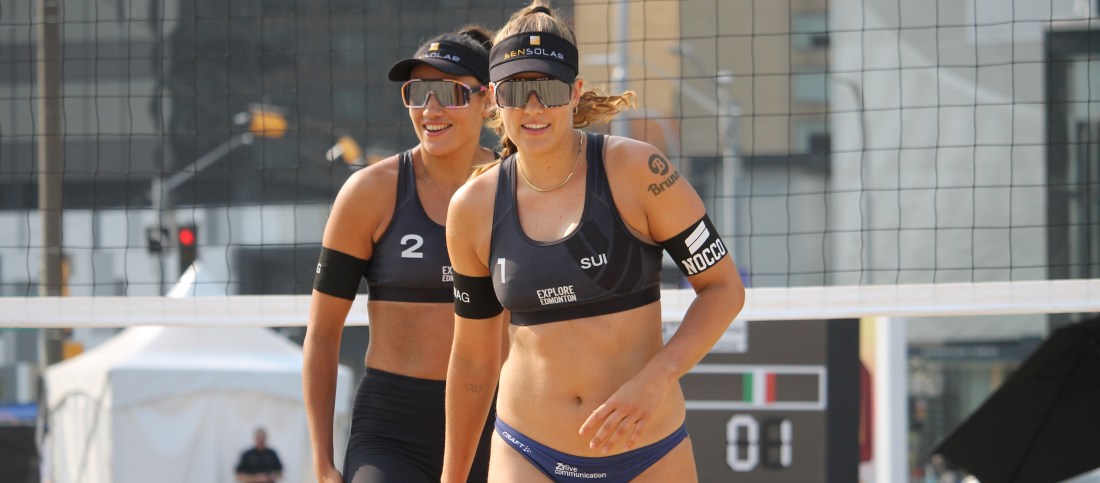
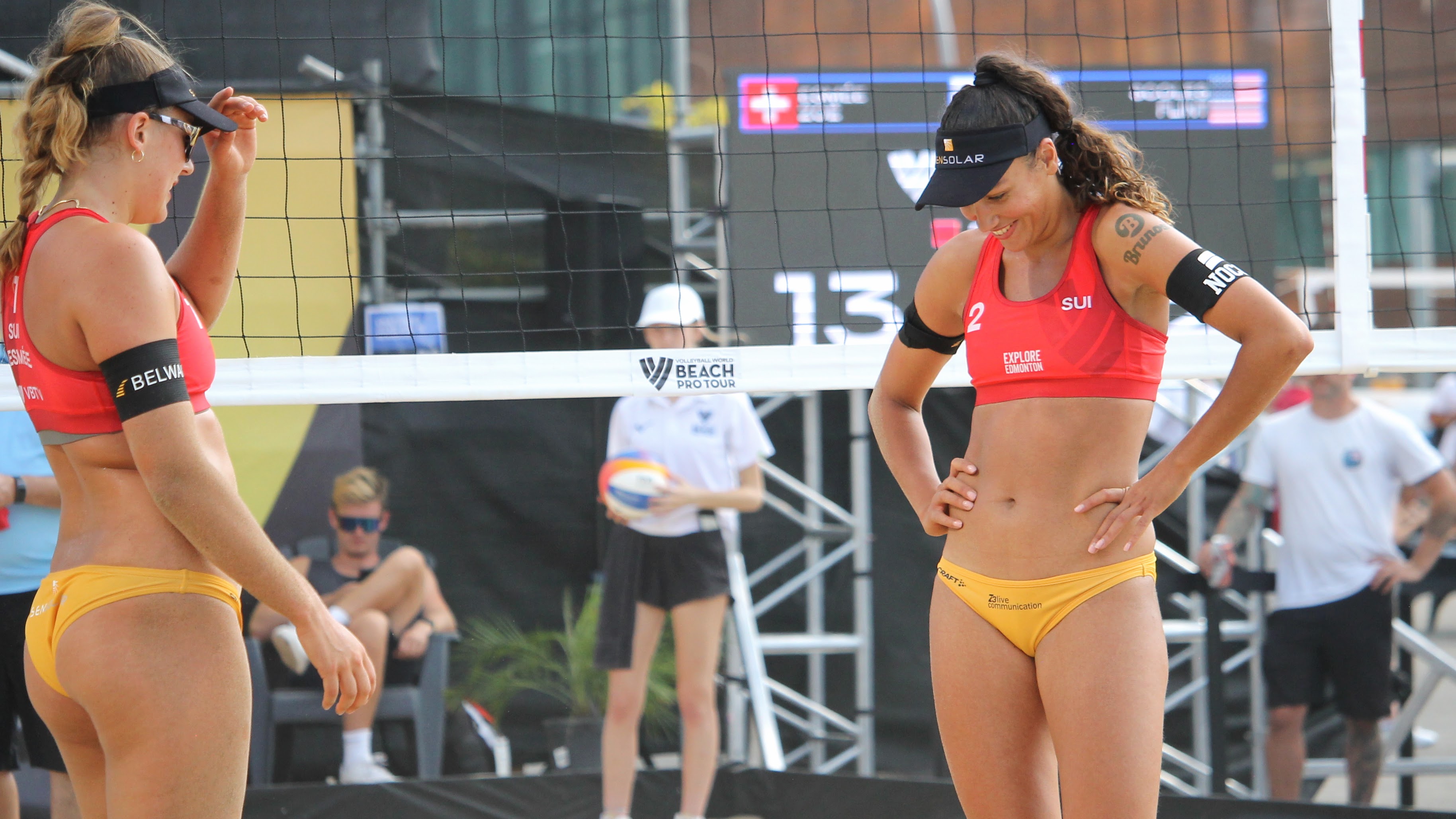
Esmée Böbner, left, and Zoe Vergé-Dépré, right, form one of Europe’s best young teams.
She was born at an inflection point, when nothing became something. She grew up dreaming of something that previous generations didn’t even know to dream about. Half of the first Swiss women’s team to compete in the Olympics, Simone Kuhn was already 20 when she started playing on the sand. Someone called and told her she would make a good blocker. Sure enough, four years after the thought of playing beach volleyball first crossed her mind, she was a European champion and Olympian. That’s how these things begin.
Two decades later, Böbner had her sights set on the sand almost form the start. At 16, she received an invitation to train at Beachcenter Bern, the hub of Swiss beach volleyball. She didn’t need anyone to explain to her what the sport was.
“I think everyone in Switzerland starts indoor, but I knew early on I wanted to play beach,” Böbner said. “I really like the atmosphere here. I think it’s way more fun than indoors.”
Yet sitting forlornly at one of the dozen or so picnic tables arrayed beyond the outer courts at a recent tour stop in Edmonton, she didn’t look especially happy or blessed by the fortunes of history. Head bowed, she looked broken. Like someone who had traveled nearly five thousand miles and crossed eight time zones just to be miserable and jet lagged. She and partner Zoe Vergé-Dépré had just lost to Americans Kelley Kolinske and Hailey Harward. It wasn’t so much the loss against a credible, if new, American team that rankled. It was that she lost meekly, caught up in her own frustrations as mistakes, to borrow an Alpine metaphor, snowballed.
Two weeks earlier, the Swiss had lost valiantly—and memorably—on home sand in Gstaad. Down a set and trailing by double digits against a surging German team, the Swiss duo rallied to win the second set 25-23 before falling 15-12 in the final set. The loss still stung, denying them a place in the knockout rounds. But cheered off the court by the home crowd, their resiliency said plenty about one of the most upwardly mobile young European teams.
In Edmonton, there was no such valor to be found. And Böbner knew it.
Approached before the match about speaking with Böbner when all was said and done, the Swiss coach indicated it would be no problem. After the match, the tight-lipped, pained smile on his face as he walked past said more than enough. This might not be the best day to chat, after all. The postgame team meeting stretched on and on before Böbner and Vergé-Dépré faded away into the night.
“I had a hard day and I didn’t like my attitude on the court,” Böbner recounted a day later. “I had to restart and refocus and kind of search my identity again. … I’m really happy I could reset and start a new day.”
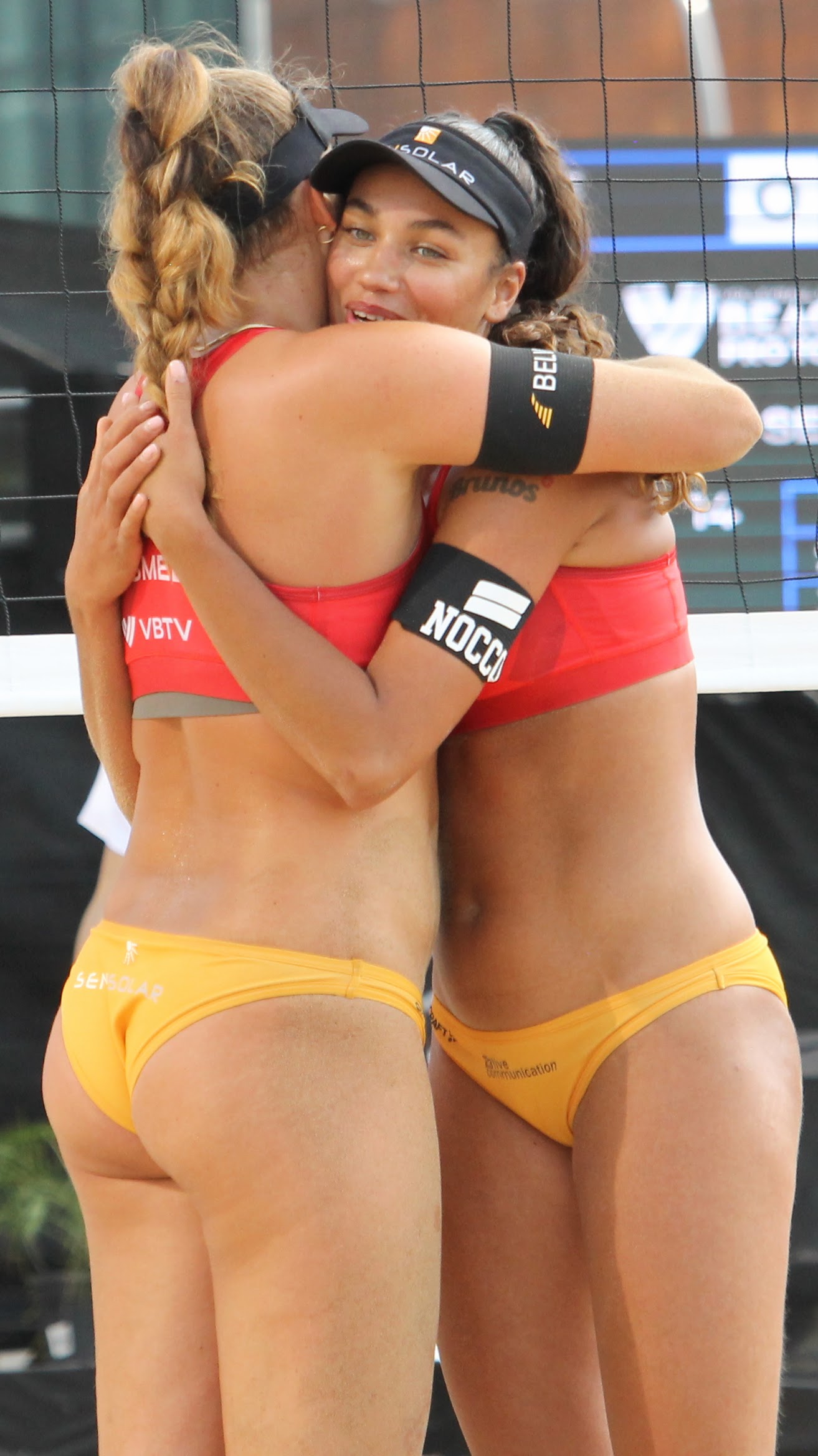
The chemistry (or is it alchemy?) of beach partnerships isn’t easy to comprehend. Not to an outsider. But Böbner pointed out that she’s fortunate to have a partner who understands her. Someone with whom there is open dialogue and encouragement, a true partner rather than a mere colleague. That helped in Edmonton, to not be trapped in her own head. But so did some decidedly universal Hollywood inspiration. Böbner watched King Richard, the 2021 Oscar nominee about the improbable rise of Serena and Venus Williams and their father.
The improbable rise of two women who very much took control of their own scripts in life.
A day later, entering the knockout round, the Swiss played on center court for the first time in the event—evident when they prematurely blew threw the public address announcer’s solo introductions and took the court together, left to stand somewhat awkwardly through the rest of the preamble.
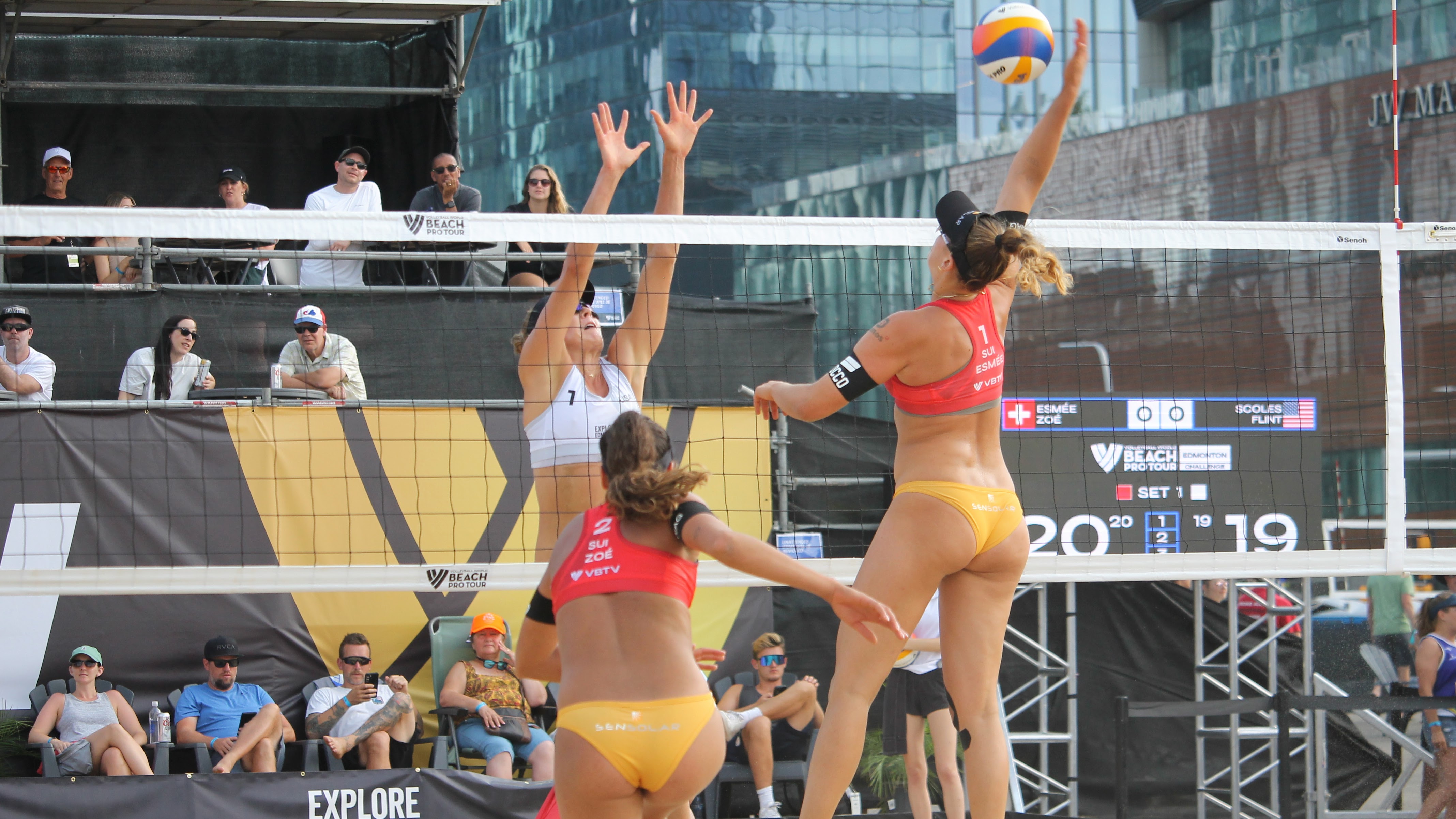
Playing the last remaining Canadian team in front of a crowd that made no secret of its rooting interest, Böbner and Vergé-Dépré won in straight sets. Böbner wasn’t perfect. The serve that can be such a weapon never quite found the mark. She made some errors. But they didn’t linger. They didn’t prevent her from doing her part on the next point. After a quick trip back to the hotel to escape the sun, they returned and beat Americans Betsi Flint and Julia Scoles in the quarterfinals. A day after despair, they earned their second semifinal berth this summer.
The Swiss were again off their game in the semifinal, losing to Italy. And then they were valiant again, dropping a three-setter against the Czech Republic for bronze, 26-24 in the second set and 15-13 in the final set of a match that stretched well over an hour.
It wasn’t a dream ending, but they played through the end of the tournament. For a young team trying to climb the ladder, pushing ahead of schedule to displace one of the established Swiss giants—reigning Olympic bronze medalists Anouk Vergé-Dépré (Zoe’s older sister) and Joana Mader or former European champions Nina Brunner and Tanja Hüberli—that itself is a victory.
Zurich to Edmonton is a long way to travel with no guarantee of anything more than a day of volleyball. Yet for Böbner, the arduous journey was from the forlorn figure at that picnic table to the fighter playing through the tournament’s final hours.
Beach volleyball has a vibe all its own—the atmosphere that first appealed to Böbner all those years ago. But it’s also a grind, a life of unforgiving travel, the finest of competitive margins and ceaseless pressure for results. It can beat you down and rob you of your identity, if you let it. If it’s your passion, and has been for as long as you can remember, it can also lift you up.
“For me, it’s not the traveling,” Böbner said of her joy. “That’s cool, but I also like to be at home. It’s the passion you can give to something. It’s important to me to keep that passion. As long as I’m having fun doing it, I think I’m the best part of myself.
“That’s really important. It’s what I enjoy about beach volleyball.”
It was her good fortune to be born at precisely the right time to live out a dream.
What she or any of us do with tomorrow is ours to decide.
“You never thought about oh my gosh we missed it in the second set? You always still believed?”
“Hmm, uh, to be honest, it was a little bit in my mind.”
Interviews in second (or third or fourth) languages are often less than revealing. It’s difficult enough for most of us to express ourselves in the language we know best, let alone find the right words and grammatical constructions to convey complex thoughts in another language. Order a meal or ask about a train schedule? Sure. Describe emotional states of existence? Trickier.
But on rare occasions that process strips away any artifice or obfuscation. All that’s left is the simple, honest truth. So it seemed with Nina Betschart’s answer above, delivered in English with an almost embarrassed grin in the obligatory postgame television interview after Saturday’s semifinal between Switzerland and Germany in the European Beach Volleyball Championships.
Betschart and partner Tanja Hüberli had just pulled off the seemingly impossible by winning five consecutive points — the first three on the brink of elimination — to complete a comeback and reach the final in Vienna, Austria.
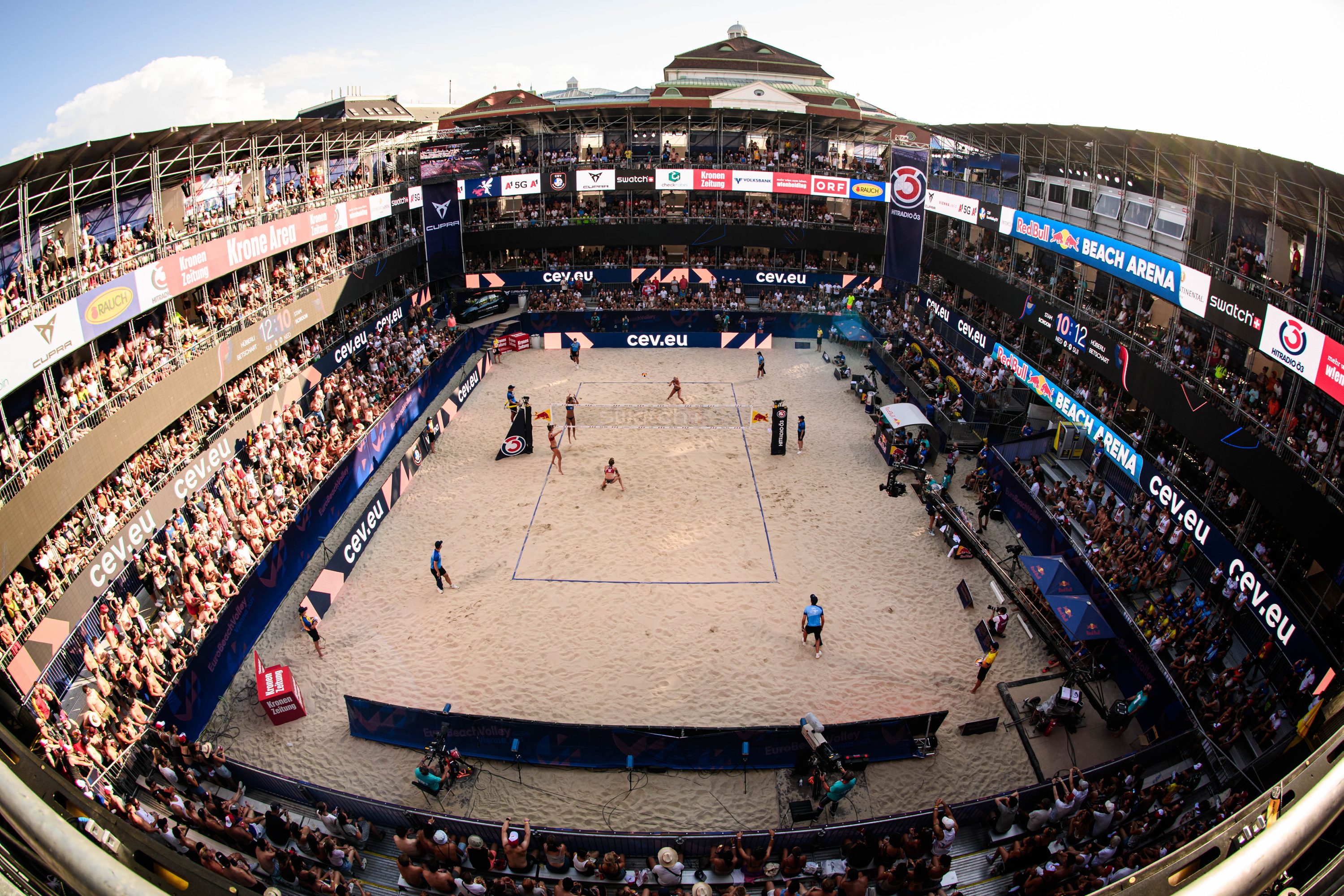
The ensuing championship match was almost anticlimactic for the Swiss — if winning a career-defining title in front of a frenzied, partying crowd in a three-story arena whose design was part Elizabethan and part Mad Max can be anticlimactic. Betschart and Hüberli rolled over a talented but inexperienced Dutch team in the final. It was joyous, to be sure, and the celebration complete with hugs, tears, the Swiss national anthem and some impressively committed champagne consumption. Even without Americans, Brazilians, Canadians or Australians, the trophy is a big deal to lift.
14.08.2021, Wien, Heumarkt
Beachvolleyball, Europameisterschaft, Finale
Stam / Schoon (NED) vs. Betschart / Hüberli (SUI)
Foto: Conny Kurth / http://www.kurth-media.de
As a fan of the Swiss team, I savored those scenes. They finished second in the same event in 2018, the same year they were semifinalists in the World Championship. They are often close to trophies, but until this win, their biggest title was a 1-star event. Still, the part of the weekend that fascinates me most wasn’t the outcome as much as Betschart’s quote and those points late in the semifinal.
How often do athletes talk after a comeback about how they never stopped believing? How often do we, in turn, ascribe to them some sort of superhuman mental strength that prevents them from accepting defeat? I can’t help thinking that shortchanges them.
In a work project the other day, I tried to decide between using “courage” and “bravery” in a passage. I would have preferred bravery because I’m a sucker for alliteration, which applied in this instance. And most sources suggest they are, at least practically, interchangeable. But to me, correct or not, bravery implies acting without regard to potential consequences, whereas courage implies understanding the consequences but acting nonetheless.
Both, I’ll hasten to add, are overused in the context of sports. Still, listening to Betschart reminded me of at least the essence the debate. If someone down 14-11 in the third set really doesn’t have any doubt that she will win, it’s still a good story if she does win. It’s still a remarkable comeback. But it’s no more relatable to most of us than is world-class athleticism.
Doubting and carrying on anyway? That’s far more familiar.
At no point in my life could I jump or run like Betschart. At no point was I as fit. (Nor was I at any point willing to put the time and effort into training my lesser abilities that she has into hers.) But I think I can imagine what it was like for her when she was down 14-11 and wondering if it might all be about to go wrong again.
For the second time this month, first in the Olympics and now in the sport’s biggest continental championship, Betschart and Hüberli faced not just impending defeat but impending defeat in a distinctly soul crushing manner.
In the Olympics, it happened in a marathon third set against countrywomen Anouk Vergé-Dépré and Joanna Heidrich in the Round of 16. That pair went on to win the first ever Swiss medals in women’s beach volleyball.
Saturday in Vienna, Betschart and Hüberli didn’t finish off multiple match points in a second set against Nina Borger and Julia Sude in which the Swiss led 16-11 late. That set eventually lost and the match leveled, Betschart and Hüberli were then down 14-11 in a winner-take-all third set to 15.
They got to 14-12 when Borger’s serve down the line went just wide, their fate out of their own hands as Betschart watched and hoped the ball didn’t clip some fraction of the tape.
Survival still meant winning consecutive points while serving. That is rare enough during any stretch in match. It’s all the more daunting with a place in the final on the line.
A big dose of Swiss good fortune made it 14-13, Hüberli’s serve clipping the top of the net and dropping straight down on the German side. But the Germans still just needed a side out to win.
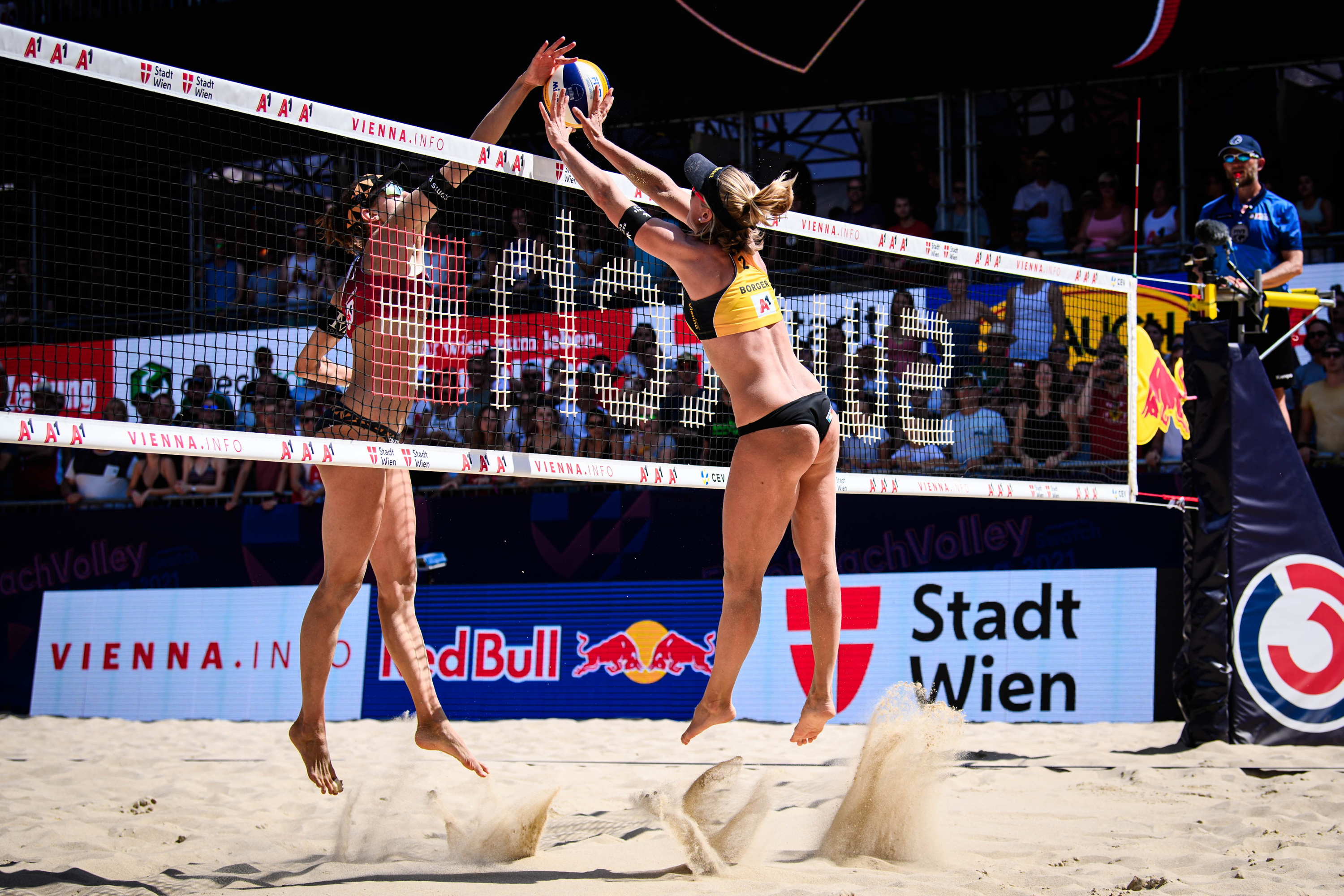
Sude’s first pass off the next serve was heavy. The ball drifted too far, directly over the net, and left Hüberli and Borger with equal opportunity to play it as they leapt. Hüberli made contact first with her right hand, but in doing so, she only managed to push the ball onto Borger’s hands — the German steering the ball right back over the net onto the Swiss side.
14.08.2021, Wien, Heumarkt
Beachvolleyball, Europameisterschaft, Halbfinale
Betschart / Hüberli (SUI) vs. Borger / Sude (GER)
Foto: Conny Kurth / http://www.kurth-media.de
Now falling away from the net as she came back to earth, Hüberli reached out her left arm in time to pop the ball into the air. Betschart then had the presence of mind to eschew any attempt to set the ball for her partner and instead hit it over the Germans and into the empty court between them and the baseline to tie the score 14-14.
And that was only half the job done. The Swiss went on to win two more points on Hüberli’s serve. They earned another match point when Sude hit the ball wide trying to go around Hüberli’s attempted block at the net. A Betschart dig and kill provided the fifth point in a row to win the match and send the teammates tumbling to the sand in celebration.
It was an unlikely enough scenario for the semifinal of any major tournament. But again, this all came less than two weeks after Betschart and Hüberli lost in the Olympics.
And not just lost but lost to their closest rivals (the team they had in recent months at the very least caught, if not supplanted, as the top Swiss side), 23-21 in the third set. The bronze medals that Vergé-Dépré and Heidrich deservedly won in the end could well have been theirs.
Even as someone who was only ever tournament-adjacent as a journalist, I remember the temporary hollowness that accompanied the end of a World Cup or Olympics. There is an all-consuming quality to those events. The months of buildup, the travel, the deadlines and the unrelenting grind of the event itself (with plenty of amazing and memorable aspects mixed in).
Even knowing you’re staying through the final game, a luxury the participants certainly don’t have, the end comes suddenly. One day you’re in a packed stadium in Vancouver or listening to anthems in Rio de Janeiro. The next day you’re in a Hampton Inn in Hibbing, Minnesota or eating a pre-dawn breakfast in a mostly empty IHOP near the Atlanta airport. It is jarring.
For athletes, especially all of those who don’t win their final competition or realize their lifelong dreams, the sense of dislocation must be orders of magnitude more profound.
There are other championships and other goals. But on some level, Tokyo had shaped Betschart and Hüberli’s world for five years.
It must have hit Betschart and Hüberli somewhere on the flight from Tokyo to Vienna.
Forget the physical challenges posed by jet lag involved or blistering temperatures in Vienna that left the sand temperature over 100 degrees for most matches. It had to be an immense mental challenge merely to be in the right head space to compete at all. It is difficult to fathom how anyone in the Swiss position could still believe when down three points in the third set.
Which is why Betschart’s answer, perhaps without the native-language fluency to evade the question, was so wonderfully revealing.
She didn’t believe. Not entirely. Not with the unthinking, blind belief of a zealot. She knew what the most likely outcome of the next few moments was.
And she played through that doubt. That’s more impressive. Or at least more human.
It was a January night like any other for Hernan Humana as a new decade dawned in Chile. Which meant it was a night when he knew what the ringing phone might foretell.
“Hernan, I think your time has come.”
The words on the other end of the line that night weren’t meant as a threat. But in Chile in 1980, they chilled Humana to the bone.
The friend on the phone, a doctor, had been at a Chilean Olympic Committee meeting. A man in military uniform had opened his briefcase and taken out a Canadian newspaper critical of Augusto Pinochet, the dictator who seized power in a 1973 coup. Humana’s father, who fled Chile several years before, was the newspaper’s publisher. The military officer suggested that instead of praising Humana, a Chilean volleyball international and a coach in the youth national system, someone should cut his throat.
“When a military man in Chile at the time said that, it’s not a figure of speech,” Humana recalled. “It’s a threat. In less than two weeks, I was out of the country. That’s how I left Chile.”
These days a professor in York University’s School of Kinesiology and Health Sciences, he arrived in Canada four decades ago with few marketable skills beyond the volleyball court and no command of English. But in Chile at that time, you didn’t ignore warnings. Leaving was better than disappearing.
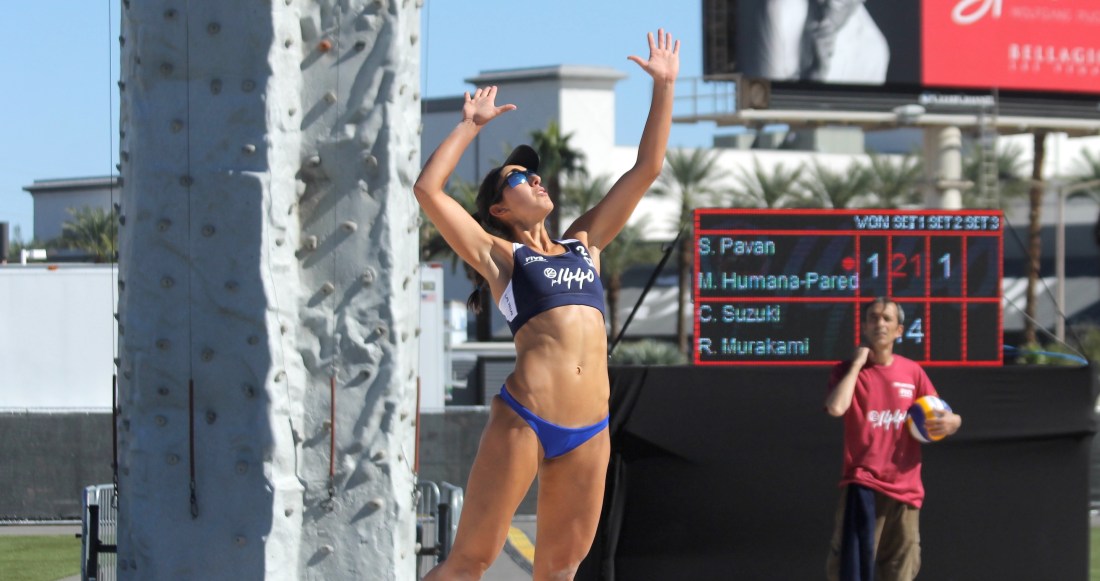
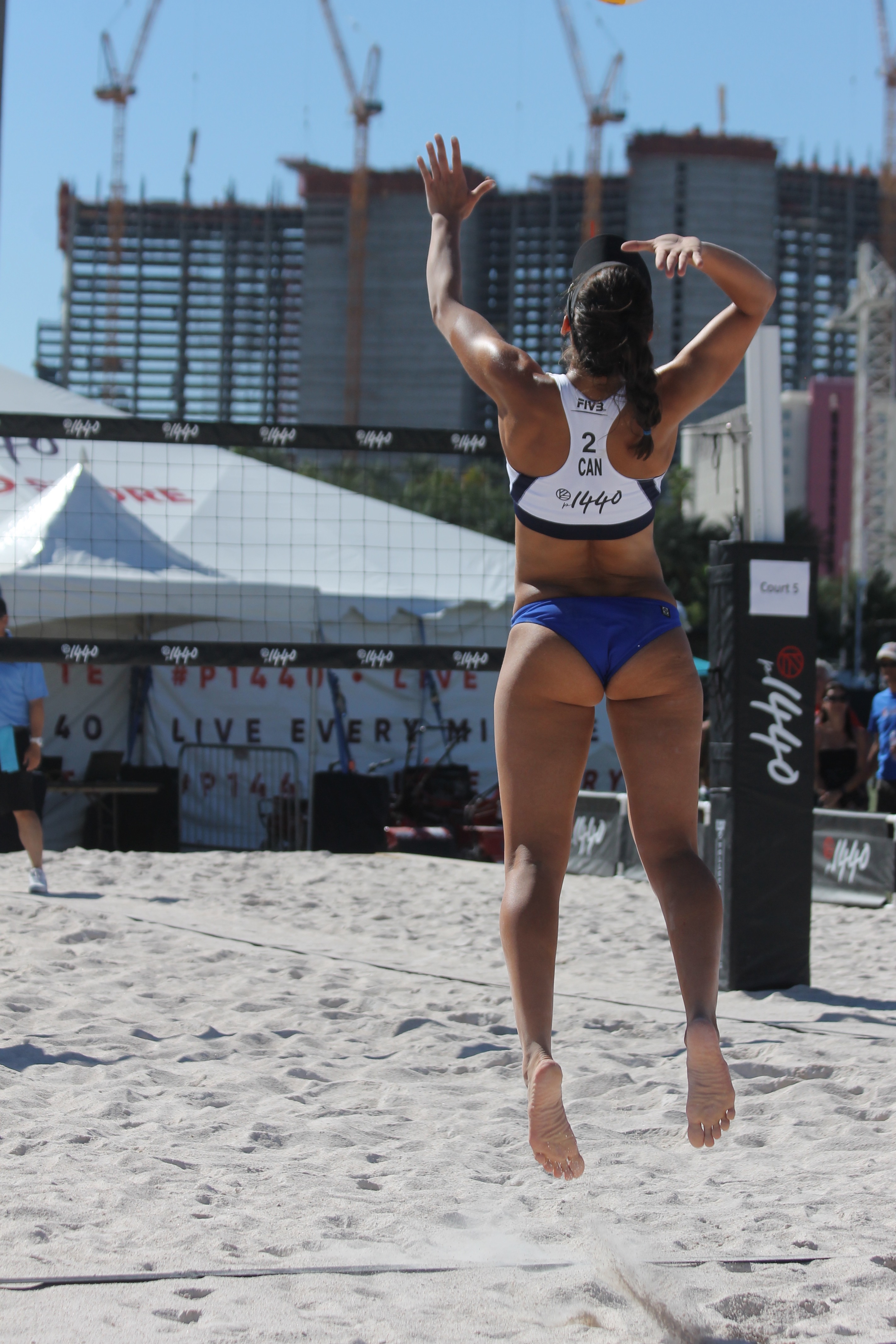
His daughter, Melissa Humana-Paredes, was born a little more than a decade after he arrived in Toronto. She knew little growing up about the dark years her parents lived under a dictatorship. She heard nothing about the inner turmoil her father felt when he represented Chile in international competition. Instead, she learned to share her father’s passion for a sport that ultimately shaped both their lives. Along with partner Sarah Pavan, she is a reigning beach volleyball world champion and among the gold medal favorite in the Olympics.
Love grows back stronger after heartbreak. Joy means more after sorrow. One of beach volleyball’s best players and most ebullient souls, joy for life and sport may lead Humana-Paredes, 28, to Olympic gold in Tokyo. They were also all her father took with him when he fled Pinochet’s Chile at 27.
“I was the same age as them when they were going through the coup and dictatorship,” Humana-Paredes said. “To put myself in those shoes, I can’t fathom it. I can’t relate to everything they went through at my age. And they came through and persevered and came to a new country and created a new life. My parents are just the happiest people and have this zest for life. You would never know that in their past they saw such horrors and atrocities.
“It made me look at them in a different light. You understand them differently.”
Volleyball under a dictator
Humana had already played for the Chilean national team by the time a coup changed everything about life in the country, including what the flag represented. He was a university student in Santiago on Sept. 11, 1973, when Augusto Pinochet’s military junta seized power from the democratically-elected government of President Salvador Allende. He saw confusion in the streets as people began to learn what was happening. Living in housing for national team athletes, he spent Septermber 12 under curfew and visited by soldiers. He was finally able to venture outside again on September 13.
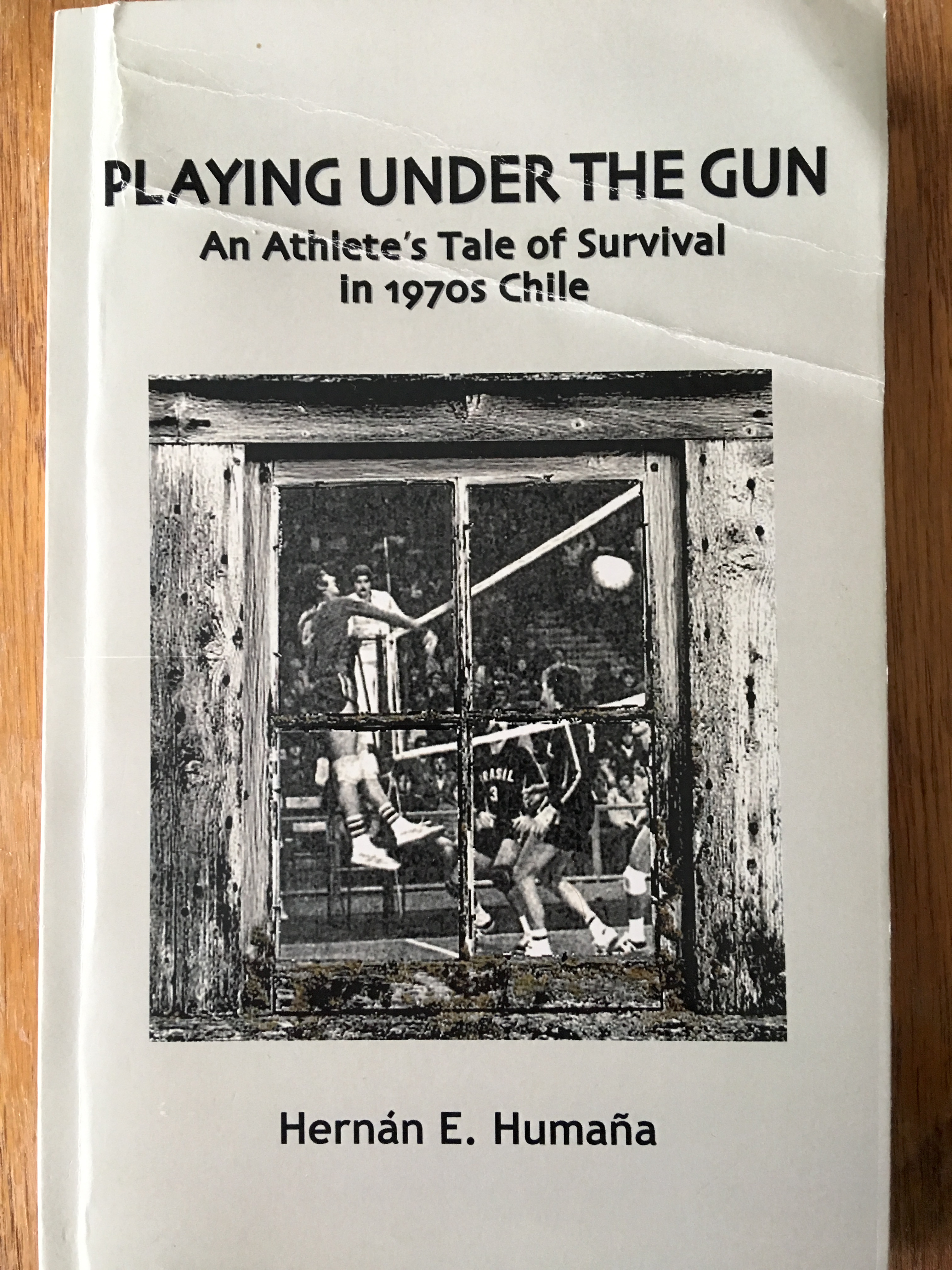
In Playing Under the Gun: An Athlete’s Tale of Survival in 1970s Chile, his memoir, he recounts a conversation with a neighbor limping down the street.
He spoke slowly, as if seeing life around him in some terrible new light. On September 11, he was arrested by a military patrol and taken to the national stadium, where he was tortured. His interrogators wanted to know who was organizing the resistance in his neighborhood. He was burned with cigarettes butts, and electric cattle prods were applied all over his body. He raised his shirt to reveal purple bruises and burns all over his skin. It was shocking. I didn’t know what to say. How could I communicate my compassion for him? Nobody is taught proper etiquette for dealing with victims of torture.
The neighbor’s experience was one endured by far too many Chileans in the months and years that followed the coup, tens of thousands of ordinary citizens who were arrested, tortured, murdered or simply disappeared, their fates unconfirmed but also obvious.
Humana’s experience under the dictatorship was more fortunate by comparison, but it was also emblematic of the fugue that fell over the country. He had close calls. Soldiers searched his dorm room but didn’t notice proscribed books. A friend told him he had been denounced by a neighbor as an Allende sympathizer and militant. He was suspended from university for two years after running afoul of authorities. His father was arrested and detained for months, then blacklisted from any jobs in his former field of engineering. But like the vast swath of Chileans who were neither Pinochet supporters nor suffered the harshest fate in makeshift prisons, Humana mostly tried to find some normal routine in a country he hardly recognized.
In a chapter titled “Playing with Ghosts,” Humana writes about so often playing volleyball in what was then called the Estadio Chile, the national arena in Santiago. Along with the Estadio Nacional, the outdoor soccer stadium, it became a concentration camp and place of torture and execution following the coup (it was subsequently renamed in honor of Victor Jara, the poet who was tortured and murdered by Pinochet’s forces in the regime’s earliest days).
On one occasion, when he was playing particularly poorly, a friend cajoled him to do better for those who died there.
I remember looking straight into his eyes and silently wondering how he couldn’t understand what I was feeling. This was just a meaningless volleyball game. The real issue was the horrors so many had endured in this place. I did not say anything, and my game didn’t change drastically. I think that I had reached some kind of critical point. Perhaps I was more vulnerable that day, overcome by a profound sense of hopelessness for my country. All I know is that I didn’t want to play that day. Or better put, I couldn’t play that day.
Almost from the moment Pinochet seized power, when his volleyball team was dragooned into a farce of a youth festival at the national stadium, Humana and other athletes faced a dilemma familiar to those living under repressive regimes. Play on and offer what silent or subtle protest they could? Or refuse, risking the safety of friends and family and leaving spaces that would be filled by toadies all too willing to praise Pinochet and belt out the national anthem?
And when I didn’t play well, perhaps it was because I was on some level confronting the horrors, and confronting my own complicity through my role as the symbolic representative of the perpetrators.
His parents and siblings finally left for Canada in 1975. He remained in Chile to finish university, delayed by the suspension and the loss of purposeful destruction of records under the new regime. He continued to play the sport he loved. Although even that was forever changed.
By then, the beachfront club Trauco was long gone. Located in the city of Quintero, on the Pacific Ocean northwest of Santiago, Trauco was the spot where Humana fell in love with beach volleyball. He spent summers there at the invitation of the club owner, nominally working in the evenings but mostly playing for the club’s beach volleyball team. The club and volleyball carried on for a couple of years after the coup, but then Pinochet’s soldiers showed up one summer and destroyed all of it.
The Chile in which such things thrived was a fading, bitter memory.
A new life in Canada
So when the warning phone call finally came in 1980, the friend’s account of the Olympic Committee meeting quickly confirmed by another present, it was hardly a surprise. He made it through more than six years, but no one who wasn’t subservient could make it forever. There wasn’t any midnight run for the border, but within a week or two, he was in Canada.
His younger brother helped Humana make inroads in the volleyball community — and helped translate initially. Humana received an advanced coach certificate from York in 1983 and his Master’s from the school in 1993. He coached both men’s and women’s volleyball for York at various times.
In 1995, John Child approached Humana, his former youth indoor coach, about coaching beach volleyball. After appearing as a demonstration sport in the 1992 Olympics, beach volleyball was added to the regular program for the 1996 Olympics in Atlanta. Calling on his experience in the sand in Chile, Humana took on the new challenge. Child and partner Mark Heese went on to win the bronze medal.
That remains Canada’s only Olympic medal in men’s or women’s beach volleyball. But that may be on the verge of changing. Humana-Paredes was still a few months shy of her fourth birthday in 1996, but she spent a lot of time in the sand while her dad continued to coach indoors and outdoors following the Olympics. Yet Humana recalls that far from him dragging her to practice, it was more often Melissa knocking on his door early on Saturday mornings to go and play.
“By no means was it pushed on us by our dad,” Humana-Paredes concurred. “He exposed us to the sport, and it was always around because we would be at the beaches to watch him practice and whatnot, but he never forced us into anything.
“For me, it was an immediate attraction. I started playing as soon as I could.”
Melissa Humana-Paredes goes for gold
While the picture may be changing with the growth of beach volleyball as an NCAA sport, notably including current Latvian Olympian Tina Graudina and former UCLA standouts and Canadian twins Megan and Nicole McNamara, it was still unusual 10-to-15 years ago for a teenager like Humana-Paredes to train almost exclusively for beach volleyball.
“She was by herself the whole winter playing beach volleyball alone,” Humana said. “It was a lonely, lonely battle. I was there with her, but it was a lonely battle. She would miss indoor, the social aspect and the friends that you make. She’s a very social person. But she loves beach volleyball. That’s her sport.”
She ultimately played four successful indoor seasons for York, where Hernan had previously coached the women’s volleyball team. But even then, the beach was her focus. After her freshman year at York, she and partner Taylor Pischke won a silver medal at the 2011 FIVB Junior World Championship in Halifax, losing to Switzerland’s Nina Betschart and Joanna Heidrich in the the final match (a decade later, three of the four are in the Olympics).
“I love beach because the incredible mental, physical and emotional challenges that it brings,” Humana-Paredes said. “You’re more involved in the game, you have more control of the game — you’re more independent.”
She played her first major pro event while still in college. A few months after finishing at York, she and Pischke reached the quarterfinals of a full-fledged FIVB event in Sao Paolo.
But it was while serving as a training player for the Canadian teams that qualified for the 2016 Olympics in Rio de Janeiro that she got to know Pavan, the former NCAA indoor All-American at Nebraska. A few months later, back in Rio, they finished second in their first FIVB tournament together. They won a five-star event later that summer and soared up the rankings, Pavan’s prowess at the net a perfect complement to Humana-Paredes’ defense and passing.
In 2019, they won the World Championship in Hamburg, Germany, beating April Ross and Alix Klineman in the final and losing just two sets in five knockout round matches. That win came with the added bonus of automatic Olympic qualification, which proved all the more valuable as most other teams scrambled to adjust the pandemic-dictated qualification process this year.
Hernan coached her in the early years. He certainly had the resume for it, from the Olympic success in 1996 to running a beach volleyball club in Ontario. But he said that both agreed when she was a teenager that it would be better for her to work with the coaches then in the Canadian national program. Besides, the professional circuit that takes her from Asia to Europe to South America on a near-weekly basis wouldn’t fit a university professor’s life very well.
Still, when the frequently California-based Humana-Paredes returns to Toronto, it is her father serving her ball after ball in the otherwise empty gym. Just like always.
“My dad will always be my coach,” Humana-Paredes said of his influence nonetheless. “With his knowledge and background and passion and love for the game, I always respect and care for everything he tells me — whether I agree with it or not. I’ll always take what he says to heart.”
All the more after his memoir, which Humana dedicated to Melissa and her brother Felipe, and shared with them while writing it. Although they visited Chile on multiple occasions growing up, Pinochet finally ousted in 1988, they knew few of the details of their father’s life in Chile.
It is a story about the resiliency of joy. The same joy evident when Humana-Paredes plays. The joy she will feel listening to the Canadian anthem if she and Pavan stand atop the podium. It will sound far sweeter than the Chilean anthem did to her father by the end.
Maybe too much happened to too many to speak of winners and losers. But joy survived.












 Graham Hays