Moment of a Lifetime

The moment is everything in sports. It’s their redeeming virtue.

It’s the tradeoff for the soap opera and scandal. It makes it worth putting up with the hot take industrial complex and overhyped snoozefests. Sports can still squeeze the past and future out of the picture and slow down a present that otherwise never seems to stick around very long.

We watch athletes try to remain in the moment, try to harness its energy. Every now and again, they find the sweet spot between the certainty of expectations—of what should happen—and the overwhelming realization of what might happen. Keep both at bay and that’s when remarkable things actually happen. In the moment.
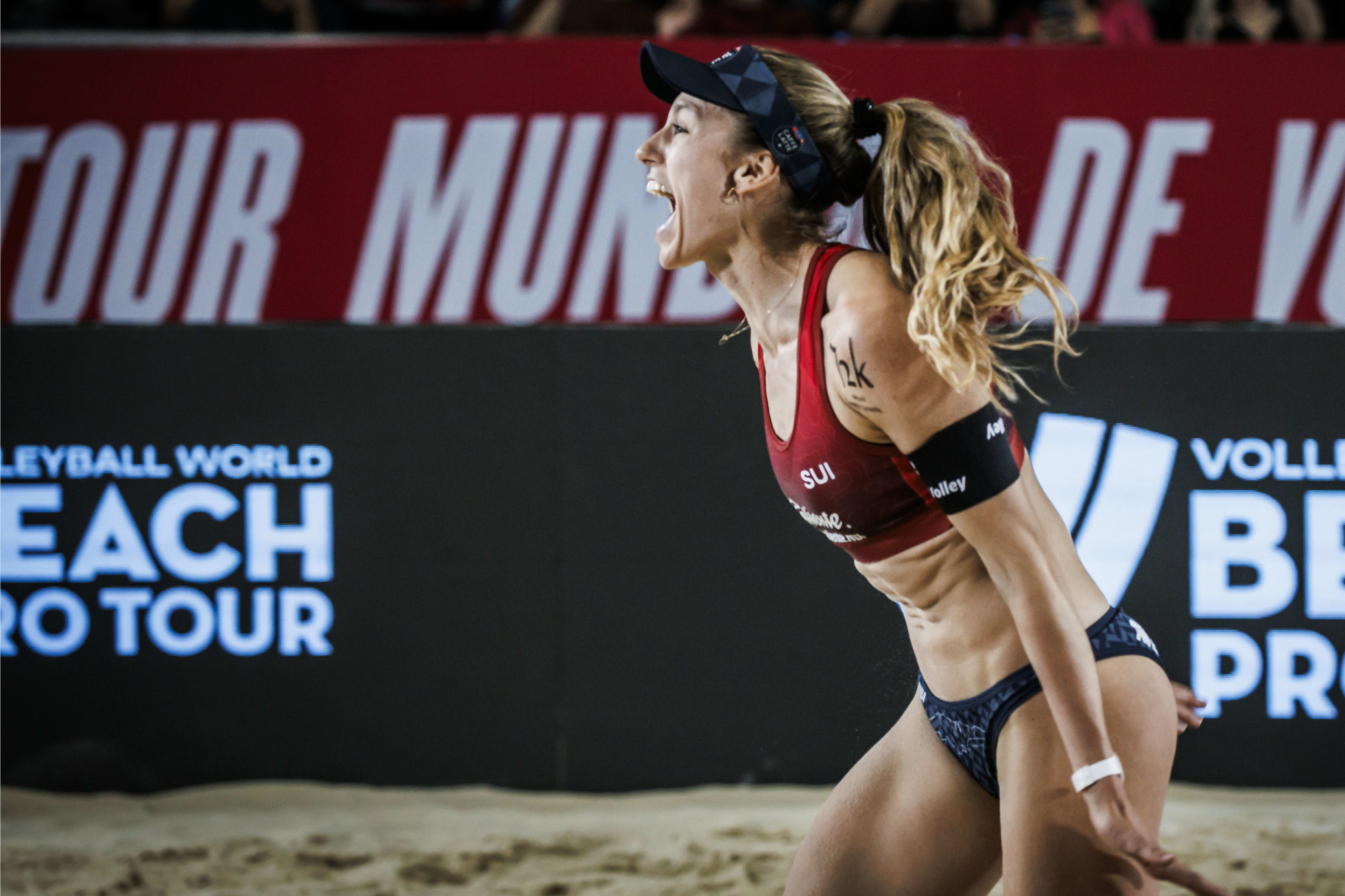
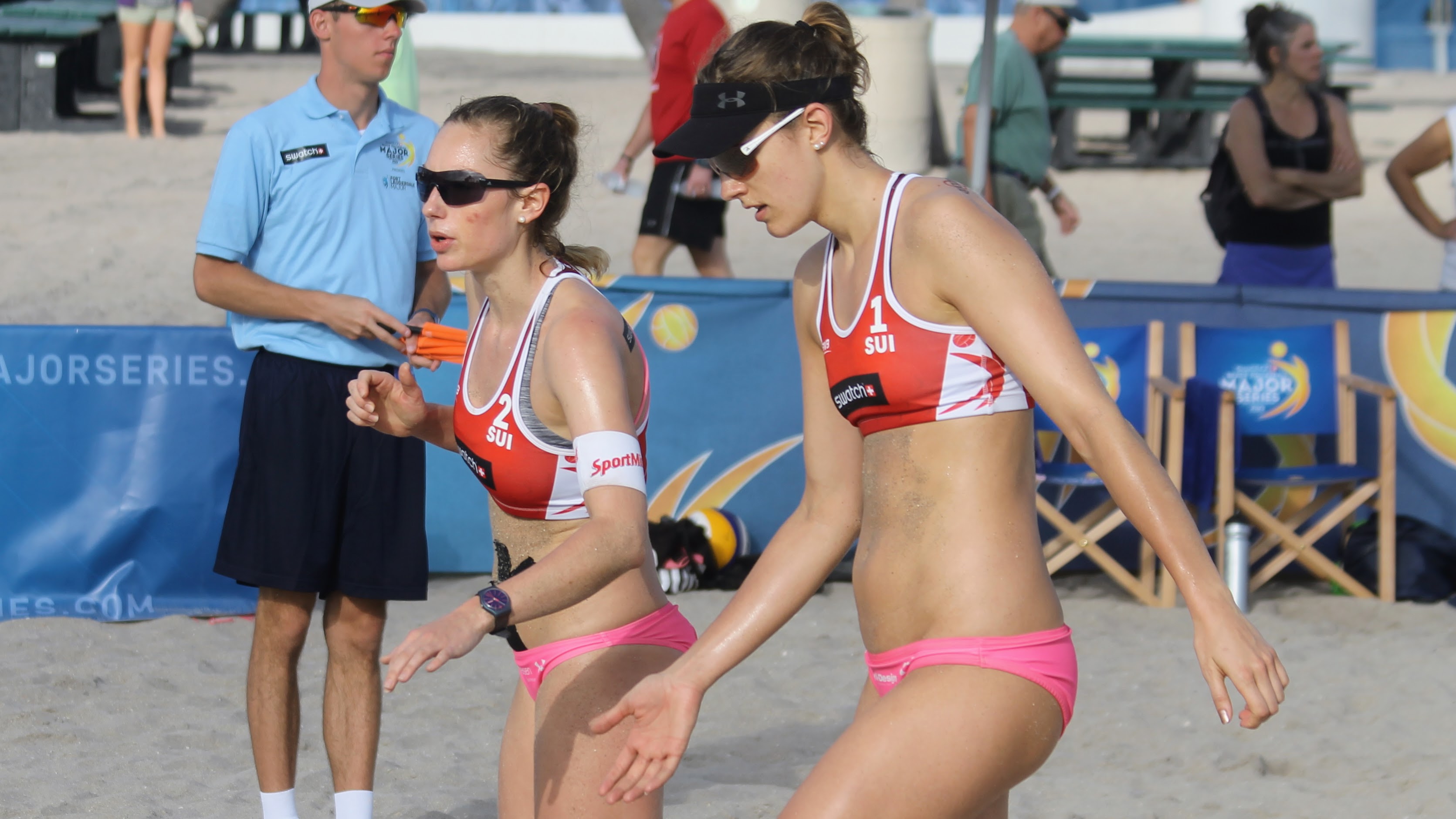
Nina Brunner (photo courtesy Volleyball World).

Nina Brunner and Tanja Huberli first played together in an international pro event, the equivalent of the current Beach Pro Tour, in April 2016. Huberli was 23 years old and Brunner 20. They finished tied for 17th. Within little more than a year, they made it to the podium with a third-place finish at a major event in Porec, Croatia.

A few more third-place finishes followed, as well as a semifinal appearance in the 2019 World Championship. Over the past two years, they finished second in Elite 16 events—the highest level in current iteration of the pro tour—in Hamburg and Doha. They played in the delayed 2020 Olympics, narrowly missing out on the medal round. And, of course, they made history as the first Swiss women to win multiple European Championships, in 2021 and 2023 (nearly the first women’s team from any country to win three in a row, settling for silver in 2022).

But across eight years, 19 countries and nearly 100 events together, they never won a title on the international pro tour. Until Sunday in Tepic, Mexico, when they defeated the Dutch team of Katja Stam and Raisa Schoon, 21-14, 19-21, 19-17, to win the year’s second Elite 16 event.

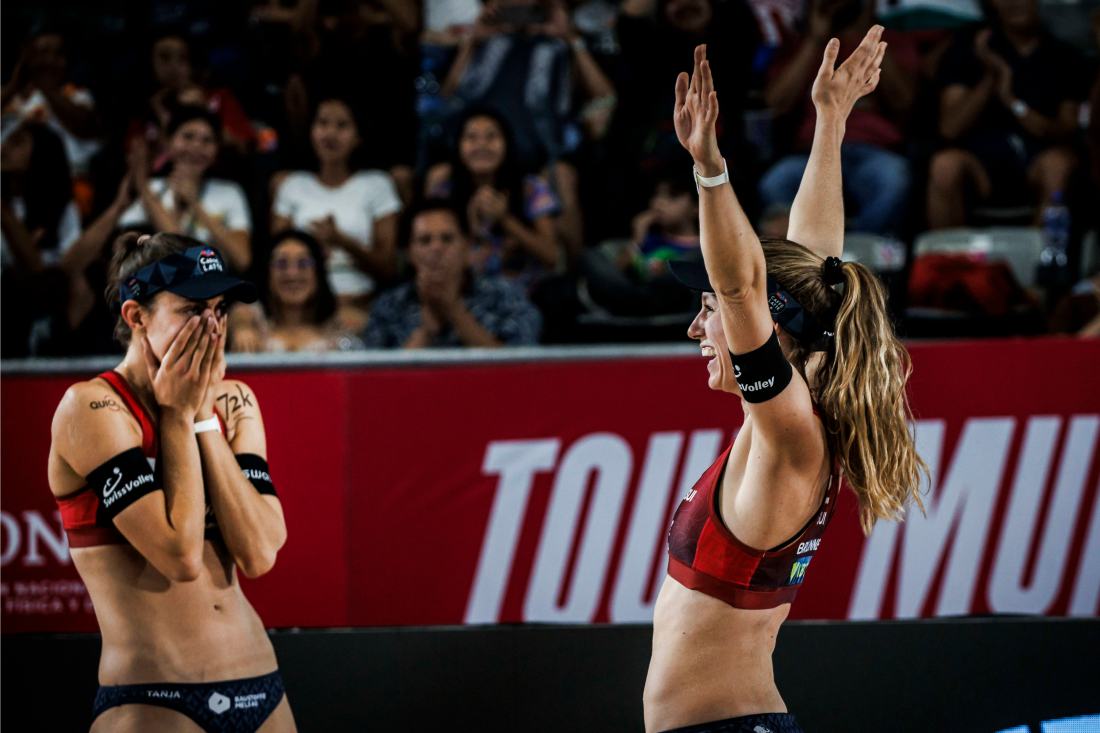
For four days, the Swiss were brilliant. Huberli led the field in blocking. Brunner hit cut shots at impossible angles and reacted on defense as if everyone else was playing on a delay—never tipping her hand but somehow always just where the opposing player tried to hit. In six matches, they beat five of the eight teams seeded ahead of them. They didn’t lose a set until the final. And when it was over, the reaction said everything.

Match point in Tepic.

Entering the reckless speculation portion of this post, I’ve wondered quite a bit about whether or not the Paris Olympics might be the end of the road for one or even both of the partners.

They haven’t played much over the past year and half compared to many in their peer group. Granted, they haven’t needed to—in a three-way race for two Swiss Olympic spots, their success when they do play means they maintained a steady and largely untouchable lead throughout that time. They didn’t need to trek to Challenge events in India, the Philippines or, much to my chagrin, Edmonton. But Huberli has also visibly battled foot issues for some time—at least twice in Tepic, she had to stop mid-match and re-tape toes. It might be a manageable annoyance. Athletes manage plenty of them as years of competition take their toll. But maybe second only to bad backs, foot woes can rapidly degrade your entire quality of life.

On the other side of 30 years old, with two European Championships and two Olympics to her credit, would she really want to keep putting in hundreds of hours in the sand and leaving family and friends for volleyball’s arduous, expensive and nomadic lifestyle?

If not, would Brunner want to take on a new partner? On one hand, she’s in the prime of her athletic life and the peak of her talents. From afar, she appears driven to play the sport to a degree that would make it difficult to walk away. On the other hand, as something of a youth prodigy who won a junior world title at 16 years old, she’s already been doing this for more than a decade. Unless one of Anouk Vergé-Dépré or Joana Mader also retired after this year, splitting up that Swiss team, there’s no obvious new partner if Huberli leaves—not at the level to which Brunner is accustomed. Would she set her sights on LA 2028, when she would be 32? Beach volleyball produces some impressively long careers, but it’s not as if it comes with the opportunity to accrue generational wealth.

Again, it’s all idle speculation. And as something of a pessimist, likely born of nothing more than me worrying my favorite team won’t be around forever. The way they’re playing right now, they would be among the top contenders to win any Elite 16 event they entered, along with World Championships and World Tour Finals, for at least the next two years. The Olympics are a big prize, but one quadrennial tournament doesn’t determine everything in a volleyball career. There are other goals to play for.

That’s a hyper-specific look at possible future scenarios in the careers of two Swiss volleyball players that most people haven’t heard of. It’s also an inherently universal theme. Not just in sports—where Bayer Leverkusen supporters, even amid current joy, must wonder how much time they have left with Xavi Alonso and Florian Wirtz—but life.

Future concerns always intrude on the present. For athletes. For the fans who watch them. What’s coming down the road? What if a company downsizes to please investors? What if a house’s plumbing needs replacing? And it’s not always about dread. Job opportunities, relationships, spending splurges, people stand at mini-crossroads every day, trying to figure out what awaits down one path over another. Living in the present feels like a luxury, almost irresponsible. But it’s where life happens.
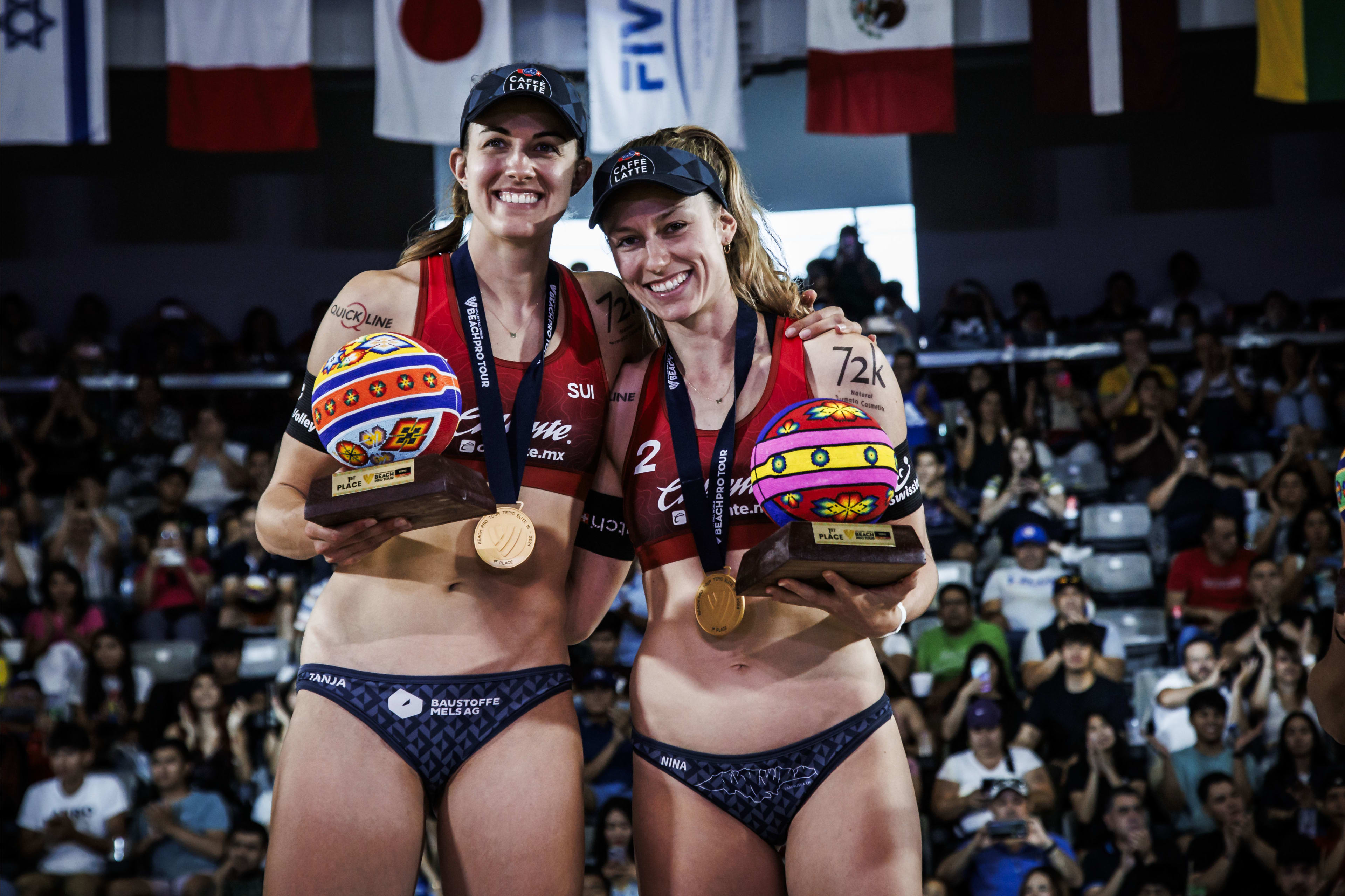
The Swiss entered Tepic ranked ninth in the world (photo courtesy Volleyball World).

That’s where my mind went during the tense third set, thinking about these two individuals with so much history behind them, the same uncertain future that we all confront and, here, suddenly, the opportunity of a lifetime if they could just stay in the moment.

As mentioned, Brunner and Huberli didn’t drop a set in their first five matches. They were in control—in the zone, in sports parlance. And then the second set slipped away. The Swiss didn’t play all that poorly in the second set. Huberli’s serve got away from her a few too many times. Brunner’s seemingly unerring accuracy hitting shots down the seam suddenly erred. But mostly it was just a really good Dutch team rising to the occasion in the sort of back-and-forth set that turns on a couple of points—the normal run of things at the back end of a major tournament.

The Swiss took a 5-1 lead in the third set, forcing the Dutch to take their only timeout to regroup. And regroup they did. Schoon got to everything, Stam met Huberli at the net, and the lead slowly but methodically evaporated. In a race to 15 in the final set, the Netherlands took its first lead at 11-10 and again at 13-12. Had Huberli’s subsequent high line shot over Stam drifted a few inches wide instead of smacking off the line, the Dutch would have had two match points.

Instead, it was 13-13 and Betschart’s sensational defensive read and arcing high line shot on the next point gave Switzerland its first match point.

Match point after match point then came and went, the tension rising with each opportunity. The Dutch sided out again and again to prevent the Swiss from getting the two-point margin needed to claim the set. In turn, any slip when it was Brunner and Huberli’s turn to side out—and the Dutch allowed opponents to side out less than 40 percent of the time en route to the final—would have put them on the brink.

Finally, after two great digs from Betschart—time seemingly standing still as Huberli sprinted across the court to keep one of them alive—they found the winning point.

The Swiss stayed in the moment. And for an hour and change on a Sunday evening, I was right there with them. Past and future forgotten, savoring only the present.

Two Roads in Vienna: Swiss Win Euros as Spain Arrives

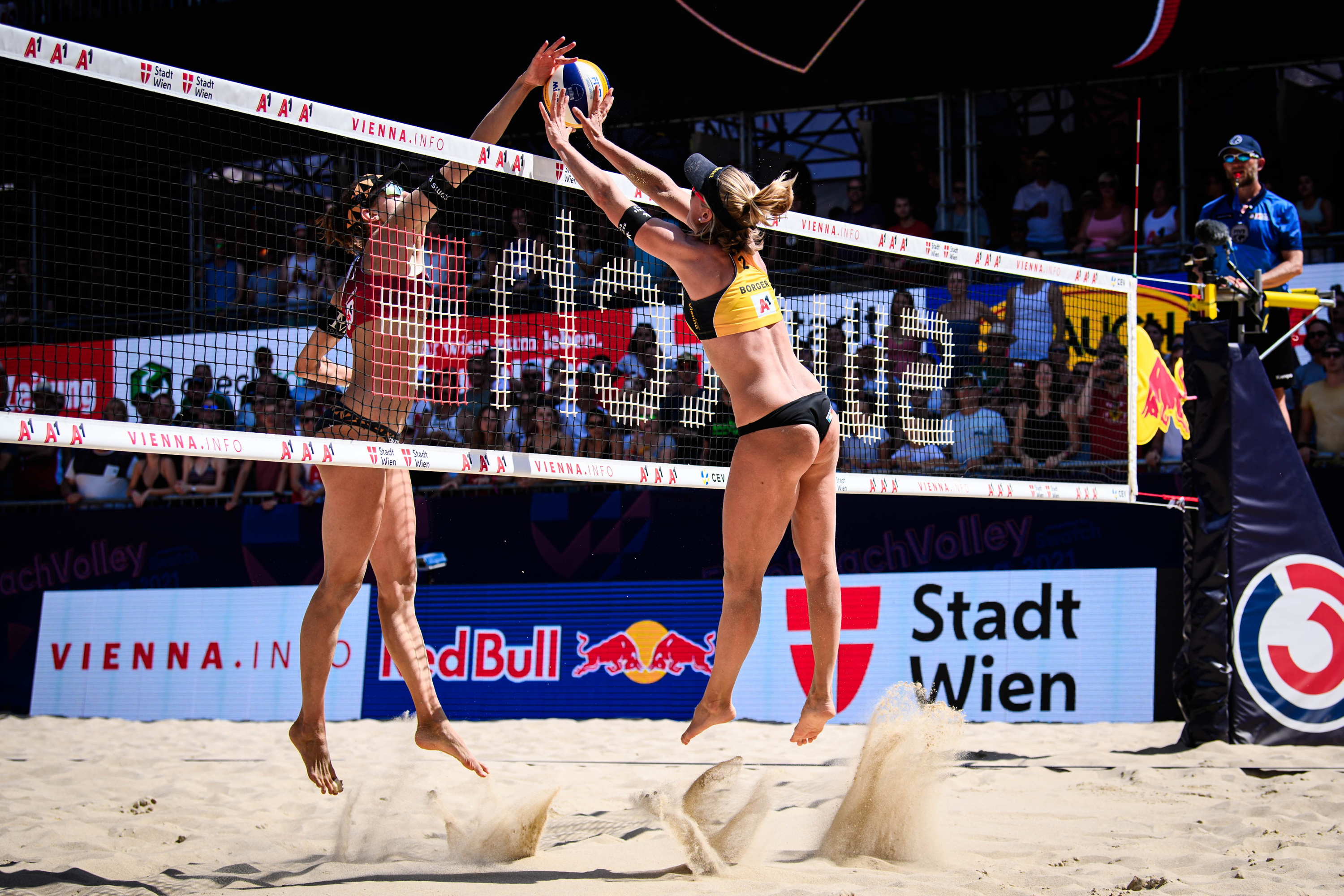
Already down a set and 7-0 after the first change of ends in the second set of Saturday’s European final, Daniela Álvarez could only laugh when she finally spiked a ball that Switzerland’s Tanja Hüberli couldn’t block and Nina Brunner couldn’t parry.

On this court, she knew. On this day, it wasn’t meant to be.

Vienna belongs to the Brunner and Hüberli. Again. As a result, so does Europe, no small detail a year ahead of an Olympics on European soil.

But the future? Something in that smile suggested Álvarez now knows her day is coming.

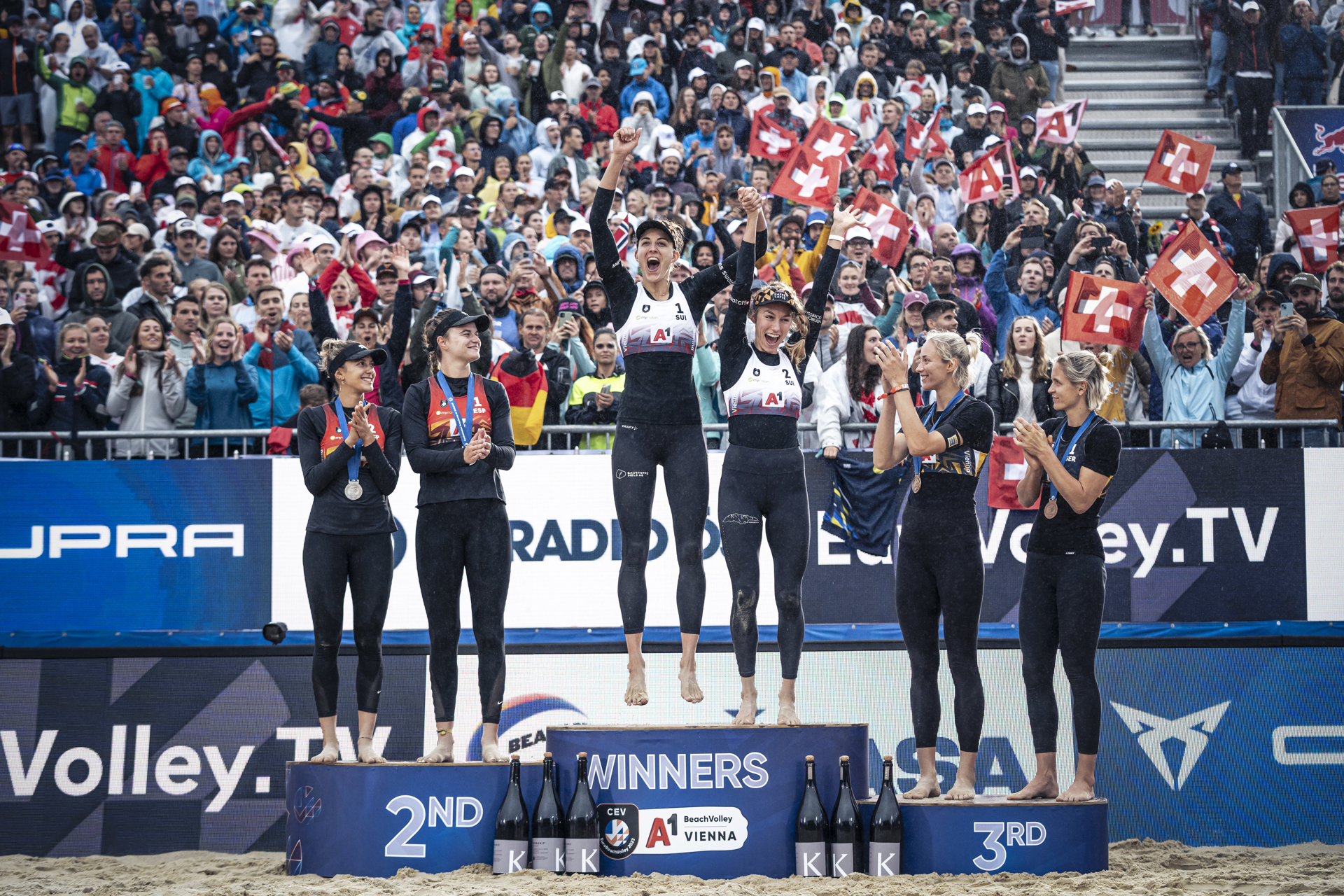
Brunner and Hüberli routed Álvarez and Tania Moreno 21-12, 21-13 to win the Beach Volleyball European Championship. In their third consecutive appearance in the final of the annual showcase event, the Swiss pair won their second European title—both in Vienna.

Credit: CEV/Martin Steinthaler-Acts

On the same day when Spain eliminated Switzerland from the FIFA Women’s World Cup in a 5-1 shellacking on the other side of the world, what went down on a rainy, grey day in the Austrian capital was no less lopsided. After a pair of epic, three-set semifinals earlier in the day, the Swiss won the final by the most lopsided margin in the entire knockout round (24 matches).

I’m not impartial when it comes to the Swiss. Brunner and Hüberli are my team. They are one of the only sporting entities who results still steer my mood. It just about ruined my summer when they skipped the two North American tour stops in Edmonton and Montreal. The loyalty is born of investment. I’ve followed them almost from their beginning, intrigued by Hüberli’s unassuming demeanor and Brunner’s preternatural rise now more than a decade ago, winning junior world titles at 15 and 16 year old—competing against future Olympians as old as 20.

Seven years. It’s a long time. For some.

Seven years ago, they were a team on the rise, promising but unproven. It felt like a fairytale when they reached the European final in 2018, losing to the Dutch pair of Sanne Keizer and Madelein Meppelink that played the tournament on home soil. Keizer and Meppelink were the veterans, multiple-time Olympians and, in Keizer’s case, a former European champion.

It was still difficult to think of the Swiss as proven contenders by the time the pandemic-delayed Olympics arrived in 2021. They won their pool in Tokyo but lost a heartbreaking round of 16 match against countrywomen Anouk Vergé-Dépré and Joana Mäder. It was a three-set classic played in brutally hot conditions, but no one remembers round of 16 matches. Vergé-Dépré and Mäder went on to win bronze. Brunner and Hüberli went back to the fringes of acclaim.

Brunner (left) and Hüberli (right) in 2017 when they were 21 and 24, respectively.

For all of two weeks. Just a fortnight after losing in the Olympics, Brunner and Betschart were crowned European champions in Vienna. They beat the Dutch pair of Katja Stam and Raïsa Schoon in a final that felt like something of a referendum on the young team that had arrived. Or at least the primary challenger to Latvia’s Tina Graudina and Anastasija Samoilova for that label.

Somewhere along the way, Brunner and Hüberli grew up, for lack of a better phrase.

One of the reasons that sports are so compelling is they really do hold up a mirror to the world—for better and, on a day when greed and conference realignment rule the headlines, often for worse. But it’s also a funhouse mirror in some respects. We see competitive lives unfold on fast forward, prospects entering their peaks and slipping into decline and retirement in less time than many of us hold onto a car. I still wear clothes that I had seven years ago. I still sit on the same couch, cook with the same pans.

Seven years isn’t a long time. Except in sports. In sports, it’s half a lifetime.

Saturday, that was inescapable. Brunner and Hüberli aren’t old, by any stretch. So precocious at such a young age, Brunner is still just 27. And even at 30, Hüberli was nearly a decade younger than Germany’s indomitable Laura Ludwig, who along with ridiculously impressive indoor-convert Louisa Lippmann pushed Switzerland to the limit in a 21-19, 19-21, 16-14 semifinal. But if the Swiss aren’t old, they also aren’t young anymore. They’re in the sweet spot.

Anomalies like Ludwig notwithstanding, athletic careers are defined by the intersection of two lines going in opposite directions on a graph. One is experience, wisdom, athletic IQ—a line that rises as years and competitions accumulate. The other line is athleticism—descending as those same years and competitions take a toll on joins, ligaments and various and sundry parts of the body. At some moment, those lines intersect. That might last a summer or it might last several years. It might not even mark the period of your greatest success. But you’re never better equipped to succeed than you are when those lines meet. That’s where the Swiss reside.

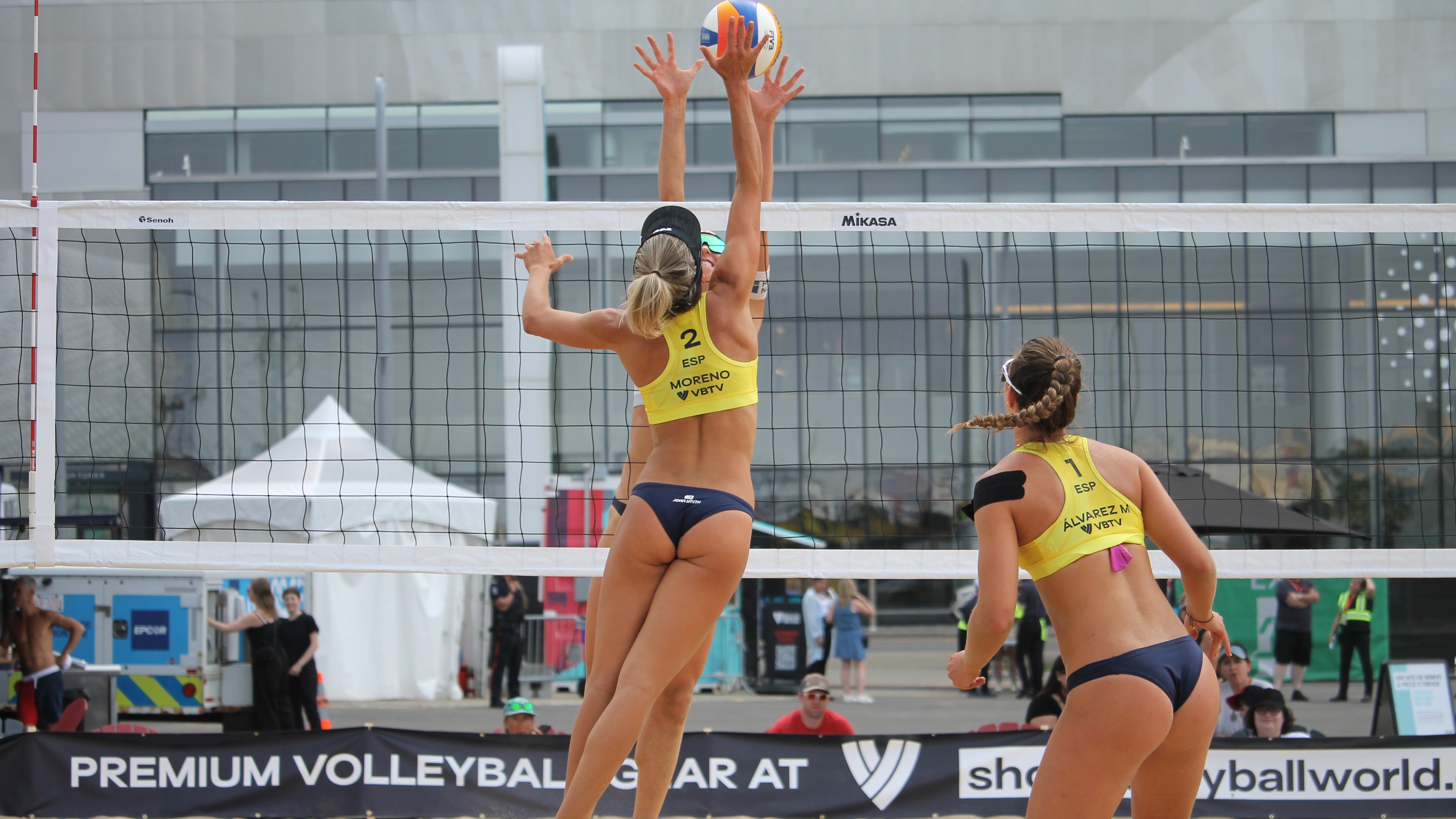
Moreno at the net during tour stop in Edmonton.

They entered the Euros with no momentum whatsoever. They suffered a profoundly disappointing pool play exit in Gstaad in July, one of the biggest tournaments of the year for every team but all the more for Swiss teams playing on home soil. This week, Hüberli, who has dealt with injuries in recent seasons, could barely even celebrate a pool play win, crumpled on the sand and in need of treatment from trainers.

“Of course we were thinking about medals,” Hüberli said of expectations this week. “But we were also a little bit unsure [because of] the last tournament.”

Brunner echoed the sentiments in her German-language interview (as best I could tell with some translation assistance).

None of it mattered. It didn’t matter because the Swiss long ago learned how to deal with the inevitable setbacks that are part of any sport—the random weeks when luck isn’t on your side you simply play like crap. And Hüberli’s ailment notwithstanding, their bodies are still in good enough condition to push through some wear and tear. Lord knows that doesn’t necessarily mean it’s easy to get out of bed the morning after a tournament. But it’s manageable.

So, the Brunner and Hüberli weren’t troubled when they fell behind 6-1 in the opening set of Friday’s round of 16 match against Spain’s Liliana and Paula. They held off a three-set challenge from rising countrywomen Zoé Vergé-Dépré and Esmée Böbner in a quarterfinal later the same day. They outlasted the Germans. And when Brunner was called for a lift on the opening point of the final and Hüberli followed with an error on the second point? They shrugged and rolled to dominant performance.

Perhaps because it was such a rout, and perhaps because it ended on an anticlimactic service error, the immediate celebration after clinching the title felt subdued. By the time they got their hands on the trophy a few minutes later, the celebratory dances and trophy lift spoke to plenty of joy. But there was something to that first reaction. This wasn’t their first title. This wasn’t a surprise—to them or anyone else. The joy came, but for a second, it seemed mixed with relief.

More than seven years after playing their fist match together, this was less a dream than the expectation that they devote their lives to achieving. The sense of perspective was even there when the on-court host asked Brunner if it “was easy to play against this Spanish team.”

“A final is always a hard job,” Brunner said, parrying an inelegant question as easily as she defused the Spanish attacks. “I think the Spanish team did a very good job in this tournament, we knew that. We only played them twice so far. They’re a young team, and we knew they’re going full.”

It must have felt like looking in a mirror.

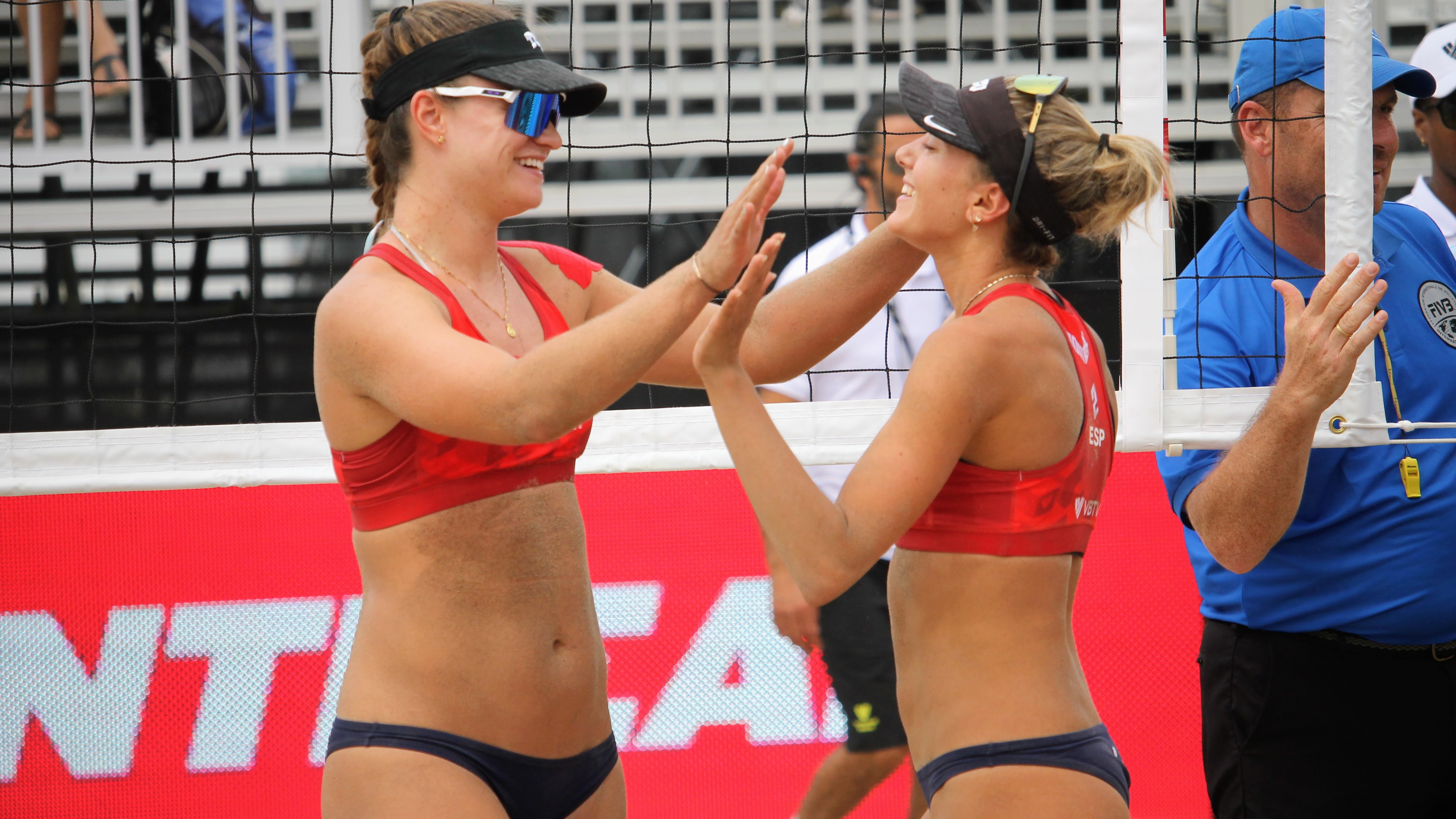
Alvarez (left) and Moreno (right) during July’s tour stop in Montreal.

The 2022 European Under-22 champions, Álvarez and Moreno are still in the midst of their college careers at TCU (they led TCU to the semifinals of this past spring’s NCAA tournament).

When Brunner the wunderkind won her first junior world title in 2011, Álvarez and Moreno were 9 years old. When the Swiss pair set out on the pro tour together in 2016, Álvarez was just deciding to give up tennis and get serious about beach volleyball.

For them, Saturday arrived in a hurry.

Not that they took any shortcuts to the final. They beat two recent former champions en route, eliminating two-time European champions and reigning Olympic silver medalists Graudina and Samoilova in the round of 16 and former European champions and reigning Olympic bronze medalists Vergé-Dépré and Mäder in a thrilling semifinal. They lost the opening set in that semifinal 27-25, trailed late in the third set and still had the mettle to win.

When Moreno, the darting, acrobatic, seemingly spring-loaded defender, saw Brunner reading every angle and digging every ball in the final, she might well have seen a reflection of her future, polished self. Yet she could have said much the same thing about three-time Italian Olympian Marta Menegatti—who she eliminated in straight sets in a quarterfinal.

Moreno in action in July’s tour stop in Edmonton.

The Spanish team was in no way out over its skis. They were capable of winning. On a different day (like any of the previous three days of this tournament), they might have. It’s just that when you’re young, you have a few too many of these days—especially against the best.

All of which helps explain why Álvarez could only laugh when she and Moreno finally got their first point in the second set—after Brunner nearly saved the point with a miraculous, reaction one-arm fling to keep the ball in play.

Not long after, Álvarez was smiling again, this time after Spain’s best moment of the match. During an extended rally, Moreno made one of her familiar full-extension, over-the-head blind saves, somehow putting the ball right where it needed to be for Álvarez to react and complete an athletic spike. The point cut the deficit to 10-8.

It was as close as Spain would get but also a show of resolve from a team that left defeated but not embarrassed.

As a Swiss fan, there was something bittersweet watching the final. To be sure, the end isn’t nigh. A second Euro title cements Brunner and Hüberli’s place as Olympic contenders in 2024. It also sets them up for this fall’s World Championships in Mexico. These are good times. Beyond the immediate future, Brunner, certainly, has every opportunity to be around for Los Angeles 2028. Hüberli would be far from the oldest Olympian, if she chose to continue playing that long.

And still, time is unbeaten. Pessimistic as the thought may be, there is only one chapter left after the peak. There is only decline. Many more days like Saturday may lie between now and that reality, but it is inevitable.

Somehow, seeing the Swiss at their best only underscored that. It’s the same feeling as reaching the later episodes of a brilliant series. It has been everything you hoped. It has entertained and inspired. And it will end.

Paradoxically, it’s the team that lost decisively that buoyed me Saturday. Spain’s story is just beginning. The potential still seems limitless, the characters still emerging. And the opening scenes, in person in Edmonton and Montreal and from afar in Vienna, promise great things.

Saturday, the Swiss and Spanish occupied the same sand in soggy Vienna. But not the same moment in time. The Swiss road led to Vienna. The Spanish road leads from it.

A reflection of life. Always a reflection of life.

Betschart and Hüberli Win European Championship

Courtesy: Conny Kurth/CEV

“You never thought about oh my gosh we missed it in the second set? You always still believed?”

“Hmm, uh, to be honest, it was a little bit in my mind.”

Interviews in second (or third or fourth) languages are often less than revealing. It’s difficult enough for most of us to express ourselves in the language we know best, let alone find the right words and grammatical constructions to convey complex thoughts in another language. Order a meal or ask about a train schedule? Sure. Describe emotional states of existence? Trickier.

But on rare occasions that process strips away any artifice or obfuscation. All that’s left is the simple, honest truth. So it seemed with Nina Betschart’s answer above, delivered in English with an almost embarrassed grin in the obligatory postgame television interview after Saturday’s semifinal between Switzerland and Germany in the European Beach Volleyball Championships.

Betschart and partner Tanja Hüberli had just pulled off the seemingly impossible by winning five consecutive points — the first three on the brink of elimination — to complete a comeback and reach the final in Vienna, Austria.

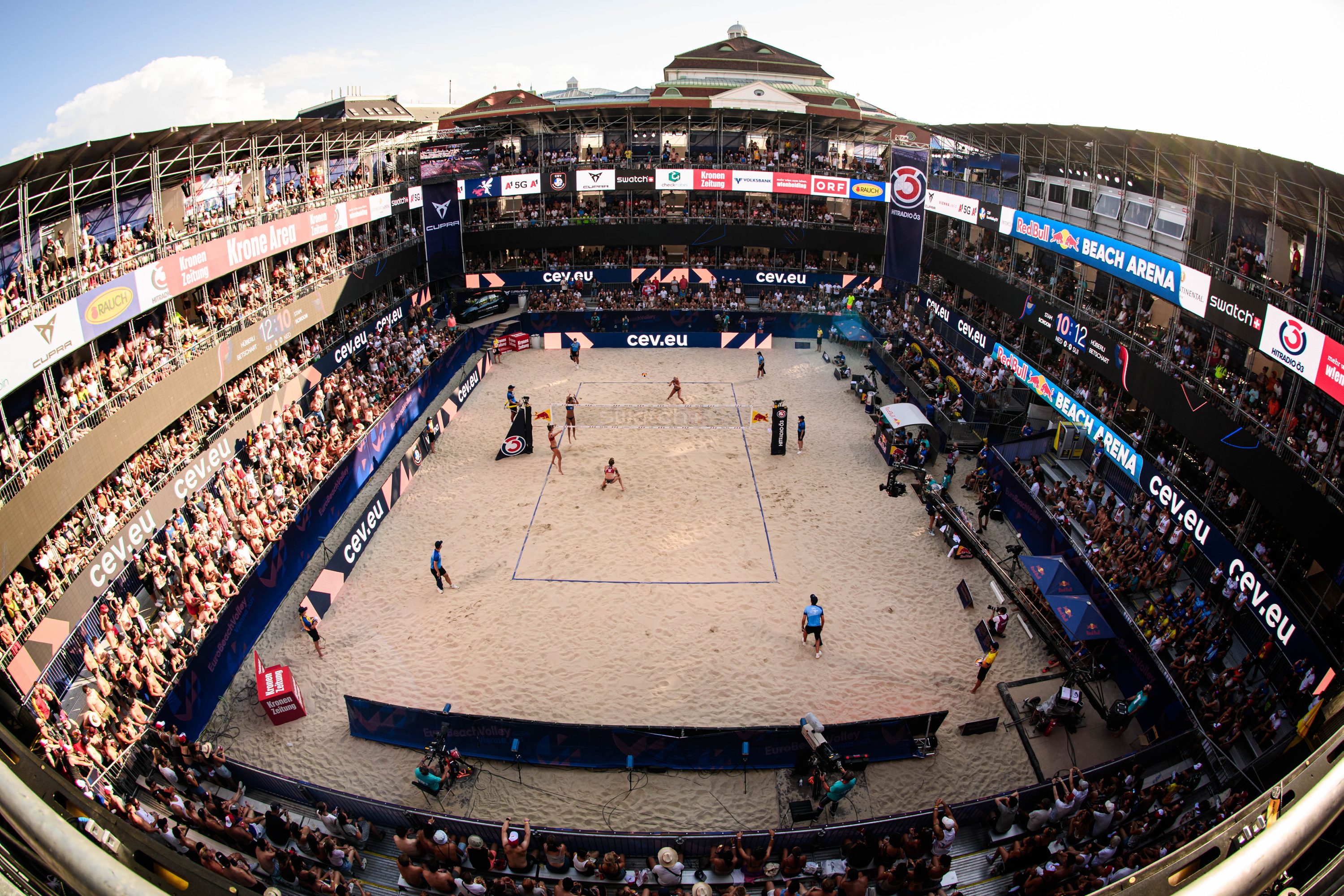
The ensuing championship match was almost anticlimactic for the Swiss — if winning a career-defining title in front of a frenzied, partying crowd in a three-story arena whose design was part Elizabethan and part Mad Max can be anticlimactic. Betschart and Hüberli rolled over a talented but inexperienced Dutch team in the final. It was joyous, to be sure, and the celebration complete with hugs, tears, the Swiss national anthem and some impressively committed champagne consumption. Even without Americans, Brazilians, Canadians or Australians, the trophy is a big deal to lift.

14.08.2021, Wien, Heumarkt Beachvolleyball, Europameisterschaft, Finale Stam / Schoon (NED) vs. Betschart / Hüberli (SUI) Foto: Conny Kurth / http://www.kurth-media.de

As a fan of the Swiss team, I savored those scenes. They finished second in the same event in 2018, the same year they were semifinalists in the World Championship. They are often close to trophies, but until this win, their biggest title was a 1-star event. Still, the part of the weekend that fascinates me most wasn’t the outcome as much as Betschart’s quote and those points late in the semifinal.

How often do athletes talk after a comeback about how they never stopped believing? How often do we, in turn, ascribe to them some sort of superhuman mental strength that prevents them from accepting defeat? I can’t help thinking that shortchanges them.

In a work project the other day, I tried to decide between using “courage” and “bravery” in a passage. I would have preferred bravery because I’m a sucker for alliteration, which applied in this instance. And most sources suggest they are, at least practically, interchangeable. But to me, correct or not, bravery implies acting without regard to potential consequences, whereas courage implies understanding the consequences but acting nonetheless.

Both, I’ll hasten to add, are overused in the context of sports. Still, listening to Betschart reminded me of at least the essence the debate. If someone down 14-11 in the third set really doesn’t have any doubt that she will win, it’s still a good story if she does win. It’s still a remarkable comeback. But it’s no more relatable to most of us than is world-class athleticism.

Doubting and carrying on anyway? That’s far more familiar.

At no point in my life could I jump or run like Betschart. At no point was I as fit. (Nor was I at any point willing to put the time and effort into training my lesser abilities that she has into hers.) But I think I can imagine what it was like for her when she was down 14-11 and wondering if it might all be about to go wrong again.

For the second time this month, first in the Olympics and now in the sport’s biggest continental championship, Betschart and Hüberli faced not just impending defeat but impending defeat in a distinctly soul crushing manner.

In the Olympics, it happened in a marathon third set against countrywomen Anouk Vergé-Dépré and Joanna Heidrich in the Round of 16. That pair went on to win the first ever Swiss medals in women’s beach volleyball.

Saturday in Vienna, Betschart and Hüberli didn’t finish off multiple match points in a second set against Nina Borger and Julia Sude in which the Swiss led 16-11 late. That set eventually lost and the match leveled, Betschart and Hüberli were then down 14-11 in a winner-take-all third set to 15.

They got to 14-12 when Borger’s serve down the line went just wide, their fate out of their own hands as Betschart watched and hoped the ball didn’t clip some fraction of the tape.

Survival still meant winning consecutive points while serving. That is rare enough during any stretch in match. It’s all the more daunting with a place in the final on the line.

A big dose of Swiss good fortune made it 14-13, Hüberli’s serve clipping the top of the net and dropping straight down on the German side. But the Germans still just needed a side out to win.

Sude’s first pass off the next serve was heavy. The ball drifted too far, directly over the net, and left Hüberli and Borger with equal opportunity to play it as they leapt. Hüberli made contact first with her right hand, but in doing so, she only managed to push the ball onto Borger’s hands — the German steering the ball right back over the net onto the Swiss side.

14.08.2021, Wien, Heumarkt Beachvolleyball, Europameisterschaft, Halbfinale Betschart / Hüberli (SUI) vs. Borger / Sude (GER) Foto: Conny Kurth / http://www.kurth-media.de

Now falling away from the net as she came back to earth, Hüberli reached out her left arm in time to pop the ball into the air. Betschart then had the presence of mind to eschew any attempt to set the ball for her partner and instead hit it over the Germans and into the empty court between them and the baseline to tie the score 14-14.

And that was only half the job done. The Swiss went on to win two more points on Hüberli’s serve. They earned another match point when Sude hit the ball wide trying to go around Hüberli’s attempted block at the net. A Betschart dig and kill provided the fifth point in a row to win the match and send the teammates tumbling to the sand in celebration.

It was an unlikely enough scenario for the semifinal of any major tournament. But again, this all came less than two weeks after Betschart and Hüberli lost in the Olympics.

And not just lost but lost to their closest rivals (the team they had in recent months at the very least caught, if not supplanted, as the top Swiss side), 23-21 in the third set. The bronze medals that Vergé-Dépré and Heidrich deservedly won in the end could well have been theirs.

Even as someone who was only ever tournament-adjacent as a journalist, I remember the temporary hollowness that accompanied the end of a World Cup or Olympics. There is an all-consuming quality to those events. The months of buildup, the travel, the deadlines and the unrelenting grind of the event itself (with plenty of amazing and memorable aspects mixed in).

Even knowing you’re staying through the final game, a luxury the participants certainly don’t have, the end comes suddenly. One day you’re in a packed stadium in Vancouver or listening to anthems in Rio de Janeiro. The next day you’re in a Hampton Inn in Hibbing, Minnesota or eating a pre-dawn breakfast in a mostly empty IHOP near the Atlanta airport. It is jarring.

For athletes, especially all of those who don’t win their final competition or realize their lifelong dreams, the sense of dislocation must be orders of magnitude more profound.

There are other championships and other goals. But on some level, Tokyo had shaped Betschart and Hüberli’s world for five years.

It must have hit Betschart and Hüberli somewhere on the flight from Tokyo to Vienna.

Forget the physical challenges posed by jet lag involved or blistering temperatures in Vienna that left the sand temperature over 100 degrees for most matches. It had to be an immense mental challenge merely to be in the right head space to compete at all. It is difficult to fathom how anyone in the Swiss position could still believe when down three points in the third set.

Which is why Betschart’s answer, perhaps without the native-language fluency to evade the question, was so wonderfully revealing.

She didn’t believe. Not entirely. Not with the unthinking, blind belief of a zealot. She knew what the most likely outcome of the next few moments was.

And she played through that doubt. That’s more impressive. Or at least more human.