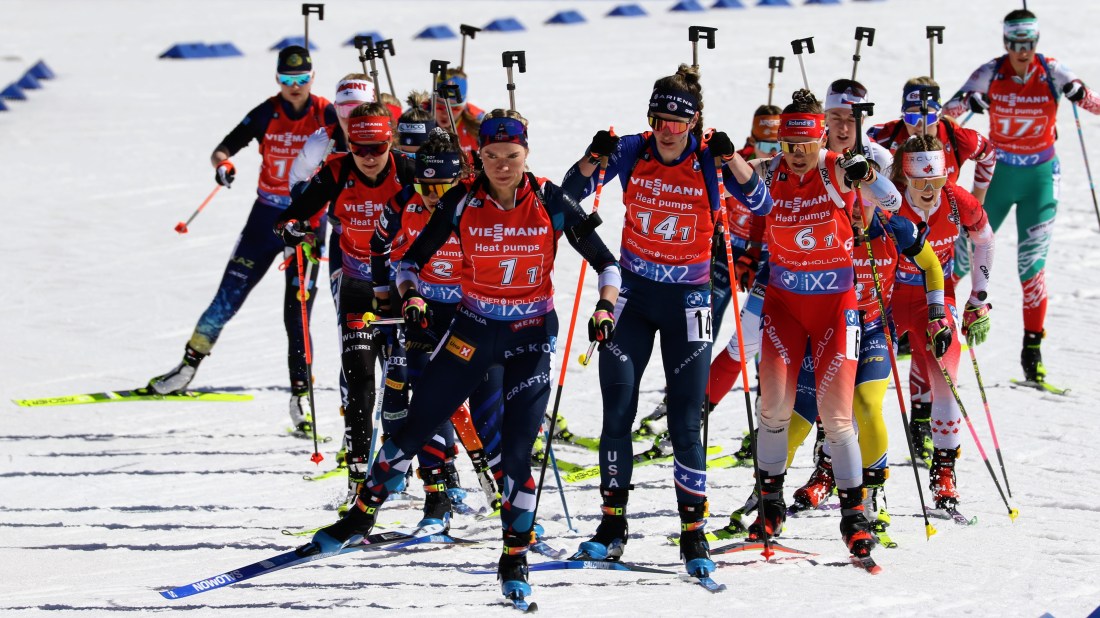
Stranger in a familiar land: Biathlon and community in the Wasatch Back 

“Toooooo-lii Toooooo-mingas”

Tuuli Tomingas might have been the only person more surprised than I was to hear the delightfully alliterative vowels ring out in the Utah afternoon. The Estonian biathlete was several thousand miles away from home, after all, well away not just from her continent but the epicenter of her sport. The International Biathlon Union’s World Cup stop at Solider Hollow Nordic Center in Utah was an outlier. It was one of only two North American stops on a tour that is often exclusively contested in Europe, not infrequently in front of tens of thousands of flag-waving, cowbell-ringing, merrymaking fans. 

Skiing across the course at a leisurely pace toward the shooting range to warm up before her first race of the weekend, Tomingas appeared briefly taken aback to hear the unmistakably American-accented voice bellow her name. In the context of a sport at all its levels, not to mention the macro lens of human population, Tomingas is among the best who has ever lived at what she does. But in the reality of world-class biathlon, she’s just another name, good enough to finish in the top 20 but rarely the recipient of much camera time or a contender for the podium. Accorded a star’s greeting, even without a bib number or the distinctive Estonian colors visible under a warmup top, she waved hesitantly toward the stands. As if not expecting to feel at home here in the Wasatch Range foothills about 20 miles south of Park City. 

She wasn’t the only one. 
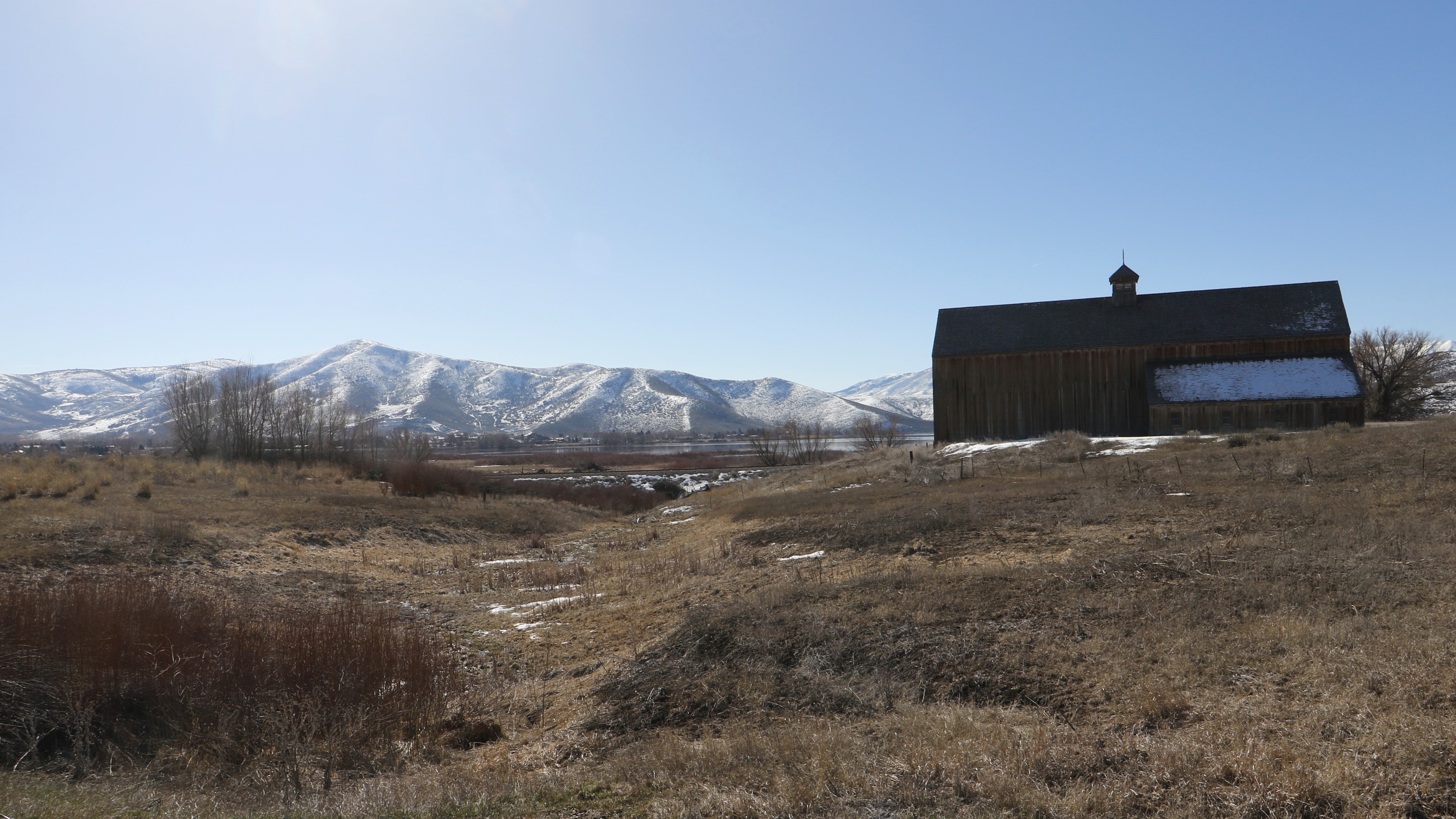
Near the Soldier Hollow Nordic Center in Midway, Utah.

As I’ve written here before, my relationship with biathlon grew from quadrennial curiosity during the Olympics to full-blown fanatic status about six years ago. Dig down and the timing probably isn’t a coincidence, rooted in foreboding about the winds of change with regard to ESPN’s mission and some sense of my own increasing lack of agency therein. I covered the sports I covered because they were passions, not as assignments or lines on a resume. So, when a job ends after a couple of decades, it’s difficult to disentangle professional from fan identity. I no longer really remembered how to enjoy an NWSL or NCAA basketball game as a fan. Watching now sometimes left me edgy. Fan muscles atrophy. Rehabbing them takes time. 

All of which is to say that biathlon, like beach volleyball, was a refuge. A sport I had previously been intrigued by but never (or rarely, in volleyball’s case) covered. Of course, the psychology of it all takes place separate from conscious thought. In real time, it’s just a familiar feeling that draws you in. It’s the routine of competitive sports. The event-to-event, week-to-week routine of a season. Learning the characters—first the names and skill sets, then the histories and personalities, finally the future possibilities. 

But without seeing it in person, at least once, there was something missing. I don’t need to be in a packed arena to watch a basketball game. Considering traffic, parking, tickets and the rest, I’d rather watch on television most of the time. But I know what it feels and sounds like in that arena. I know what the game looks like in person. Biathlon remained an entirely virtual viewing experience. I had a sense the Oberg sisters were tall (as it turns out, sort of) and Teraza Vobornikova was a pint-sized dynamo (confirmed), but it was all relative. What did they look like amongst other people? What happened on the course during all that time the cameras focused on the shooting range? How steep were the climbs, really? What did a ragged volley of two dozen .22 rifles sound like echoing off mountains? 
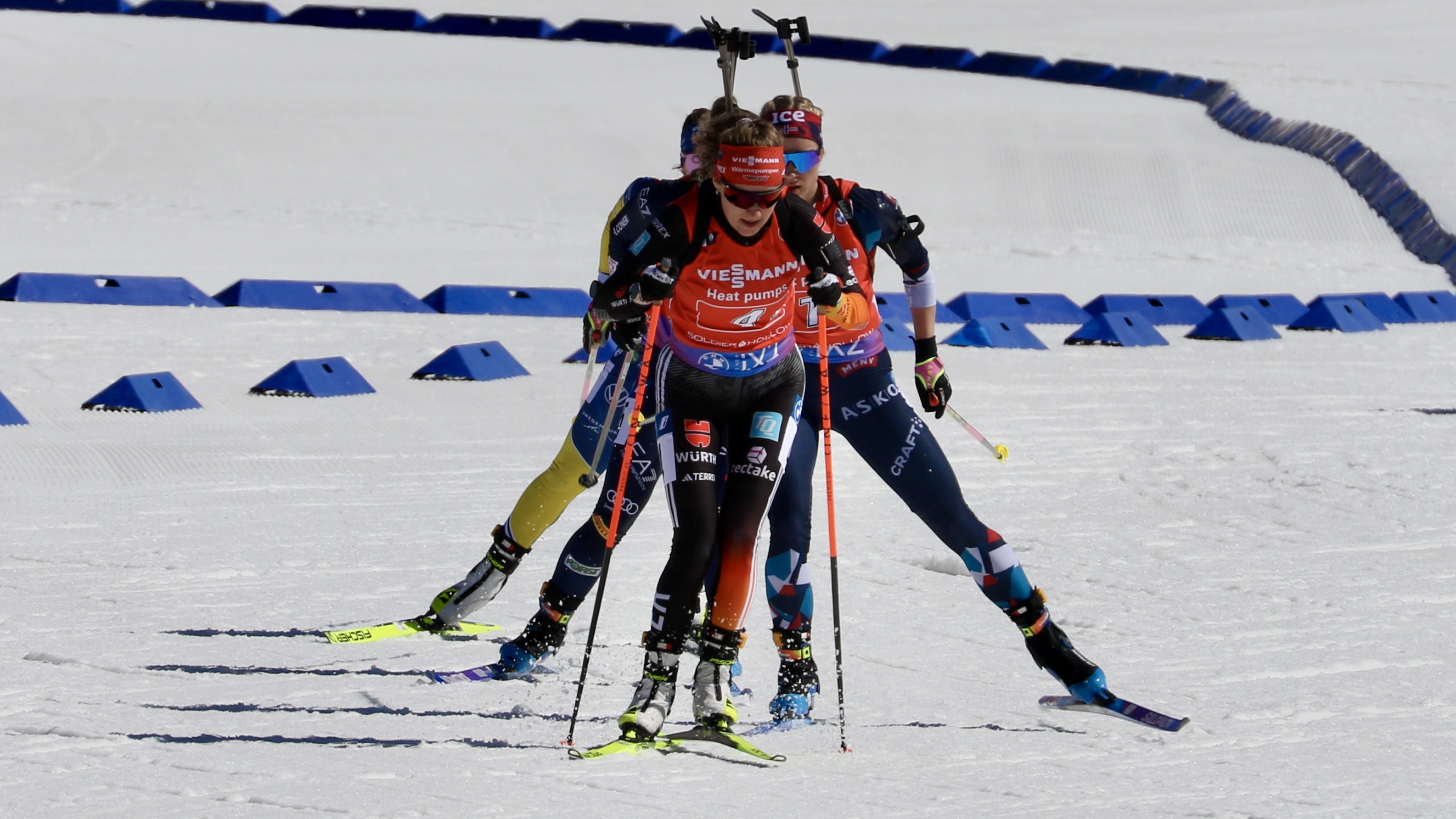
This year’s World Cup schedule featured a stop in Soldier Hollow, the first American stop since before the pandemic. And while some of the classic European stops, with packed stadiums and raucous atmospheres, had appeal as an adventure, Utah felt like a more manageable entry level effort. With only minimal equivocating, and likely without the necessary regard to the impracticalities of taking a long weekend in Utah in the middle of the busy season of two jobs, I decided to find out what it felt like in person and booked a flight to Salt Lake City.  

That others might make the same calculations never really crossed my mind. At home, I watch races alone—sometimes wondering if there is literally anyone else in the state of Indiana streaming a particular race from Ostersund, Sweden, or Ruhpolding, Germany. Even after parking, waiting in line for the gates to open and strolling around the course, I unconsciously assumed the people around me must be either locals willing to partake in anything that came to town, especially on a mild, sunny afternoon, or general winter outdoor enthusiasts, taking a break from their own skiing or snowshoeing endeavors. Anything but biathlon junkies.

Then the voice recognized Tomingas, no casual feat without a bib number and with the distinctive Estonian blue racing suit muted by warmup clothes. 

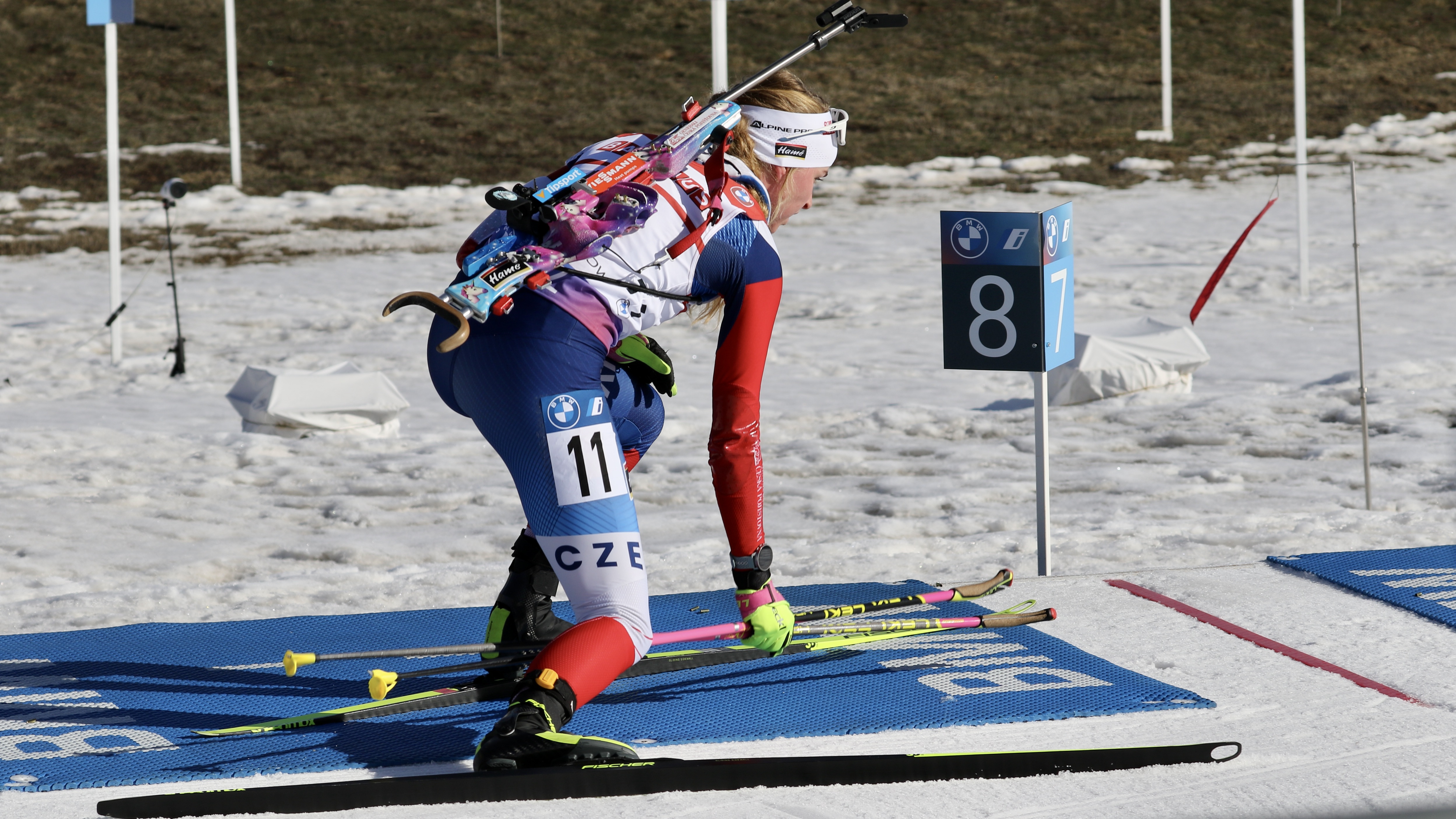
Then came the cheers for Switzerland’s Lena Hacki-Gross and France’s Lou Jeanmannot, the mellow, tattooed rising star who has brought such good vibes to the intense French camp. They welcomed the Czech Republic’s Marketa Davidova—even if they were too far away to recognize the soft-spoken amateur equestrian’s pink unicorn-decorated rifle (much like Nikola Jokic, it’s never entirely clear if Davidova is happier competing for world championships or spending time with her horses in the offseason). 
A few feet up the course from where I stood, a guy about my age and carrying an Italian flag started chatting with an elderly local. The flag-carrying 40-something was from Charlotte, not Cremona. He had started watching biathlon during the Olympics within the past decade and caught the bug. He talked about seeking out the Eurovision and IBU online streams, a routine I know well since NBC dropped the domestic broadcast rights after the 2022 Olympics. 

He talked about cheering for the Italians, most of all Lisa Vittozzi, partly born of following Vittozzi’s struggles with a career-threatening case of the yips. World-class biathletes routinely hit the target 90 percent of the time or better from the prone position, statistically the easier of the two shooting positions (while the target is smaller, laying prone lends more support to a body exhausted by the lap of skiing just completed). The fastest skiers, those who make the transition from cross-country, might be able to survive at 80 percent. During the worst of her yips, which lasted essentially a full season, Vittozzi would regularly miss three or four of the five targets from the prone position. It was painful to watch. 

Vittozzi’s prone shooting woes are a thing of the past.

A few years younger and long in the shadow of countrywoman Dorothea Wierer, who was not just a world champion but the tour’s glamour paragon and an endorsement magnet, Vittozzi was a promising talent who just needed a break. Instead, she appeared in danger of losing her career, not to Wierer or another competitor but the complexities of the brain.  

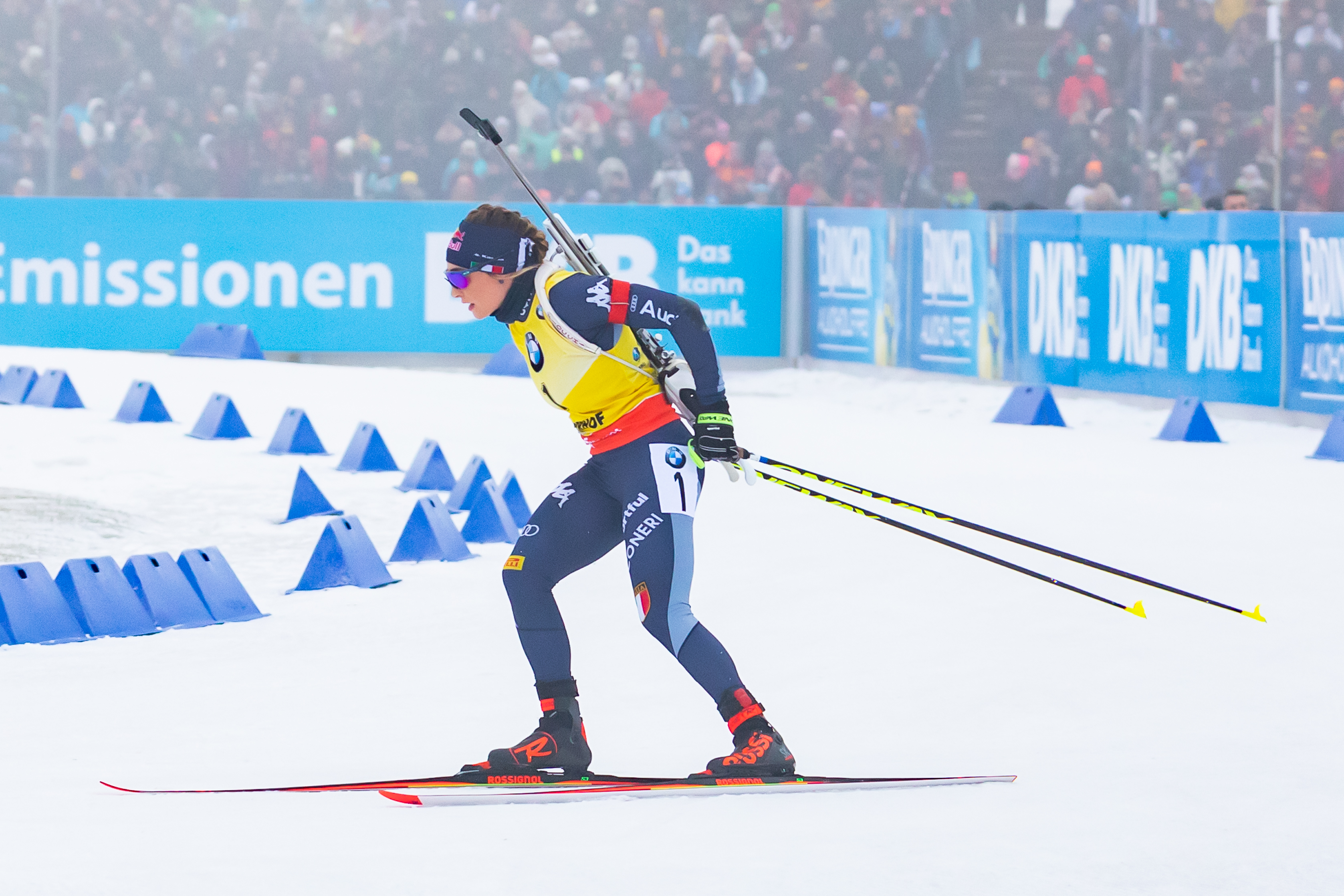
Not exactly overnight, and in all likelihood with a great deal of recalibrating routines, mental mechanisms and soul searching, Vittozzi emerged from her prone shooting woes. In fact, she’s enjoying the best season of her life. In Sunday’s pursuit, she would race France’s Lou Jeanmannot to the finish line, settling for second by inches. With one tour stop remaining after Utah, she remains in contention for the overall world title. And with Italy set to host the 2024 Olympics, when she will still be in her prime at 31 years old, she could be on the verge of the sort of storybook reversal that help make sports so enthralling. 

Skiing past on a warm-up lap before the 7.5 km sprint in which she narrowly missed the podium in a fourth-place finish, she, too, looked surprised to hear the fan with the deeply resonant voice bellow her name from the stands as others cheered. Next to me, my compatriot from Charlotte waved his Italian flag and added his encouragement.
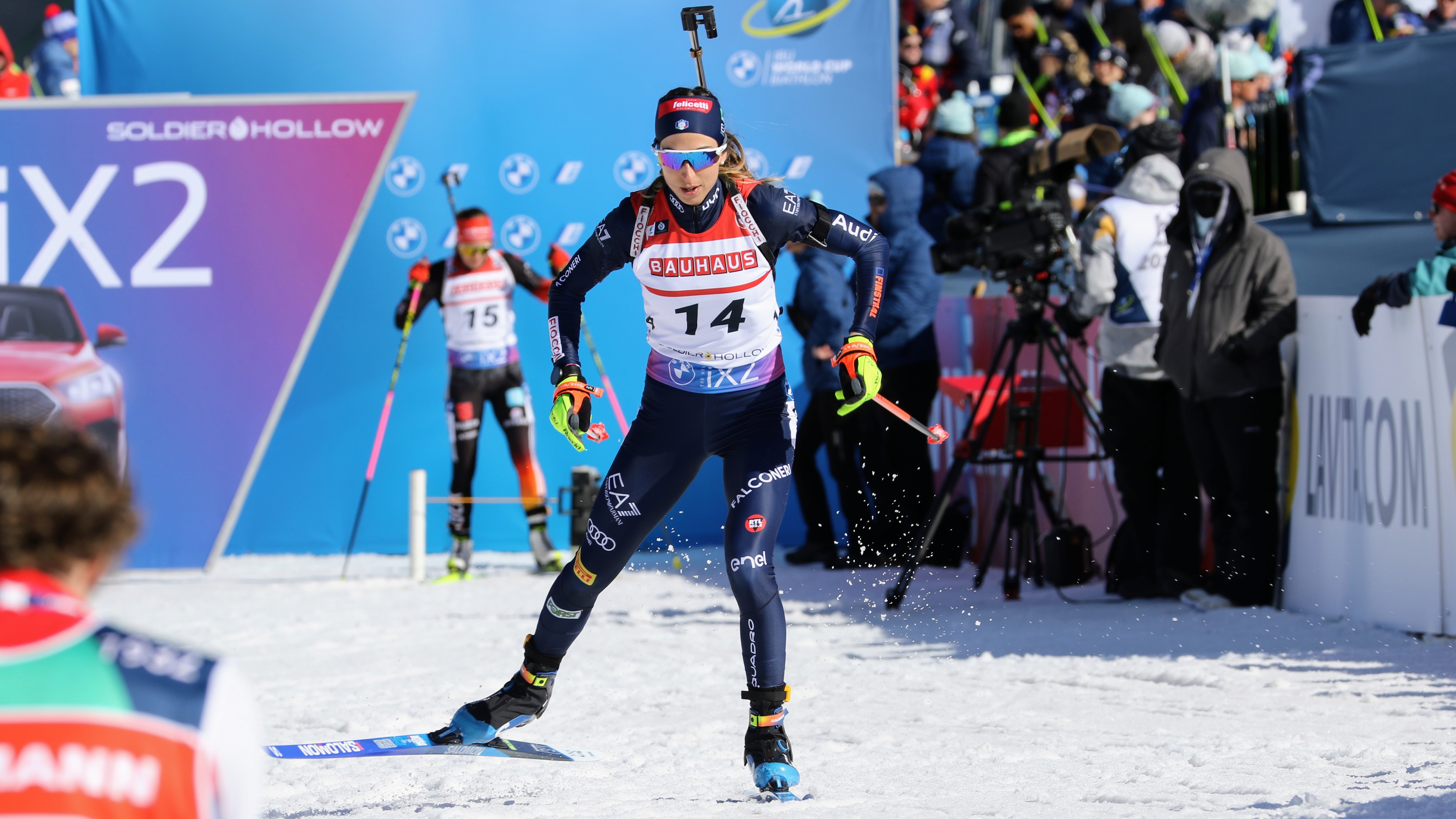
Vittozzi finished fourth in the sprint and second in the pursuit, leaving Utah in second place in the World Cup overall standings.

My camera is something of my talisman, or maybe security blanket, at events. I enjoy photography. That isn’t to say I’m any good at it, or understand many of its subtleties, but I like the challenge of finding the right shot. Something with some artistry that also captures the athleticism and action of the moment. I like editing the photos and letting them run on a digital frame at home. But bringing it with me also goes back to the simple truth that I feel out of place without something to do. I don’t miss deadlines, even the slightly more malleable sort of online writing, but I feel at loose ends without something to do, without purpose. 

So, as the athletes continued to warm up for the sprint, I slipped away from the Italian fan to reclaim a good spot I had scouted during the men’s relay. Out beyond the temporary stands, with an open view of the starting gate for the women’s sprint, it felt like a grey area for access. Would I get moved along? But I wasn’t alone. As they had been during the earlier race, another middle-aged man was there with what their conversation made clear was his son—late elementary school age. My first guess was that one or both didn’t want to waste an afternoon of spring break here, hence the self-imposed isolation. First guesses are often wrong. 

Throughout the earlier men’s relay, the son had kept an eager eye for the Norwegians, currently on a streak of dominance akin to Oklahoma softball. In this race, one of the Norwegians would have as disastrous a performance on the range as it’s possible to have, leaving the team far back in the pack after one leg. They still ended up winning easily. They’re just that much better than everyone else (I enjoy the men’s side of the tour and following it more closely is one of many reasons I look forward to retirement). 

When the son made his way back toward the main body of the crowd at one point, I started talking to the dad. Previewing what became clear soon enough, he told me that as excited as his sons (the other son and their mother joined them for the women’s sprint) were about seeing the Norwegian men, the women’s race was the main attraction. 

Both sons had gotten swept up watching biathlon in the Olympics, infecting the dad in the process. The younger generation gravitated toward the women’s side of the tour, then and even more now the tour with greater parity and competition (and considering Germany’s Vanessa Voigt is more accurate on the range than anyone in the world, man or woman, arguably the greater excellence). For the sons, the day in Soldier Hollow was all about seeing Ingrid Landmark Tandrevold in person. A forgotten Tandrevold banner led to a momentary family crisis. And they greeted each sighting of “Tandy,” as they called her, the same way I reacted to seeing Eric Dickerson or Dominique Wilkins at their age. 

If casual American sports fan have any memory of Tandrevold it’s probably from images of her forcing herself, Zombie-like, to finish a race during the 2022 Olympics before collapsing at the finish line and requiring medical assistance. Collapsing at the finish line is par for the course in biathlon, where athletes push themselves to the physical limit. But the frightening scenes of Tandrevold forcing herself to continue after her body had shut down, followed by a collapse that brought fellow competitors rushing to her side were decidedly out of the norm. 
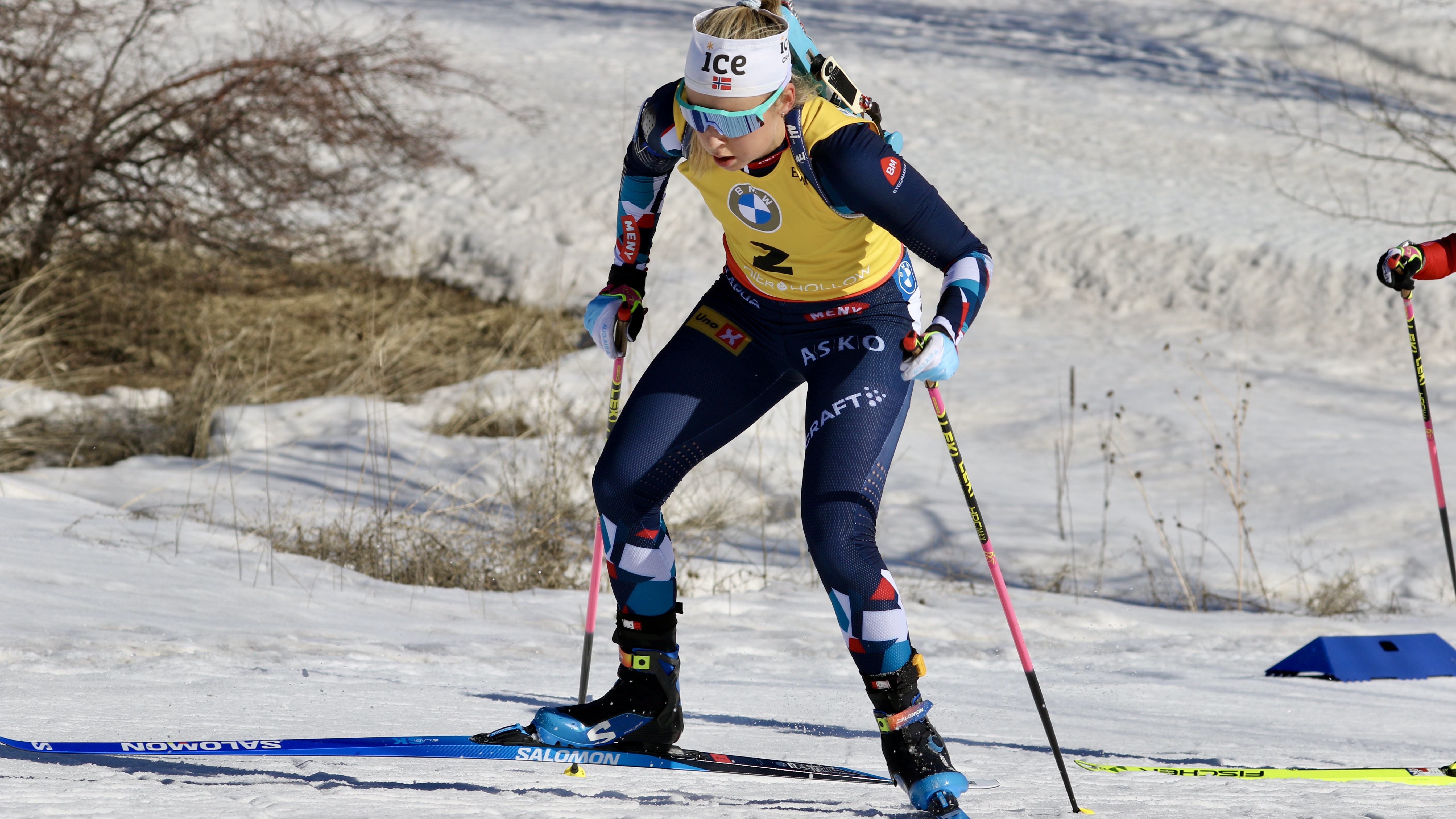
Wearing the yellow bib of the overall World Cup leader, Tandrevold makes her way uphill.

That she would be a favorite for kids is easy to understand. She is every sports narrative wrapped up in one person. She’s a smiling assassin, her charming social media vlogs and easygoing pre-race demeanor belying ruthless competitive instincts once the race begins. She is both Goliath, the No. 1 racer for Norway, and David, thrust into that No. 1 role after languishing as understudy to Tiril Eckhoff, her friend and mentor, and Marte Olsbu Roiseland, the all-time greats who both retired somewhat abruptly prior to this season. 

At 27, even as she enters next week’s season finale atop the World Cup standings, she’s trying to shake off the same sort of skepticism that greeted an athlete like Caroline Wozniacki when she ascended to No. 1—that she’s very good and very consistent but not truly great. Not as dazzling on the range as Julia Simon when the Frenchwoman is at her best, nor as elfin on the skis as Justine Braisaz-Boucher, another Frenchwoman. 

But to two kids from Utah, she was a god among mortals, every approach accompanied by “Here comes Tandy” as soon as she came into view far down the course and every shot on the range punctuated by leaps of joy or pained groans. She settled for second in the sprint, unable to match a dazzling skiing performance from Braisaz-Bouchet but progressing steadily toward the overall world title.

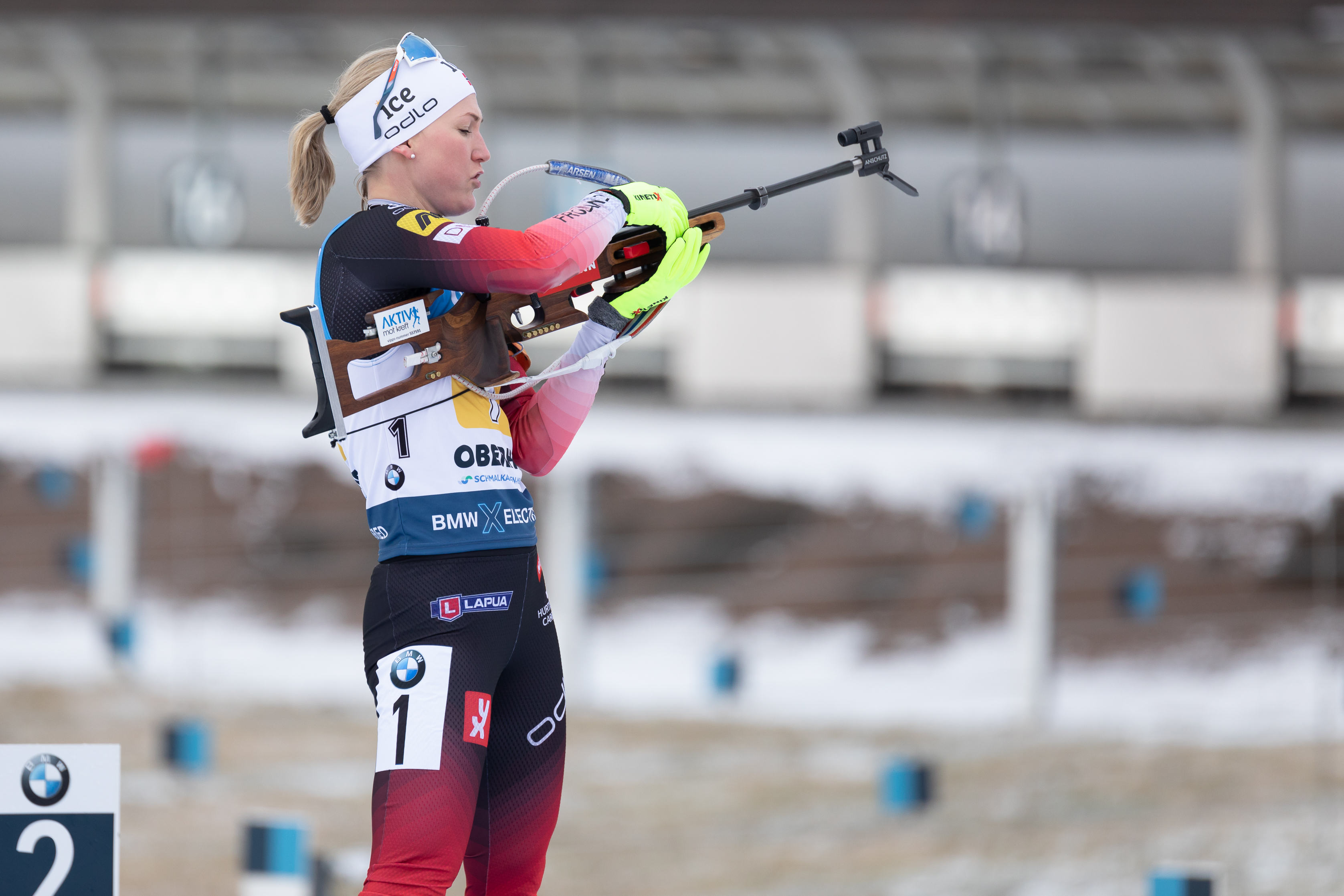
The next morning, after getting scolded by an IBU official for, as best I could discern, not looking sufficiently sophisticated to have access to the spectator portion of the shooting range, I set up shop behind the Czech and Italian encampments. Covering some portion of the final hour before the start of a race, “zeroing” is essentially range practice that allows the athletes a final opportunity to adjust their rifles to wind and atmospheric conditions. It’s only slightly more exciting than that sounds, like watching shootaround before a basketball game (not involving Steph Curry). But it is a good opportunity to take photos of shooters in action and observe interactions between teammates and coaches from a few feet away.  
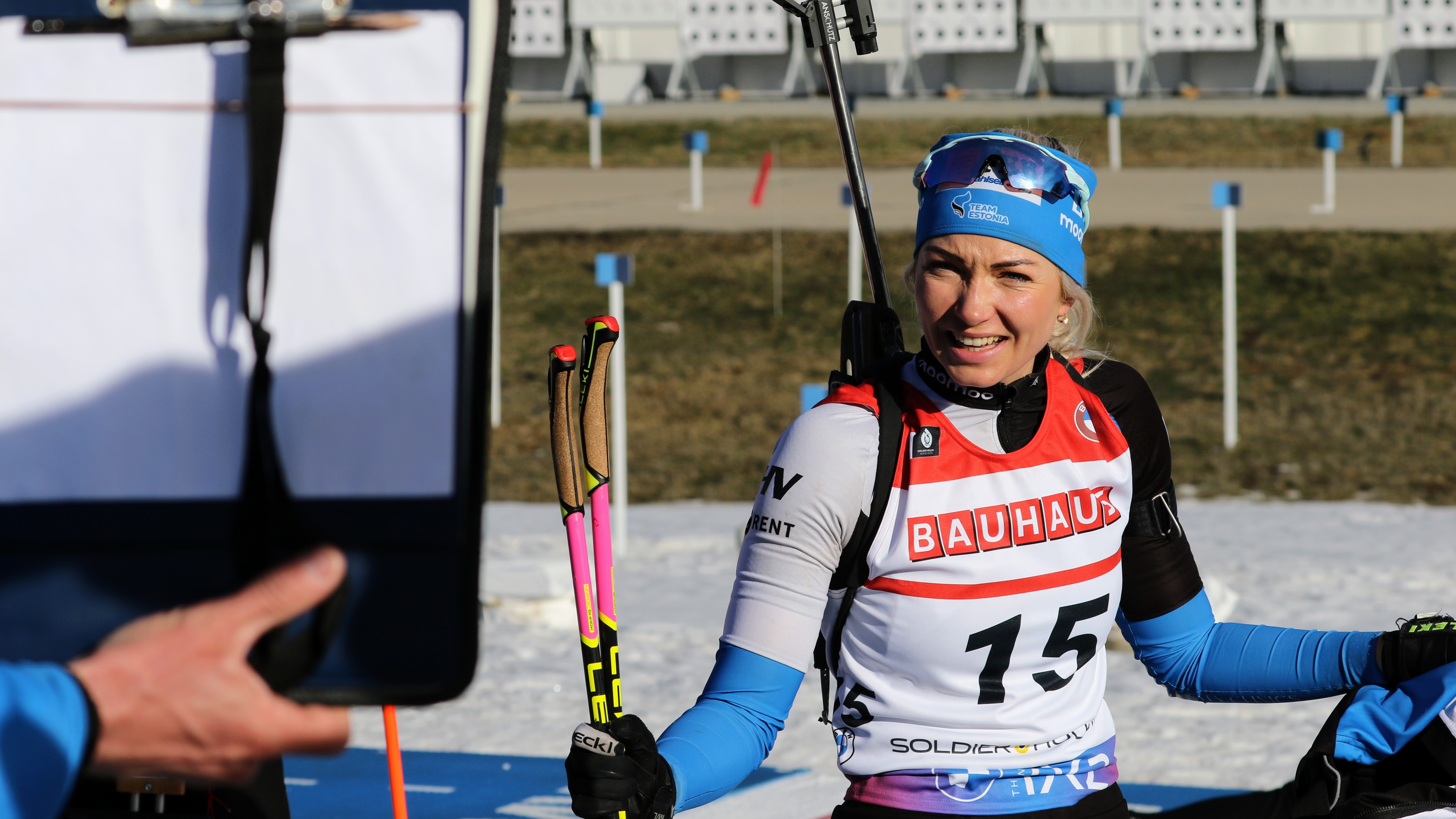
Estonia’s Regina Ermits studies a coach’s board showing her shots during zeroing.

While waiting for the whistle that announced the range was open, another fan with a camera (finally someone slightly older than me, welcome proof that this was still possible) claimed an empty space alongside me. Having missed Friday’s races, he was eager for information on the venue layout and photo opportunities. 

We got to chatting about biathlon—his son, now an adult, had competed in the sport growing up. I picked his brain about costs and entry barriers (not surprisingly, it’s not cheap, although perhaps more affordable than downhill skiing). At my urging, he attempted to impart some knowledge about the waxes used on the skis. I proved a poor student. 

He had driven down from Idaho, missing out on Friday’s races during the drive and begging for no spoilers when I started to mention how good Braisaz-Bouchet had been in winning the sprint despite missing one of her 10 shots (a difficult feat that requires supreme speed on the skis to make up the lost time). He was disappointed to learn the Italians hadn’t included Vittozzi on the start list for the second day’s women’s relay, resting her during the condensed three-day schedule. The clear takeaway from this trip: everyone roots for Vittozzi.

The final day’s early start time compounded by turning the clocks ahead the previous night, Sunday arrived with the same feeling I always had by the end of covering tournaments—that the real fun had been in the early rounds, settling the championship almost a matter of bookkeeping. But as was often the case, whether courtesy of Carli Lloyd, Arike Ogunbowale or Taryne Mowatt, the final act always has the potential to take on a life of its own. So it was, watching from the top of one of the major climbs as Vittozzi and Jeanmannot raced down the final straightaway in a rare sprint to the finish line.
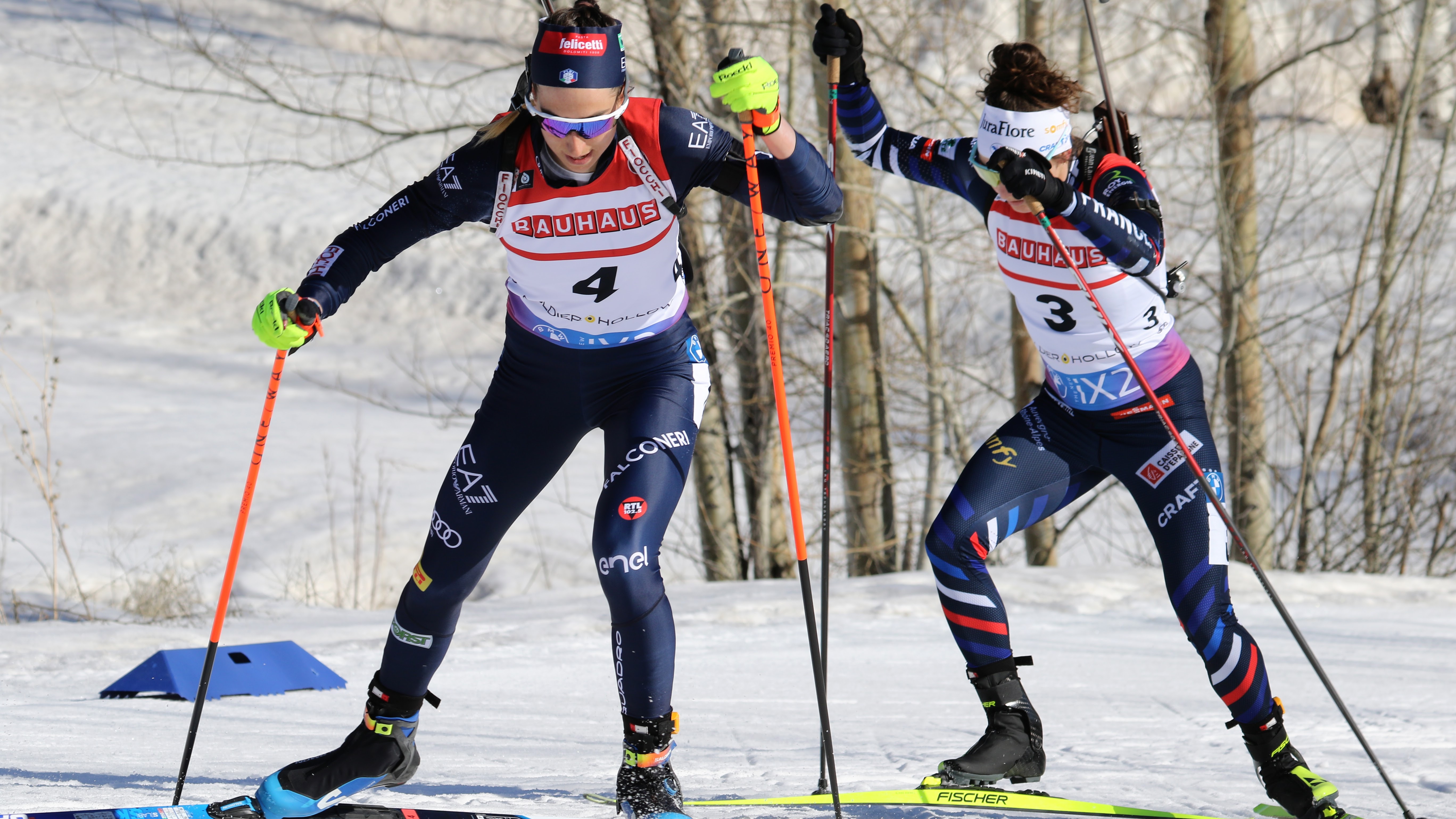
Vittozzi (4) and Jeanmannot (3) battle for first place on as ascent during the final lap of the pursuit.

Making my way back down to the center of things for the awards ceremony, I assumed that was where the story would end, Jeanmannot inching ahead to claim victory. Watching the stream, it would have ended there. But here, one more memory awaited. 

It would make for a good narrative if the rich, baritone voice that rang out from the other side of a post on the second-floor deck during the awards ceremony was the same voice I had heard Friday afternoon. It sounded familiar. Sadly, reporting ruins all the fun. The owner of the voice had not, in fact, been out on the course Friday. Still, it might have sounded familiar to someone else, too. As the awards ceremony wound to a close, the elongated vowels caught the attention of the day’s surprise sixth-place finisher (the top six are honored, three on the podium and three off). 

The tall figure looked up in search of the voice and waved, this time not surprised to hear it. 

“Toooooo-li” 

It didn’t matter that it was Utah. She was among people who understood.
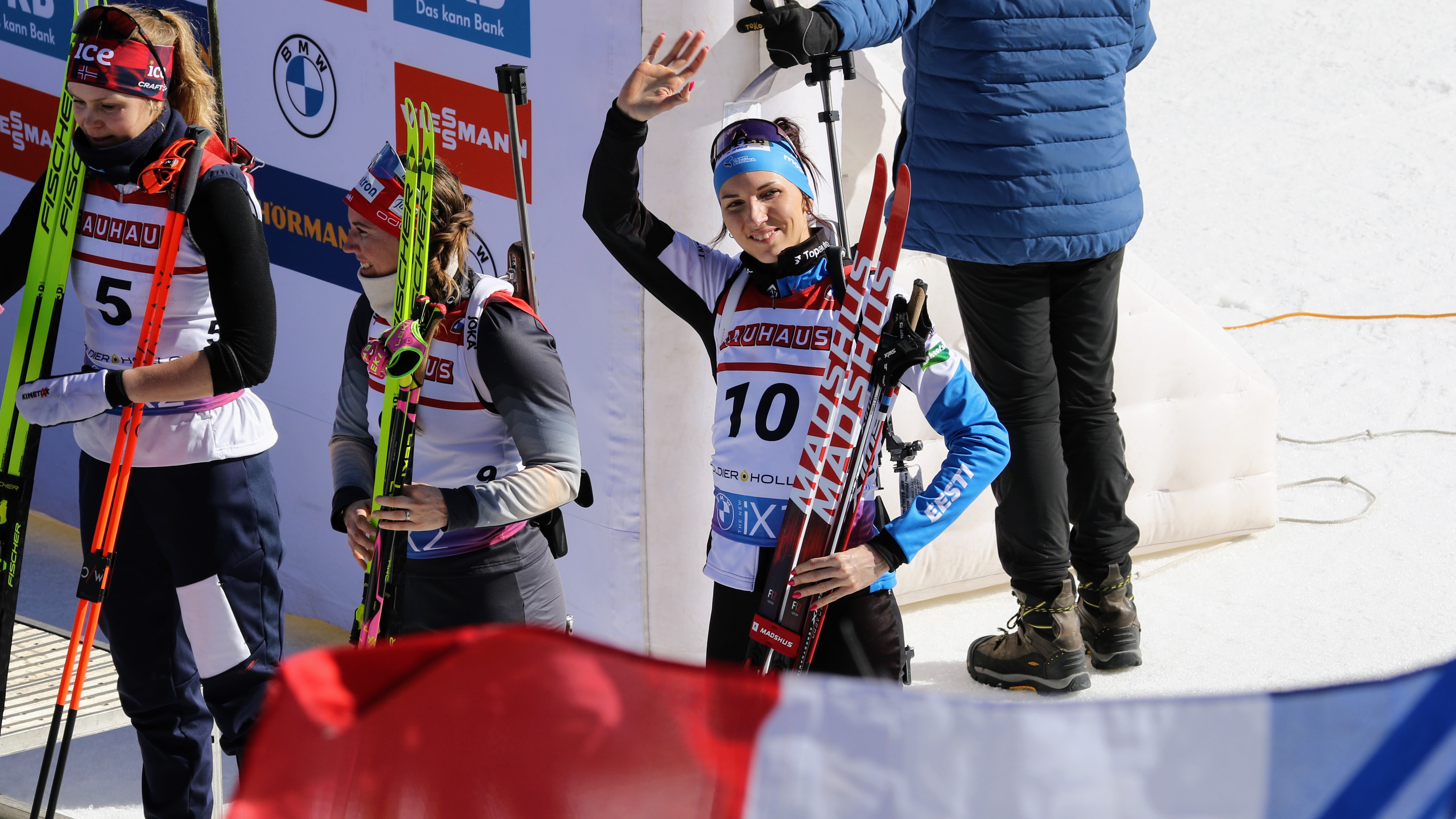
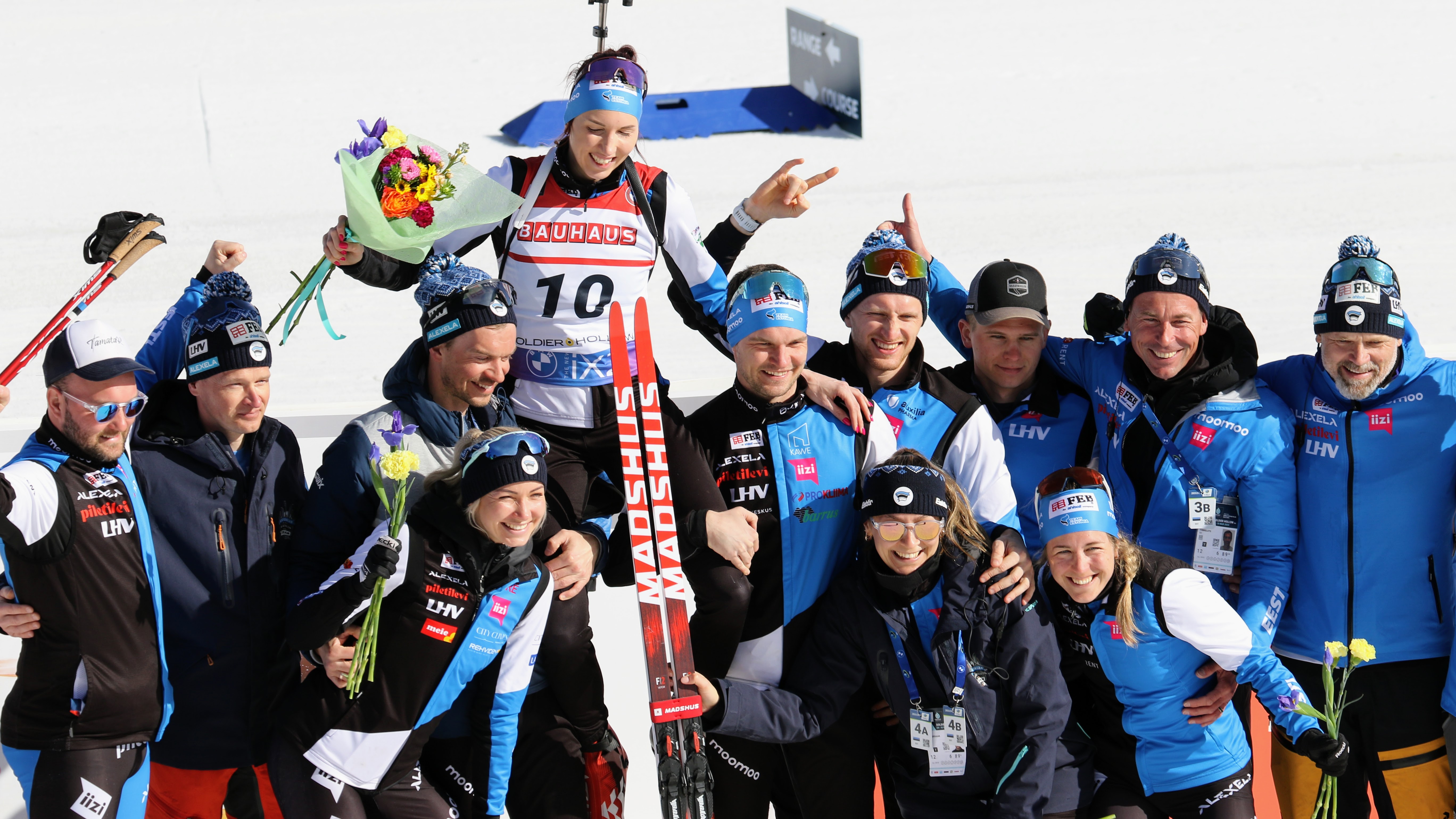
What does sixth place mean? When it’s a career-best finish, it means an opportunity for Estonia to celebrate.

The Greatest Story on Snow: Olympic Biathlon

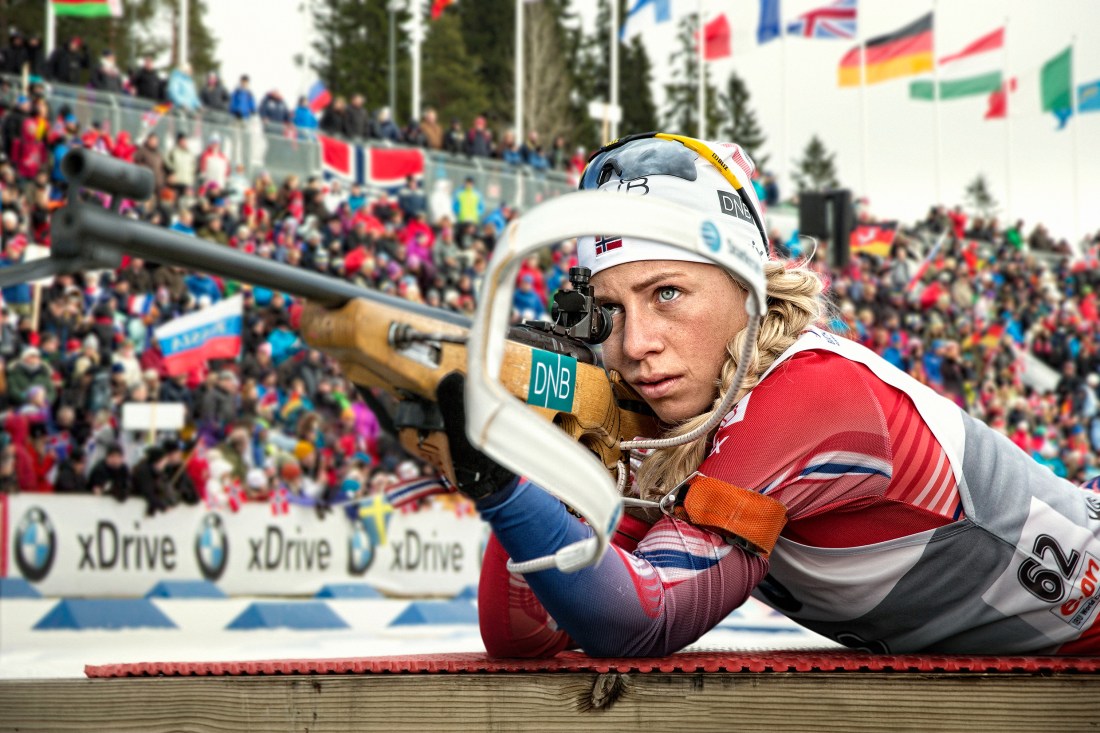
(Photo above of Tiril Eckhoff, courtesy of BillyBonkers/Norges Skiskytterforbund)

It used to be that setting the alarm for 4 a.m. meant an early morning trip to the airport. These days, my only travels are to the living room to watch the women’s 15 km individual race, the opening individual event of Olympic women’s biathlon competition. At least I don’t even have to put on my shoes, let alone take them off for TSA. And the coffee is cheaper.

I love biathlon enough to set the alarm, and I’m not sure why. I have no more expertise in the sport than the person who calls AAA to change a flat tire (also me) has watching Formula 1. 

I love skiing, but all I know of the cross-country version is more or less limited to trying to get from one lift to another at the base of a (downhill) ski resort. 

And that’s still vastly more experience than I possess in trying to hit five targets from 50 meters with a .22 caliber rifle. In the wind. And the cold. I mean, it looks difficult? And given my accuracy when I try to throw a shirt in a laundry basket that is considerably closer than 50 meters, I’m guessing I wouldn’t hit biathlon’s 1.8 inch target (from the prone position) or 4.5 inch target (when standing) more than 80 percent of the time, as Olympic athletes do. 

Despite that deep reserve of ignorance, the sport always intrigued me during the Olympics. And since discovering that NBC (now Peacock) streams World Cup events, I watched more or less every women’s World Cup race the past three seasons. Returning from an early morning walk, settling in with a cup of coffee and “traveling” to snow-covered forests in Oestersund, Sweden or Hochfilzen, Austria makes a week of stress disappear for an hour or two.

Until recently, those streams were just the raw video production without any commentary. While I eventually noticed that replays on the Olympic Channel included announcers, learning the sport while hearing only natural sound added something to the experience. At least for the World Cup circuit, there are microphones immediately below some of the shooting stations. It is mesmerizing hearing how hard the athletes are breathing when they arrive, only to slow their heartbeats and manage their breathing in a matter of seconds to begin shooting. That gets lost if someone is talking over it.

Some of my favorite people in media are announcers, and for all the grief they get, they work extremely hard to pass on knowledge and information. But biathlon is visually captivating. I never understood how people made sense of all the information constantly flashing across the bottom and side of the screen on CNBC. But watching biathlon, you slowly learn to speak a similarly unique language — reading time splits at the same time you’re watching a dozen shooters on the range. There’s a lot going on, and it’s entirely possible that some of attraction was in learning (an ongoing process) to piece together the puzzle and what it all meant. 

That also leaves a lot of room for mistaken impression. Believe me, after “doing my own research” on biathlon, I’ll yield to the experts when it comes to strategy, technique, rules, history and, well, just about everything. But sports isn’t just about understanding technical excellence or athletic prowess. It’s also a story. It’s drama. Not manufactured drama or hot air debates but genuine drama — as in theater. 

That’s what any sport really is over the course of a season or seasons, a recurring production with the same characters and ever-changing plot lines. Go see Othello in the theater and you’re going to see amazing characters tell an amazing story. But while brilliant, it’s the same story every time. In sports, it’s different every game or every race. And sure, some of the stories end up being duds. But each one has the potential to be the best story ever told. 

After several years, I’ve come to know the characters who will compete in the biggest races of their lives over the next two weeks. They’re rivals and friends, alternately heroic and hapless. I can’t help you much on the nuances of the sport. I can’t tell you anything about which team has the best wax technicians. The announcers in the opening mixed relay event, won by Norway in a dramatic finish, said the venue in Beijing has slow snow. I don’t think they meant slushy, given the frigid conditions, so I can’t really help you with what that actually means. 

But the characters? If you’re interested in a new story, I can help you there. Consider this your theater program, a list of the cast that might win you over if you tune in.

It’s worth it. Coffee tastes better before the sun comes up.

Norway’s Marte Olsbu Roeiseland (courtesy Steffen Prößdorf)

Those likable Norwegians

The Norwegians should be the ones who the casual fans root against. They’re the Yankees or UConn. Historically speaking, at least according to some of the sport’s origin stories, it’s their sport. But darned if the current Norwegian team isn’t likable to a fault. 

At least if you aren’t the ones trying to keep up with them on the course. 

The best biathlete in each of the past two seasons races for Norway, but it isn’t the same person. Current favorite Marte Olsbu Roeiseland and reigning World Cup overall champion Tiril Eckhoff bring very different stories to Beijing. 

Roeiseland is a bit of a terminator. This season, she hits the target 92 percent of the time from the prone position and 93 percent from the standing position — the only athlete among the top contenders currently at 90 percent in both. She’s also able to chase just about anyone down on the course. And yet it’s difficult to begrudge her the success. Now 31, she wasn’t the great hope of Norwegian biathlon. She toiled on the fringes of the elite for several seasons before really coming to the forefront during the 2018-19 season. And she speaks and carries herself like someone who appreciates the journey, always eager to congratulate those around her (admittedly easier to do when you’re often congratulating them on finishing behind you). 

Eckhoff is no less engaging, often playing the leading role in teammate Ingrid Landmark Tandrevold’s amusing chronicles of life in biathlon. And last season, she was no less dominant, cruising to the overall title and winning 13 races — 10 more than any other athlete. Small even in comparison to her peers, she is explosive on her skis. But the new season hasn’t been as kind to the 31-year-old. She has yet to make an individual podium, let alone win a race, and entered the Olympics hanging on to a place in the top 20 of the overall standings. 

Hanna Oeberg congratulates sister Elvira Oeberg.

Sweden’s Venus and Serena dynamic 

Hanna Oeberg was the breakout star of the 2018 Olympics, opening the women’s competition by winning gold in the 15 km individual race without missing any of 20 shots on the range. She won that race before ever winning on the World Cup circuit, but she has six more wins and 25 more podium finishes in World Cup and World Championship events in the years since. 

Long and lanky, she seems built for purpose — able to generate tremendous power while appearing to glide. Still just 26 years old, she could rule the sport for years. 

But one of the stories of this season is the Serena and Venus dynamic emerging as her younger sister comes into her own. And until this season, Elvira Oeberg was very much Hanna’s younger sister. Just 22 years old (she’ll turn 23 later this month), Elvira hadn’t won a World Cup event until winning the 10 km pursuit in Annecy, France on Dec. 18. Then she won again the next day in the 12.5 km mass start. And three weeks later in Ruhpolding, Germany in the 7.5 km sprint. That matched her sister’s total wins from the past two seasons combined. 

The first win was particularly impressive. When I started following the sport, I assumed shooting rules all — that the skiing was just to kill time between rounds on the range. The broadcasts, which focus heavily on the action on the range, often make it seem that way. And shooting is huge. But Elvria, whose 80 percent accuracy from the prone position is still a weak spot, won her first race despite missing two shots. That was one more than viable contenders like Julia Simon, Anais Bescond and Austria’s Lisa Theresa Hauser. Yet the younger Oeberg was so relentless over the 10 km of skiing that it didn’t matter. 

So will Elvira complete her ascent in Beijing, leaving Hanna to play the role of Elvira’s sister? 

The Belarus conundrum

One of the storylines that hooked me on biathlon was following Darya Domracheva’s roller coaster in 2018. After winning three of the four individual gold medals in 2014, Domracheva missed significant time in the years that followed, due first to illness and later pregnancy. Her attempt to complete the comeback with more Olympic medals was presented as one of the main narratives in 2018. She struggled in the early races but closed out her career by winning an individual silver in the mass start and a gold medal in the relay. 

All of which is to say I was inclined to keep an eye on what happened to the Belarusian story following her retirement. Sure enough, Dzinara Alimbekava and Hanna Sola emerged as two of the easiest athletes to root for. Alimbekava is relentlessly steady, quietly going about her business and almost always finishing in the top 10 (if rarely atop the podium). And Sola appears to have come almost out of nowhere to join the elite, a recent dip in form notwithstanding. 

It would be great to see either follow in Domracheva’s footsteps — if it wasn’t for the regime currently commandeering their country. Once dubbed Europe’s last dictator, an overly optimistic assessment of the future of democracy, Alexander Lukashenko remains in power and remains an autocratic thug. How much should that matter when it comes to watching sports? Should an athlete be responsible for the sins of a political regime? I don’t know what either Alimbekava or Sola think of Lukashenko. If they want to continue skiing, I don’t imagine it would behoove them to speak out even if they felt as aggrieved as the tens of thousands who protest in Minsk. 

Cast agains the backdrop of an entire Olympics swathed in moral and ethical shortcomings, I don’t know how I’m supposed to feel about two imminently likable Belarusians. 

Italy’s Dorothea Wierer (courtesy Steffen Prößdorf)

The Italian legend of Dorothea Wierer

Wierer gives off a little bit of an aura of who Hollywood would cast in a movie about biathlon — when Wierer was late for a press conference, Eckhoff joked that she had probably already left the venue by helicopter. But with three golds from the World Championships and 15 World Cup podium finishes, Wierer is more substance than style. 

She’s a good skier relative to the bulk of the world circuit, but she’s not on the same level as the Norwegians or Swedes. She’s not going to chase down an Oberg. But when she’s at her best, no one is more fun to watch on the range. She rolls through five shots in the blink of an eye with unnervingly accuracy. She wasn’t as accurate or as quick early this season, which seems like it could be the 31-year-old’s farewell campaign. But she won the 12.5 km mass start on Jan. 23, the final race before the Olympics (admittedly when several top peers were already in high-altitude training for Beijing). Her first Olympic individual medal would be a fitting capstone. 

The French Connection

The French are excellent in biathlon. They’re the only country with three women ranked in the World Cup overall top 10 at the moment. I am quite fond of France in general. Given that Denmark, my first rooting interest in all things, is the Scandinavian outlier when it comes to biathlon (not enough snow), I ought to default to cheering for the French. 

Here’s the thing. I have a difficult time telling the French skiers apart. They don’t look alike, mind you, but to my untrained eye, Anais Bescond, Justine Braisaz-Bouchet and Julia Simon seem to take turns contending one week and fading into the pack the next week. I’ll start to think that Simon is clearly the best of them, only for Bescond to end up on the podium the next time out. Like Arizona State or Rutgers in women’s basketball back in the late 2000s or early 2010s, they’re impossible not to respect but somehow also not consistently memorable. 

Perhaps because she’s the least consistent of them, Braisaz-Bouchet is the most compelling. She’s a dominant skier; she can make up 30 seconds on most of her peers in the span of a lap. She’s also a supremely inconsistent shooter — 74 percent accuracy from the prone position this season, which is 20 percent worse than a model of consistency like Alimbekava. I assume this keeps the French coaches up at night, but it makes her an intriguing boom-or-bust wild card. 

Germany’s Denise Herrmann won gold in the 15 km individual.

The German Two-Sport Surprise

I didn’t even mention Germany’s Denise Herrmann initially because, let’s face it, this is already longer than anything without chapters needs to be. Then the 33-year-old went out and won gold in the 15 km individual, missing just one of 20 shots.

A former cross-country skier who even won an Olympic medal in that sport in 2014 and then shifted to biathlon, Herrmann was overshadowed by countrywoman Laura Dahlmeier before the latter retired after winning double Olympic gold in 2018. I think I often underestimated Herrmann because she wasn’t as prolific as Dahlmeier. She wasn’t the best German I’d seen. To be fair, Monday’s win also came against form. Herrmann entered these Olympics just 18th in the overall World Cup standings and hadn’t won an individual race at any distance during the pandemic.

Herrmann’s final appearance before the Olympics hardly hinted at what was to come. Most of the German team skipped the final World Cup stop in order to train at high altitude. But Herrmann had to leave that training and enter the final race in Antholz, Italy to try and save her place in the top 15 in the overall world standings — those athletes automatically qualify for the mass start in the Olympics. It didn’t work, a poor finish in Antholz cost Herrmann the final place in the top 15 (which went to Norway’s Landmark Tandrevold). After Monday’s gold in the individual, it’s safe to say she found another way into the field for next week’s mass start.

All evidence suggested an athlete entering what is presumably her final Olympics and who had missed her window for glory. Instead, after two difficult years, Herrmann completed the journey that began when she changed sports by winning the biggest race of her life.

Again, you never know what role a character will play when a new story begins.


And here are the women’s individual competitions. 

Monday: 15 km individual. Five laps with four shooting stops, two prone and two standing. Skiers start one at a time, 30 seconds apart. The fastest overall time wins. 

Friday: 7.5 km sprint.  Three laps with two shooting stops, one prone and one standing. Skiers start one at a time, 30 seconds apart. The fastest overall time wins.

Feb. 13: 10 km pursuit. Five laps with four shooting stops, two prone and two standing. First to the finish line wins. The start is based on times in the sprint. So if you finished 20 seconds behind the sprint winner, you start 20 seconds after she does in the pursuit. 

Feb. 19: 12.5 km mass start. Five laps with four shooting stops, two prone and two standing. As the name implies, the top 30 skiers start at the same time. First to the finish line wins.