I’m no more fluent in philosophy than Norwegian or Swedish. I signed up for a philosophy course in college, but if a lecture falls at 8 a.m., does it make a sound? Not that I recall.
Aristotle, Descartes and the rest aren’t wholly unknown names, but I’m on much firmer footing when it comes to debating Mays and Aaron or differentiating Stiles from Catchings.
That also holds true for Søren Kierkegaard, who I’ve spent more time thinking about in the last month than the preceding four decades. The Danish philosopher came up often in the cultural histories of Scandinavians and the Nordic region that I read before a trip to Sweden and Norway. Previously, the name triggered little more than a vague connotation with the sort of melancholic bleakness that pervades Nordic crime fiction. As usual, a fuller picture of his times and work made me curious for more.
I just didn’t expect to run into him at Skansen Kronan, the 17th century fortress that sits atop a hill overlooking much of Gothenburg.
I never recall feeling uncomfortable with heights as a kid. Maybe that’s just memory editing, but I remember loving all towers, observation decks, gondolas, etc. I could—and did—ride roller coasters from the time an amusement park opened until last call. But somewhere along the way, increasingly over the past 10-to-15 years, I’ve grown decidedly skittish at even the suggestion of open, elevated spaces. In Edmonton a couple of years ago, I forced myself to walk across the Waterdale Bridge, which soars over a ravine. But I couldn’t bring myself to pause long enough to take a photo, unsure I could get my legs in motion again.
It’s an irrational fear (maybe most are). As best I can tell, it’s not specifically a fear of falling. Nor is it height alone—the steerage seats are the only part of flying that bothers me. It’s just an overwhelming sensation of openness on too many sides that leaves me frozen.
Those are the physical manifestations, but it feels somehow more all-consuming. Perhaps life feels naturally limitless when you’re young, so the boundlessness of height is the world as it should be. Whereas with age, as I become ever more aware of the limitations of time and possibility, those same open heights somehow feel more daunting, even threatening.
More to the point, perhaps the boundless physical space forces me to confront such a pure distillation of my own fears about the limits of time and possibility that I short circuit.

On this particular day, it hit me walking to the top of the path leading to the Skansen Kronan. The paved path was steep—the sort of path cut centuries ago when no one from health and safety needed to sign off. It was a cold, wet and windy morning, and as these things go in Gothenburg in January, still a long way from dawn offering any natural light. So, not ideal conditions for a stroll. But this also wasn’t the final ascent on Everest. It was maybe five minutes and half a dozen switchbacks. No big deal. But with each turn, and for reasons that had nothing to do with the incline, the next step was harder and harder to take.
Soon, even with the top in sight, it was too much. I knew I could push on. Ascending is always more manageable than descending. But I wasn’t sure I could force myself back down, and that was going to make it decidedly difficult to catch my train to Oslo later in the morning. Frustrated at missing a good view and a good picture, I turned around.
Maybe Kierkegaard had it right.
“Anxiety may be compared with dizziness. He whose eye happens to look down into the yawning abyss becomes dizzy. But what is the reason for this? It is just as much in his own eyes as in the abyss. … Hence, anxiety is the dizziness of freedom.”
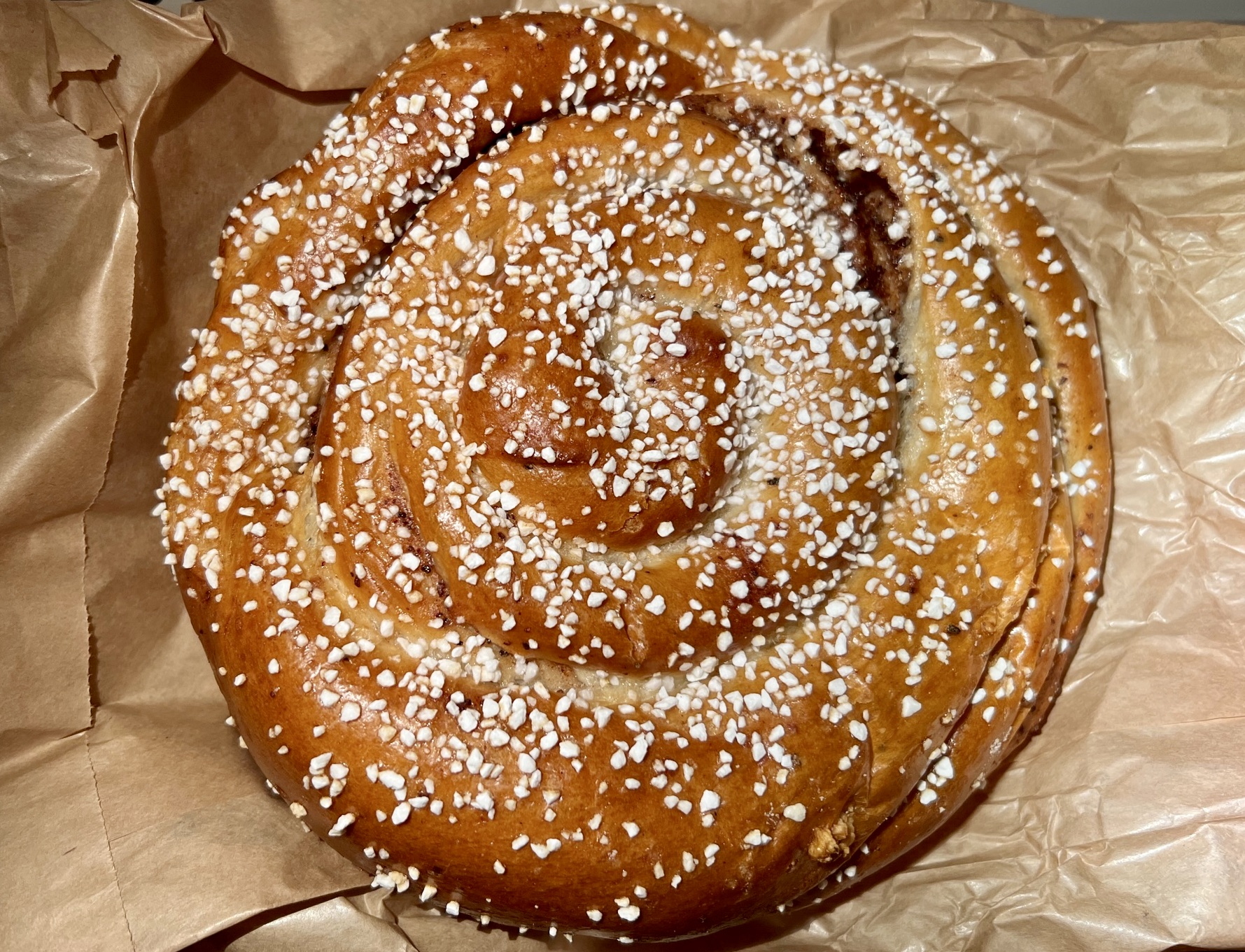
Back on level ground, I set off in search of Café Husaren’s giant cinnamon rolls.
Because as philosophers go, I still find the greatest solace in Douglas Adams. There may be as many existential crises in the “long dark teatime of the soul” as there are in Kierkegaard’s universe. But the world feels more sensible with coffee and a bun.

 Graham Hays