THE HAGUE, Netherlands — The ascent is everything in sports. Athletes and teams rise to the occasion. They climb the mountain and scale the summit. Many of us just invested two weeks binge watching the phenomenon in its most concentrated form. From archery to volleyball, the Olympics are all about ascent—the four year journey to qualify and the handful of moments when, like Swedish pole vaulter Mondo Duplantis, someone literally soars to unmatched heights.
The descent gets less attention. Not a decline or fall, mind you. There is as much drama in calamity as in greatness. People will watch a comeuppance with glee. They’ll shed tears over genuine misfortune. But for most athletes who ascend to some achievement or moment of excellence, the necessary descent is more mundane.
People write books about climbing Mt. Everest. What happens the day after they return home gets an afterword, at best.

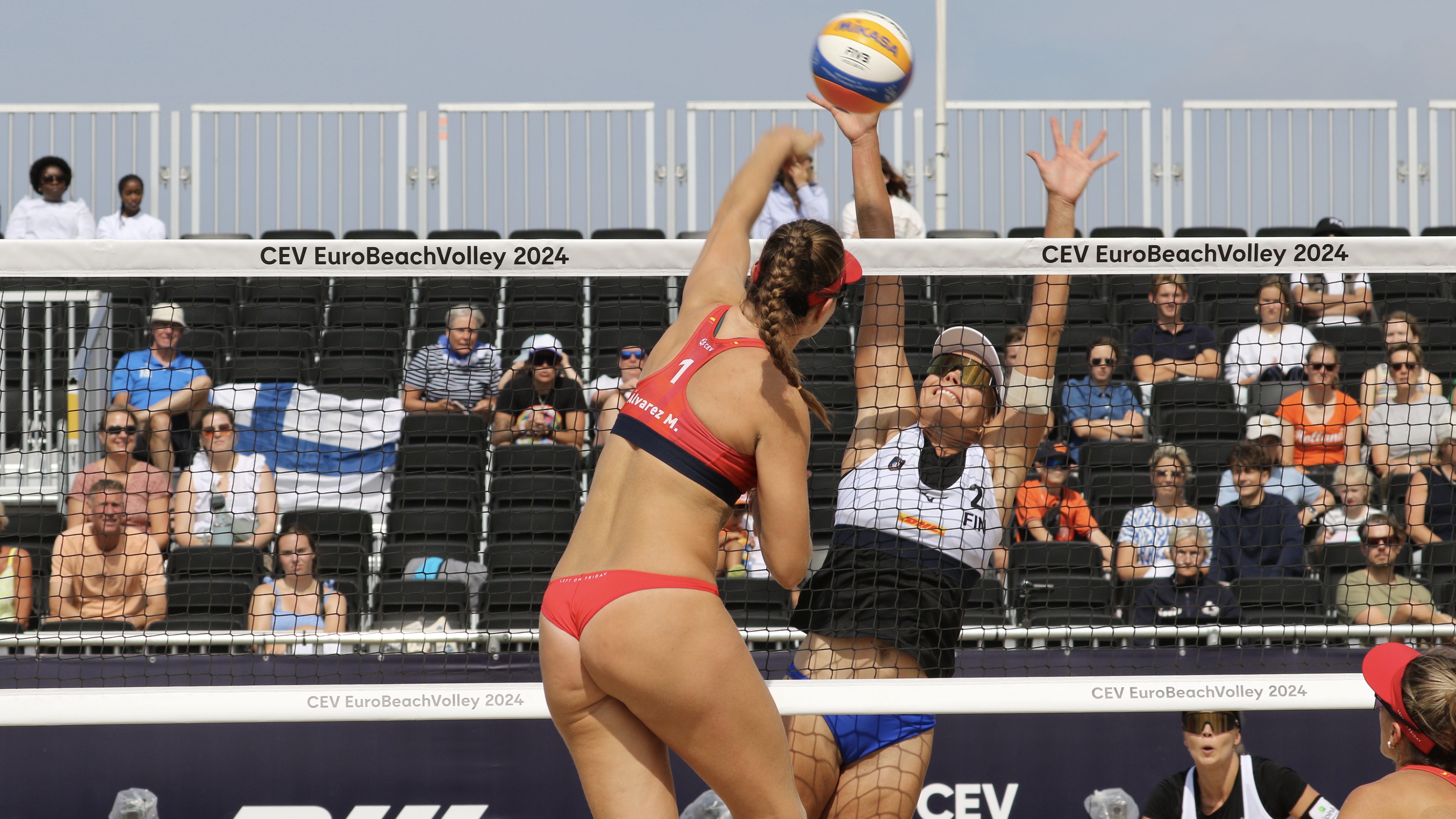
Thursday, the Spanish team of Daniela Alvarez and Tania Moreno exited the European Beach Volleyball Championships in a two-set loss against Finland in the Round of 24. The result was an upset, perhaps even of the stunning variety. Silver medalists in the same event a year ago and coming off a run to the Olympic quarterfinals, Spain was the fifth-best remaining seed in the field. Finland was seeded 29th. If that felt a little low for the familiar pro tour pairing of Niina Ahtiainen and Taru Lahti-Liukkonen, it wasn’t off by orders of magnitude.
To those of us unapologetically rooting for the Spanish duo on the shores of the North Sea, perhaps muttering a quiet riff, ram, bah zoo under our breath to honor their TCU ties, it was quite a bummer. Even more so to Alvarez and Moreno, presumably. With two full days of the women’s tournament still to play in the Hague, the Spanish were cut adrift.
This event was in some ways where Alvarez and Moreno announced themselves at the elite level of beach volleyball a year ago. In Vienna, they took out reigning champions Tina Graudina and Anastasija Samoilova in the quarterfinals and former Olympic bronze medalists Anouk Vergé-Dépré and Joana Mader in the semifinals, settling for second place only after losing in the final to Nina Brunner and Tanja Huberli. Each Spanish player barely 21, it was an audacious run. It marked them, in the language of ascent, as a team on the rise—and on the move.
Taking a year off from NCAA beach volleyball to commit themselves to Olympic qualifying, Alvarez and Moreno proceeded to play in the following locales between the end of last year’s Euros and this year’s Olympics.
- Hamburg, Germany
- Paris, France
- Tlaxcala, Mexico
- Goa, India
- Haikou, China
- Chiang Mai, Thailand
- Nuvali, Philippines
- Doha, Qatar
- Recife, Brazil
- Saquarema, Brazil
- Guadalajara, Mexico
- Tepic, Mexico
- Xiamen, China
- Espinho, Portugal
- Gstaad, Switzerland
- Vienna Austria
And that’s with a couple of months offseason.
Add it up and even without any trips to Fort Worth, they probably spent about as many hours in the air over those 12 months than most people commit to exercise in a given year. The longest trips provided some of the most memorable moments—and valuable points. In almost unbearable heat and humidity, they finished third in the event in India (despite losing to a certain pair of Finns along the way). They reached the quarterfinals in Thailand four weeks later and finished second in the Philippines at the beginning of December.
By the turn of the year, their Olympic resume was in pretty good shape, but they kept up with the relentless pre-Olympic schedule. In the span of 55 days in March and April, they played in Qatar, back-to-back events in Brazil, back-to-back events in Mexico and China. They had enough left to take the bronze in the last of those in Xiamen, their fourth medal in a world tour event (three in what would now be the Elite 16/Challenge levels).
And after losing their Olympic opener rather comprehensively to former Euro foes and eventual Paris medalists Brunner and Huberli, the Spanish team rolled off three wins in a row, beating one of the home teams from France, German former gold medal winner Laura Ludwig and pre-tournament top contenders Raisa Schoon and Katja Stam.
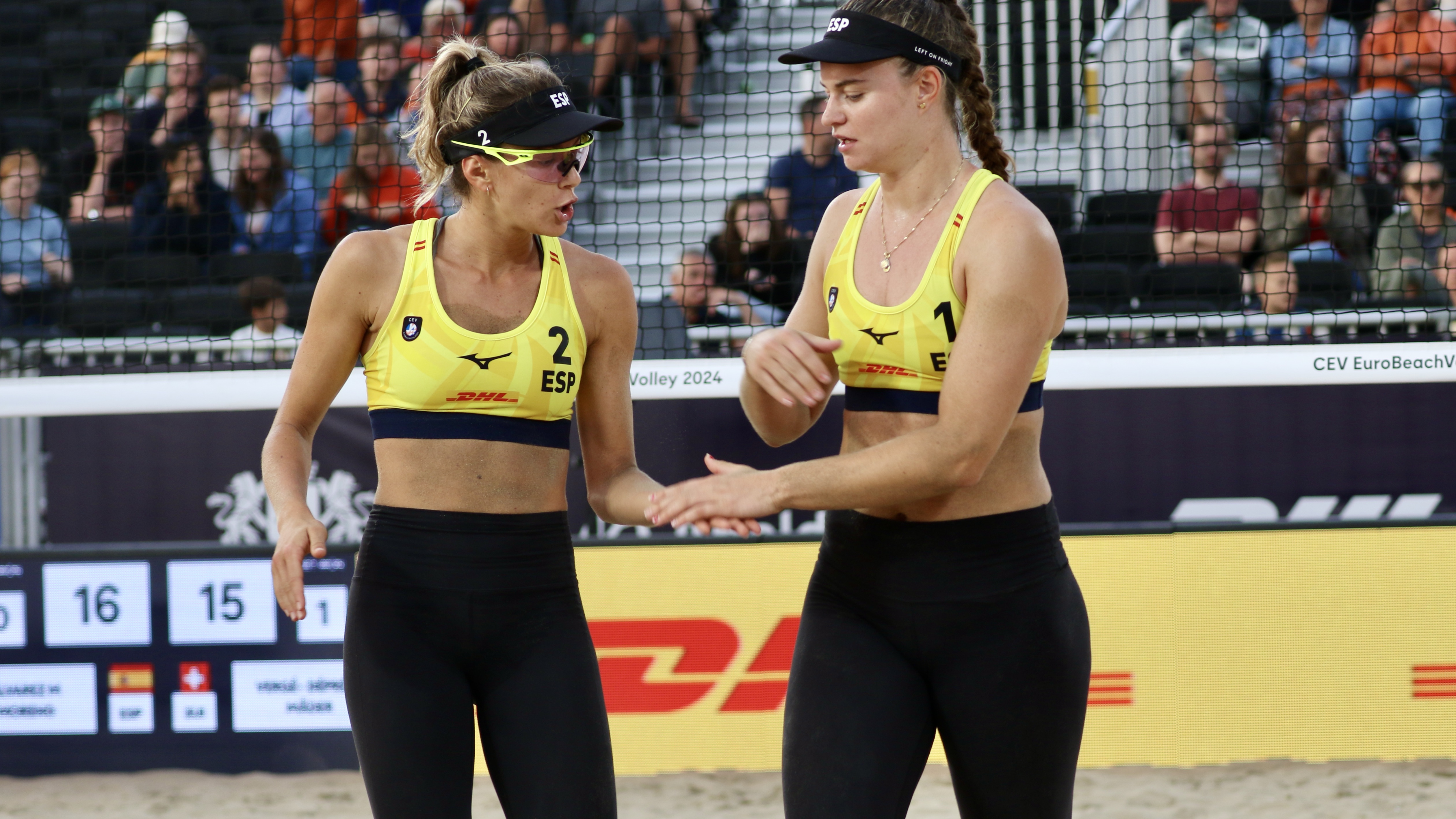
Alvarez gives up an inch or two to many of her counterparts at the net. She makes up for it by embodying the athletic persona of a crafty lefty. Physical and athletic enough to get her share of blocks, she also has a pool shark’s sense of angles, dropping off the net as much as almost any blocker and playing a variety of shots. Off the court, Moreno, too, isn’t likely to stand out in the land of giants that is a beach volleyball tournament. It’s a different matter on the court, where there may not be a better inch-for-inch athlete and she utilizes a second-generation beach volleyball brain to see the future.
They are an ideal team to adopt. Young and unimposing enough from a country with mixed results in the women’s game to be underdogs of sorts. Talented enough, with their transatlantic training, to need neither fairytales nor favors to compete with anyone.
Arriving in the Netherlands, it was easy to be optimistic—it’s always easy for those watching from afar. Three years ago, after an Olympic knockout exit, Brunner and Huberli won the European title the following week. With that Swiss team electing not to defend its more recent Euro title after an Olympic medal run, perhaps the door was open for Spanish duo to take the next step. Never mind the toll that the past couple of weeks, let alone the past 12 months, must have taken on weary bodies and exhausted emotions.

They dropped the opening set of their first match, played against the third-best Spanish team on the venue’s breezy secondary court–a far cry from the shadow of the Eiffel Tower. They rallied to grind out a three-set win in the opener, then benefitted from a morning off with a walkover win against a German team dealing with illness.
But with first place in the pool and a bye to the Round of 16 on the line, Alvarez and Moreno lost to Verge-Depre and Mader in two sets on center court Wednesday evening. That loss—their first in more than a month against a team that didn’t eventually medal in Paris—set up Thursday’s Round of 24 now-or-never clash against Finland.
It wasn’t to be. Spain wasn’t bad. Alvarez and Moreno just weren’t quite themselves. Serves missed the line by inches. Alvarez couldn’t get the blocks to go down. Moreno got only a mouth full of sand for her diving dig attempts. In an otherwise back-and-forth affair, the Spanish lost something like 10 of 14 points across the end of the first set and beginning of the second set. When Moreno finally got a serve to drop onto the line in the second set, Ahtiainen somehow came up with a one-handed dig that promptly turned into a kill. The Spanish never went on a run.
As the crowd quickly turned its attention to the all-Dutch match that followed, the Spanish quickly packed up their belongings on the bench and exited. It marked just their second finish outside the top 16 in their last nine events.
Fans of the Spanish, and I wasn’t the only one on hand, didn’t get to see the young team win its first major title. We still might have seen them begin to take the next step.
For a year, beginning with last year’s Euros, Alvarez and Moreno committed themselves to the ascent. They traveled the world, exhausting themselves physically and mentally, in pursuit of an opportunity few ever earn. In coming within a win of playing for an Olympic medal, not to mention standing on other medal stands along the way, they thrived where the competitive air is thinnest.
But no one gets to stay at the top. Well, maybe Ana Patricia and Duda have a time share. But even the Brazilian gold medalists are fallible. We celebrate athletic excellence as what people do in the biggest moments. It’s just as much about what you do next.
When the adrenaline of a yearlong or seasonlong quest fades. When the world’s attention gradually drifts away. When you reach your goal or come closer than you ever imagined.
To be great, you’ve first got to figure out a way to the top. You’ve also got to be able to come back down. If only so that you can begin the next ascent.
NCAA champions, assuming they return as anticipated for one more season at TCU? European redemption next summer? World champions next fall in Australia? The 2028 Olympics? The 2032 Olympics, when each will still barely be 30 years old? There are plenty of mountains still to climb.
It would have been fun to see a Spanish celebration in The Hague. Being there to see a down payment on future medals may yet make for a pretty good story.

 Graham Hays