(Listen to this post)
Two sisters travel the world together. Raised in a volleyball family, the daughters of parents who competed internationally, they crisscross continents pursuing a shared lifelong passion.
That’s one sort of story.
Now tweak the wording ever so slightly. Two sisters follow each other around the world, each chasing a prize that can only come at the other’s expense.
That’s a very different story.
One of the most compelling Olympic competitions will be over by the time the world turns its attention to Paris this summer. When beach volleyball begins quite literally in the shadow of the Eiffel Tower, either Anouk Vergé-Dépré, 32, Zoe Vergé-Dépré, 26, will be in the sand representing Switzerland. But not both. With time running out, they continue circling the globe—from Brazil to Mexico to China and back to Brazil in recent weeks—in an effort to qualify at the other’s expense.
Against all odds, Switzerland is a beach volleyball superpower. I’ll go to my deathbed muttering that the hows and whys of this geographic oddity deserves a book of their own, but it’s indisputable. At least on the women’s side, after Brazil and the United States, Switzerland is as good as anyone. Three Swiss teams are ranked among the top 19 in the world. And that’s the problem for the Vergé-Dépré clan. Each country is limited to a maximum of two teams in the Olympics. It doesn’t matter how good you are. If you’re third in your country, you miss out.
Reigning European champions Nina Brunner and Tanja Huberli are the top-ranked Swiss team and have amassed what is an almost insurmountable lead in qualifying. That leaves Anouk and partner Joana Mader, bronze medalists in the delayed 2020 Olympics, competing against Zoe and partner Esmée Bobner for the other Olympic berth.
Sister against sister. It wasn’t always so.
I had the opportunity to sit down with Anouk in 2018 while reporting a story on Kerri Walsh-Jennings’ new and ultimately short-lived domestic tour (since restyled as a futures tour for younger athletes). Mader was recovering from surgery that summer and fall, and needing high-level training, Anouk went to California to train and play with Walsh-Jennings in the debut event in San Jose.
Earlier that year, with her regular partner out, Anouk and Zoe played together in the European Championships. It was a lark. Zoe was only 20 at the time, still rising through junior competitions and minor tour stops—what are now the Futures events on the Volleyball World Beach Pro Tour. For Anouk, playing with Zoe even meant moving back to blocker, the role she played when she competed in the 2016 Olympics but which she largely gave up when she teamed with Mader in 2017.
Anouk described feeling lost as that summer began, so familiar with the routine of a volleyball life that she didn’t know how to process a calendar without competitions. But it’s entirely possible that all that followed, including an Olympic medal, owes some measure of debt to that year and the time it allowed for self-discovery. Among other things, exploring her family’s Caribbean connections, she went to Cuba to take dance lessons for two weeks. And she played in the Euros with her sister, not for career advancement or even really a title. Just to enjoy the game with someone she loved.
“It opened up a lot of very unique opportunities,” Anouk said of he year. “To play with my sister, it’s something I never imagined would happen so early. It was so fun because you know the person so well off the court and now you’re standing on court with her. So we had a lot of fun. We had good humor on court.”
Jump ahead to more recent times. Mader was again out of action entering 2023, meaning she not only had to regain rhythm and form upon returning but the team had to go through qualifying rounds for most of the major events. Only a limited number of spots in the main draw are reserved for teams at the top of the rankings. That, in turn, unlatched a door that Zoe and Esmée kicked wide open, emerging as one of the best young teams on the circuit. Instead of taking the torch from her older sister for the 2028 Olympics, Zoe was competing for 2024.
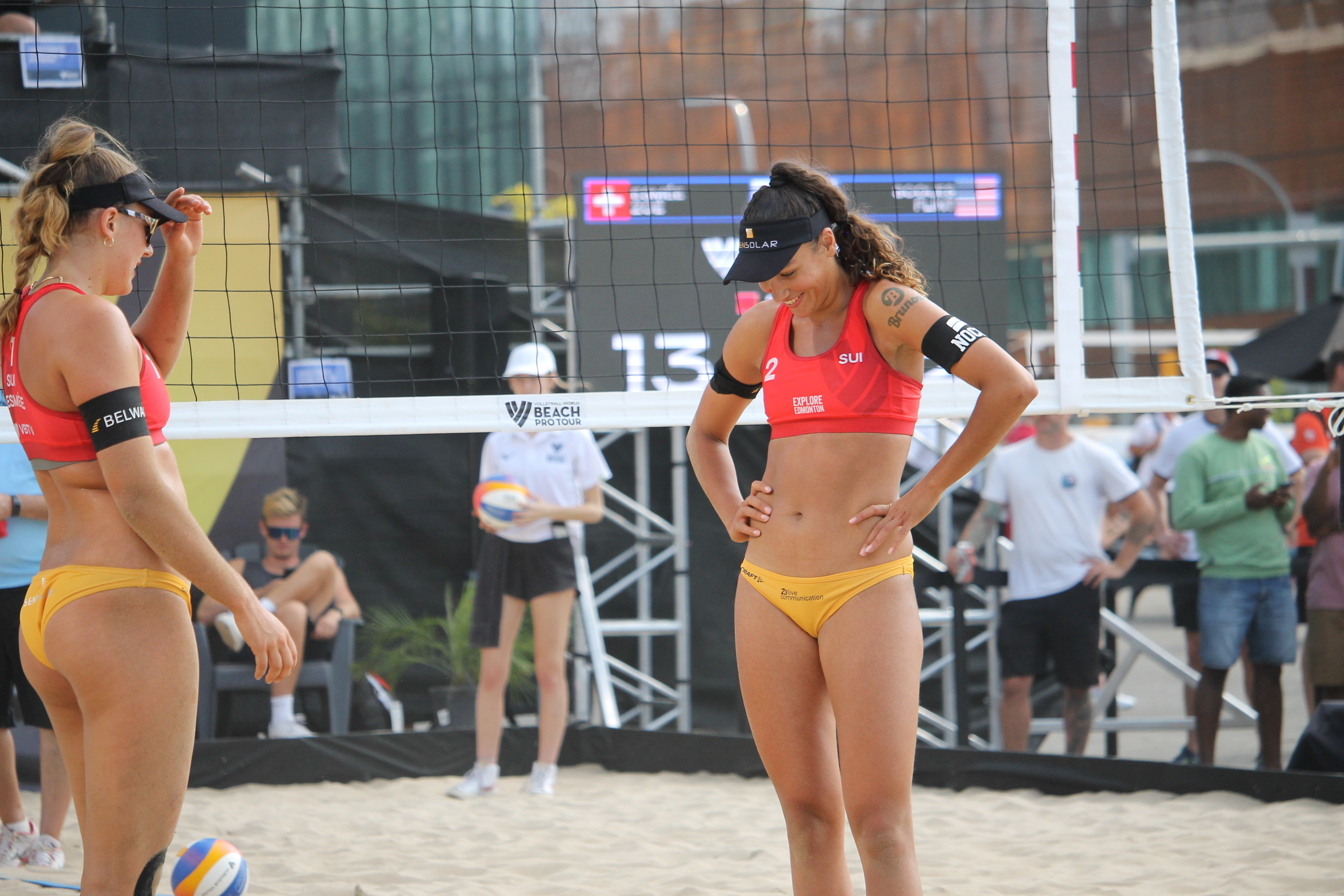
The sisters appear to go their own ways at competition sites. Cameras rarely catch one in the stands watching the other. When both teams were in Edmonton, I never spotted them pausing more than briefly to observe one another. They can’t afford to. With two matches a day in often hot conditions, every free minute is given over to recovery, rest, eating, treatment and scouting. They may well talk regularly throughout the events, who knows. But they carry themselves like everyone else, generally cordial competitors vying for the same real estate.
Sisters competing for the biggest prizes isn’t new, as tennis fans will be the first to point out. But at least Serena and Venus Williams had four potentially career- and legacy-defining competitions every year in the Grand Slams. And each was assured entry in the field.
For a beach volleyballer, winning a world championship or even the annual Tour Finals is a big deal, an achievement that demands the respect of your peers and the rest of the sport. But Anouk and Joana could win multiple world titles and still not receive the acclaim or opportunities that winning a single Olympic medal in 2021 afforded them.
In terms of how the world—and more specifically, your country—perceives you, the Olympics are everything.

In Guadalajara, Mexico, the second week of April, Anouk and Joana came out flat in qualifying, couldn’t buy a break and thudded to a defeat without even making the main draw. That was damaging enough, but the misery only deepened when Zoe and Esmée went on a run and won the entire tournament—their first title in an event in one of the world tour’s top two tiers.
That was enough for Zoe and Esmée to leapfrog Anouk and Joana in the qualifying standings. Suddenly, the youngsters were in. The veterans were out.
From there, both teams traveled to Tepic, Mexico, for another event, then across the Pacific to Xiamen, China, an island a stone’s throw from Taiwan. All in successive weeks.
In Xiamen, Zoe and Esmée couldn’t get past the Round of 16—scuttling a potential quarterfinal against Anouk and Joana. The latter two nearly failed to capitalize. Trailing 11-6 in the third set to former Olympic champion Laura Ludwig and Louisa Lippmann, Anouk and Joana rallied for a remarkable 15-12 win. Another miraculous comeback against the Spanish (and TCU) duo of Tania Moreno and Daniela Alvarez earned a place the final and the accompanying points haul.
Even settling for the silver medal, Anouk and Joana made up significant ground on Zoe and Esmée. Enough, in fact, to move back ahead of the younger duo.
Currently, Anouk and Joana are 15th in the Olympic rankings with 7,440 points, while Zoe and Esmée are 17th with 7,360 points. (The young Spanish team that had Anouk and Joana on the ropes in Xiamen is sandwiched between them at No. 16.)

Now, it’s back to South America for this week’s Elite 16 tournament in Brasilia. At the top tier event, neither team is among the 12 guaranteed a place in the main draw. That list includes Brunner and Huberli, whose strong position meant they could comfortably skip Xiamen.
Jet lag, physical and mental fatigue notwithstanding, Anouk and Zoe each needs to win twice in Wednesday’s qualifying to have any hope of improving her standing.
As Anouk said in an Instagram post, “yes unhealthy, expensive & unsustainable, but what can we do!?”
Olympics points are determined by a team’s best 12 finishes during the qualifying period. The top 17 in the rankings qualify automatically for Paris, as long as there aren’t two higher-ranked teams from your country (again, the Swiss conundrum—although the races for Canada and Germany, in particular, are similarly unsettled, with Zoe and Esmée playing their first qualifier against similarly desperate Canadians Sarah Pavan and Molly McBain).
All of this comes to an end in early June. After Brasilia and two weeks off, teams have three more opportunities at events in Portugal, Poland and, finally, the Elite 16 in Ostrava, Czechia.
After circling the globe for more than a year, one sister will come up 800 miles short of Paris and a lifelong dream. The other will have the opportunity of a lifetime under the Eiffel Tower.
Only in Paris, finally and perhaps bittersweetly, success for one sister won’t come at the expense of the other.
Update May 7: Sports are brilliant. And cruel. But mostly brilliant.
If you want a challenge, go to a travel booking site like Orbitz and search flight options from Xiamen to Brasilia. Zoe Vergé-Dépré and Esmée Bobner apparently made the trek in under 30 hours, according to VBTV announcers. I never did find an itinerary under 40 hours (connecting through Amsterdam or Madrid and Sao Paulo), so clearly, my travel agent skills have lapsed.
After completing that trip, the final leg of a three-week Mexico-China-Brazil odyssey, Zoe and Esmée put together the week of their young volleyball careers. The week that may well lead them to the Olympics. Playing nine matches in five days, the youngest of the top Swiss teams won bronze medals in Brasilia. Two weeks after winning their first big tournament at the Challenge event in Guadalajara, they again made it to the podium—this time at the highest level of competition outside of the World Championships, Olympics or Tour Finals.
So, once again, ownership of the all-important second Swiss place in the Olympic rankings will change hands. Maybe for good this time.
Anouk and Zoe each won their opening qualifying matches on May 1. But with the Swiss teams playing their next qualifiers one after another on adjacent courts, Zoe and Esmée advanced to the main draw while Anouk and Joana lost to Brazil’s Agatha and Rebecca (a qualifier in which three of the four players were former Olympic medalists and all played in the 2020 Olympics).
Advantage Zoe and Esmée. But they were just getting started.
After losing their first match in pool play, they beat Germany’s Laura Ludwig and Louisa Lippmann 24-22 in the third set of their next match—a win they knew they likely needed to have any realistic chance of getting out of pool play.
They lost to Americans Taryn Kloth and Kristen Nuth in their final pool match, 23-25, 19-21, but they did enough to slip through as one of the last teams into the knockout round. The prize for advancing? The world’s No. 4 team: Canadians Melissa Humana-Paredes and Brandie Wilkerson.
The Swiss duo had yet to beat the Canadian team. Down 17-20 in the final set, that didn’t appear likely to change. Switzerland had to side out and then win back-to-back points on its serve, not exactly a common sequence in the best of times in an Elite 16 event. But that’s exactly what they did, Zoe putting away three balls on three consecutive points to pull level.
From there, fending off three more match points seemed easy by comparison. The Swiss took the second set 25-23 and went on to win the third set to advance.
Two more wins, in the quarterfinals against the same Brazilian team that eliminated Anouk and Joana, and in the bronze medal match against the Netherlands, earned a podium finish. More importantly, at the moment, it earned Zoe and Esmee enough points to take a lead of more than 400 points on Anouk and Joana.
In perhaps the biggest tournament of her life, Bobner had 29 aces. No one else in the field had more than 13. Zoe had 83 digs. No one else had more than 66.
 Graham Hays