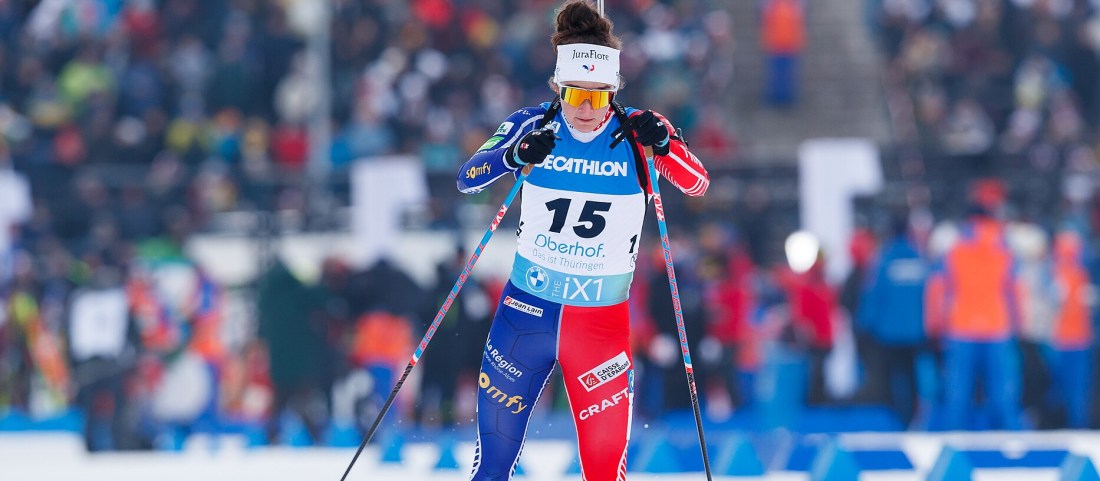
(Photo credit: Steffen Prößdorf)
There was a time when the playoff debate in college football would have consumed my Sunday morning. That it’s a time in the past isn’t meant to judge those busy debating the merits of Texas beating Alabama in Tuscaloosa, a potential playoff without the SEC and other matters.
I don’t even know that they missed anything Sunday that they would have enjoyed.
I just know I’m happier for knowing more about Lou Jeanmonnot than I did when I woke up. And I’m thankful for a final lap and a sprint to the finish in Ostersund, Sweden, that raised at least one heart rate on a sleepy Sunday morning in far away Indiana.
Jeanmonnot is a 25-year-old French biathlete, if you were wondering. Most people wouldn’t have much reason to know her name. I barely knew it before last year, when she finished a solid 11th in the IBU World Cup overall points race. Entering this week’s season-opening events in Sweden, truth be told, I barely knew anything about her beyond her name. Hers was just another name that popped up on the leaderboard from time to time, not one of stars who an admittedly casual biathlon fan followed more closely from race to race.
But several of those stars have stepped away since the last Winter Olympics, Norwegians Tiril Eckhoff and Marte Olsbu Roeiseland and German Denise Hermann-Wick prominent among them. Continuity always ebbs and flows in sports. Short careers, relative to lifespans, mean we watch generation after generation rise, peak and eventually be replaced. Sometimes that’s more discombobulating than others—as with a U.S. women’s national team moving on from the generation of Carli Lloyd, Megan Rapinoe and Alex Morgan or men’s tennis gradually moving on from Roger Federer, Rafael Nadal and Novak Djokovic. Yet the more unsettled the times, the greater the opportunity for something or someone to introduce themselves.
Friday, Jeanmonnot seized her opportunity by wining the 7.5 km sprint in Ostersund.
The sprint is three laps around the course, interspersed with two stops on the shooting range—five shots from a prone position on the first stop and five shots from the standing position on the second stop. A handful of the fasted skiers might be able to win with one miss (each miss means an extra loop around a 150-meter penalty oval), but for the most part, you don’t win without hitting the target on every shot. Jeanmonnot didn’t miss—and skied well enough to finish 8.5 seconds ahead of Norwegian Karoline Offigstad Knotten.
The sprint is purely a race against the clock, like a time trial in cycling. The field of more than 100 starts one skier at a time, a staggered start. Jeanmonnot started 27th, meaning she knew by the time she crossed the finish line that she was the fastest to that point—but she wouldn’t know for sure that she won until the other 70-plus competitors crossed the finish line.
Sunday’s event was different. The 10 km pursuit is a race against people—first one across the finish line wins. By virtue of her win in the sprint, Jeanmonnot started first in the pursuit, given an 8.5 second head start on Knotten. Each successive skier then started according to the time she finished behind Jeanmonnot in the sprint. But 8.5 seconds is nothing in a race spanning five laps and four rounds of shooting. By the end of the first lap, Jeanmonnot was just one part of a lead pack of six skiers who entered the shooting range at the same time.
She hit all five shots from the prone position, but so did four others in the lead pack.
She hit all five shots after the next lap, again prone, but so did German Vanessa Voigt and Norwegians Juni Arnekleiv and Ingrid Landmark Tandrevold from the lead pack.
She hit all five shots after the third lap, this time shooting from the more challenging standing position. But so did Arnekleiv and Voigt. And as those three embarked on the fourth lap skiing around the two-kilometer course of ups and downs, Voigt and Arnekleiv began to pull away from Jeanmonnot. One announcer wondered aloud if the Frenchwoman might be intentionally falling back, saving her energy and managing her breathing to be ready for the final round of shooting. Maybe. Mostly, she just looked tired and cold amid temperatures near 0 Fahrenheit.
Whether strategy or not, Voigt and Arnekleiv each missed early in the final round of five shots from the standing position and set off on their penalty laps. Taking her time—agonizingly so in a sport in which there is a fine balance between giving away seconds on the range in hopes of avoiding them on the penalty loop—Jeanmonnot once again hit all five shots. Between the Friday’s sprint and Sunday’s pursuit, she went 30-for-30 on the range.
Jeanmonnot began her final lap about six seconds ahead of German Franziska Preuss, whose strong skiing had largely erased the deficit of an earlier penalty loop. The Germans had been fast on their skis all week, perhaps winning the weekly wax war that is also a part of the sport. It seemed inevitable that Preuss would now catch her quarry. Sure enough, by the halfway mark of the final lap, Preuss had dominated the climbs and not only taken the lead but opened up a gap of several seconds.
Jeanmonnot’s best hope—and perhaps her strategy all along, if she’s indeed a tactical savant—was to rely on her weeklong strength on the downhill portions near the end of the course. Sure enough, at the course flattened for the final time with the finish line only a couple of hundred meters away, she had closed the deficit and pulled level with the German.
Now it wasn’t about shooting accuracy, ski technology or strategy. Now it was a sprint to the finish line and finding some untapped reservoir to feed oxygen-starved muscles.
Even when the format allows for them, sprint finishes are rare. The outcome is usually settled before those final few meters. Earlier in the final lap, one announcer mused he couldn’t recall ever seeing the 29-year-old veteran Preuss in a one-on-one sprint to the finish. Certainly no one had seen Jeanmonnot at the World Cup level. But here they were.
The final straightaway is divided into lanes. Coming off the final turn toward the straightaway, Jeanmonnot had to go wide to attempt to pass Preuss. As the meters vanished, she inched ahead, first by the tip of a ski and finally by about half a ski length—0.3 seconds at the line.
It was heartbreaking for Preuss, who earlier in the week lost the 15 km individual event by 0.1 second to Italian Lisa Vittozzi (whose own comeback from the yips on the shooting range over the past two years is a story worth its own post). At least that wasn’t a head to head finish, just a race against the clock out of Preuss’ hands in the end.
But the depth of the heartbreak also provided the height of Jeanmonnot’s elation—at least once the Frenchwoman regained any breath after initially collapsing in an exhausted fetal curl on the snow, skis still attached.
It sometimes feels as if the world spends as much time talking about sports—and the dramas, controversies and personalities adjacent to sport—as it does watching competition. That’s hardly a sin. Sports are drama. Narratives engage us, characters entertain us.
And maybe that’s as it ever was, more visible only because of improved communication.
But I can’t help but wonder if the balance isn’t out of whack. Because I don’t know what sports are for—really for—if not the increased heart rate and knot in the stomach of watching someone turn for home and wondering if she will find the will to get there first.
I do know more about Jeanmonnot than I did when I woke up Sunday. I look forward to seeing how she fares next week in Hochfilzen, Austria, as a new season takes shape.
And for that, I’m grateful to stll love sports this Sunday morning.
 Graham Hays