
Already down a set and 7-0 after the first change of ends in the second set of Saturday’s European final, Daniela Álvarez could only laugh when she finally spiked a ball that Switzerland’s Tanja Hüberli couldn’t block and Nina Brunner couldn’t parry.
On this court, she knew. On this day, it wasn’t meant to be.
Vienna belongs to the Brunner and Hüberli. Again. As a result, so does Europe, no small detail a year ahead of an Olympics on European soil.
But the future? Something in that smile suggested Álvarez now knows her day is coming.
Brunner and Hüberli routed Álvarez and Tania Moreno 21-12, 21-13 to win the Beach Volleyball European Championship. In their third consecutive appearance in the final of the annual showcase event, the Swiss pair won their second European title—both in Vienna.
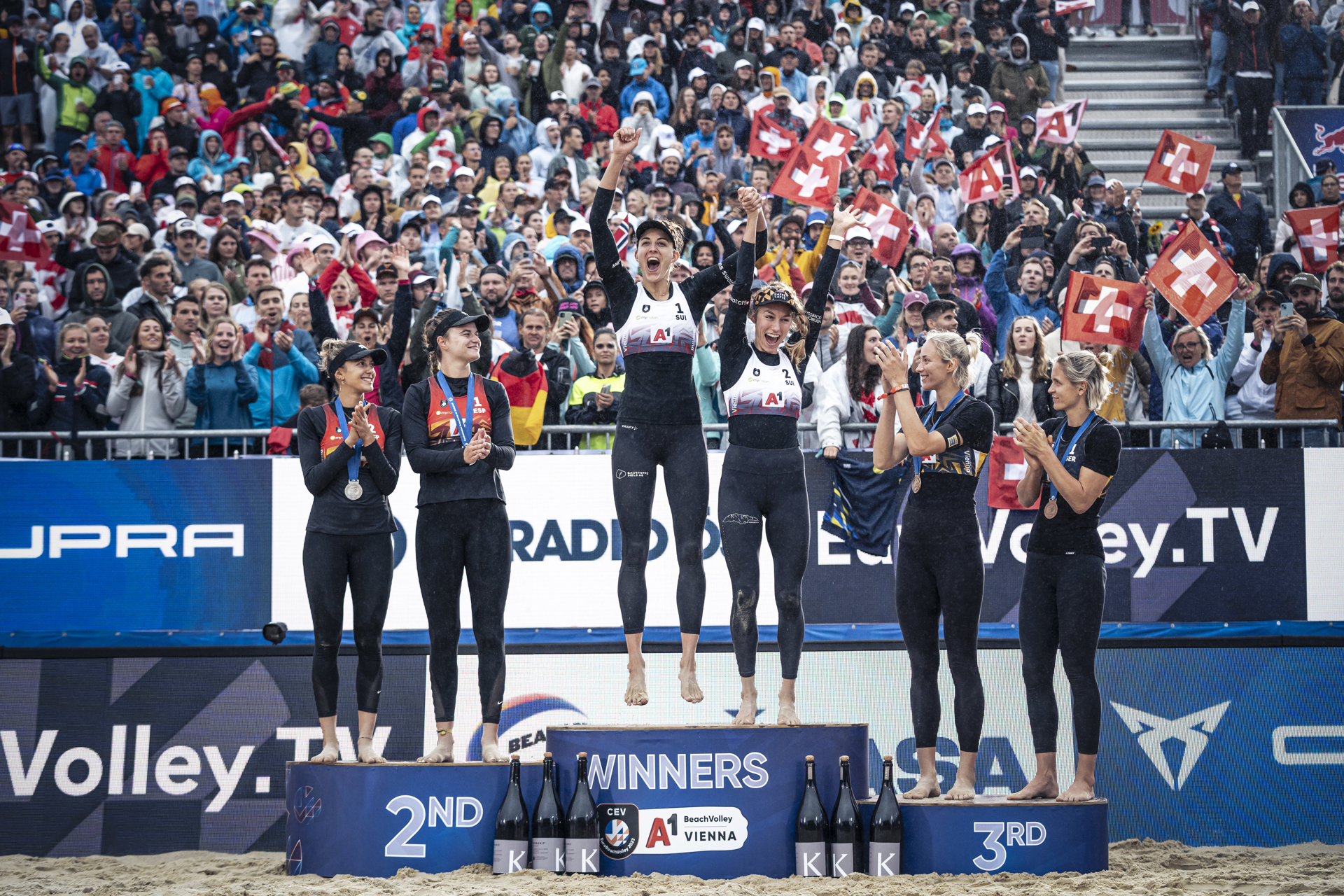
On the same day when Spain eliminated Switzerland from the FIFA Women’s World Cup in a 5-1 shellacking on the other side of the world, what went down on a rainy, grey day in the Austrian capital was no less lopsided. After a pair of epic, three-set semifinals earlier in the day, the Swiss won the final by the most lopsided margin in the entire knockout round (24 matches).
I’m not impartial when it comes to the Swiss. Brunner and Hüberli are my team. They are one of the only sporting entities who results still steer my mood. It just about ruined my summer when they skipped the two North American tour stops in Edmonton and Montreal. The loyalty is born of investment. I’ve followed them almost from their beginning, intrigued by Hüberli’s unassuming demeanor and Brunner’s preternatural rise now more than a decade ago, winning junior world titles at 15 and 16 year old—competing against future Olympians as old as 20.
Seven years. It’s a long time. For some.
Seven years ago, they were a team on the rise, promising but unproven. It felt like a fairytale when they reached the European final in 2018, losing to the Dutch pair of Sanne Keizer and Madelein Meppelink that played the tournament on home soil. Keizer and Meppelink were the veterans, multiple-time Olympians and, in Keizer’s case, a former European champion.
It was still difficult to think of the Swiss as proven contenders by the time the pandemic-delayed Olympics arrived in 2021. They won their pool in Tokyo but lost a heartbreaking round of 16 match against countrywomen Anouk Vergé-Dépré and Joana Mäder. It was a three-set classic played in brutally hot conditions, but no one remembers round of 16 matches. Vergé-Dépré and Mäder went on to win bronze. Brunner and Hüberli went back to the fringes of acclaim.
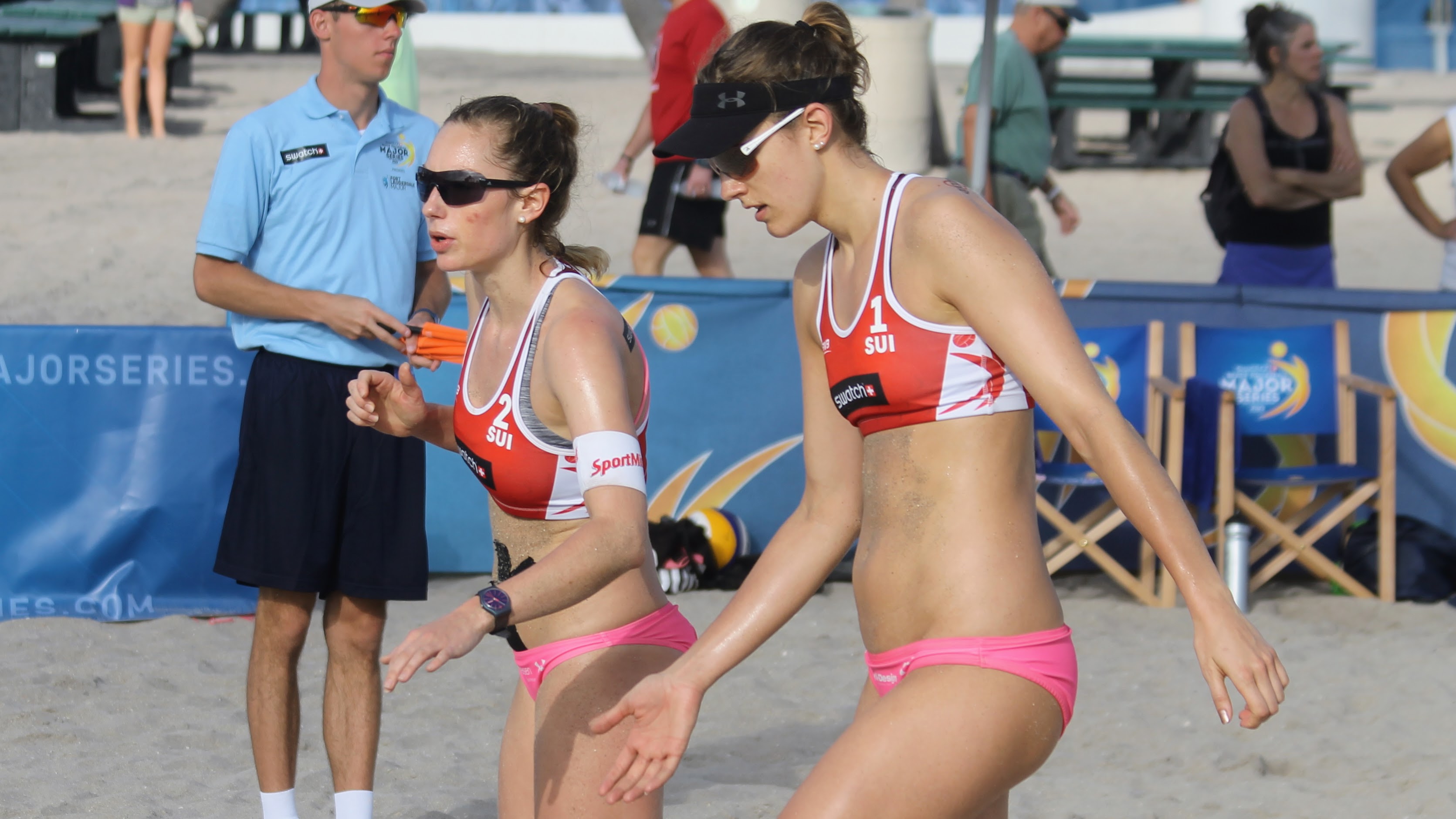
For all of two weeks. Just a fortnight after losing in the Olympics, Brunner and Betschart were crowned European champions in Vienna. They beat the Dutch pair of Katja Stam and Raïsa Schoon in a final that felt like something of a referendum on the young team that had arrived. Or at least the primary challenger to Latvia’s Tina Graudina and Anastasija Samoilova for that label.
Somewhere along the way, Brunner and Hüberli grew up, for lack of a better phrase.
One of the reasons that sports are so compelling is they really do hold up a mirror to the world—for better and, on a day when greed and conference realignment rule the headlines, often for worse. But it’s also a funhouse mirror in some respects. We see competitive lives unfold on fast forward, prospects entering their peaks and slipping into decline and retirement in less time than many of us hold onto a car. I still wear clothes that I had seven years ago. I still sit on the same couch, cook with the same pans.
Seven years isn’t a long time. Except in sports. In sports, it’s half a lifetime.
Saturday, that was inescapable. Brunner and Hüberli aren’t old, by any stretch. So precocious at such a young age, Brunner is still just 27. And even at 30, Hüberli was nearly a decade younger than Germany’s indomitable Laura Ludwig, who along with ridiculously impressive indoor-convert Louisa Lippmann pushed Switzerland to the limit in a 21-19, 19-21, 16-14 semifinal. But if the Swiss aren’t old, they also aren’t young anymore. They’re in the sweet spot.
Anomalies like Ludwig notwithstanding, athletic careers are defined by the intersection of two lines going in opposite directions on a graph. One is experience, wisdom, athletic IQ—a line that rises as years and competitions accumulate. The other line is athleticism—descending as those same years and competitions take a toll on joins, ligaments and various and sundry parts of the body. At some moment, those lines intersect. That might last a summer or it might last several years. It might not even mark the period of your greatest success. But you’re never better equipped to succeed than you are when those lines meet. That’s where the Swiss reside.
They entered the Euros with no momentum whatsoever. They suffered a profoundly disappointing pool play exit in Gstaad in July, one of the biggest tournaments of the year for every team but all the more for Swiss teams playing on home soil. This week, Hüberli, who has dealt with injuries in recent seasons, could barely even celebrate a pool play win, crumpled on the sand and in need of treatment from trainers.
“Of course we were thinking about medals,” Hüberli said of expectations this week. “But we were also a little bit unsure [because of] the last tournament.”
Brunner echoed the sentiments in her German-language interview (as best I could tell with some translation assistance).
None of it mattered. It didn’t matter because the Swiss long ago learned how to deal with the inevitable setbacks that are part of any sport—the random weeks when luck isn’t on your side you simply play like crap. And Hüberli’s ailment notwithstanding, their bodies are still in good enough condition to push through some wear and tear. Lord knows that doesn’t necessarily mean it’s easy to get out of bed the morning after a tournament. But it’s manageable.
So, the Brunner and Hüberli weren’t troubled when they fell behind 6-1 in the opening set of Friday’s round of 16 match against Spain’s Liliana and Paula. They held off a three-set challenge from rising countrywomen Zoé Vergé-Dépré and Esmée Böbner in a quarterfinal later the same day. They outlasted the Germans. And when Brunner was called for a lift on the opening point of the final and Hüberli followed with an error on the second point? They shrugged and rolled to dominant performance.
Perhaps because it was such a rout, and perhaps because it ended on an anticlimactic service error, the immediate celebration after clinching the title felt subdued. By the time they got their hands on the trophy a few minutes later, the celebratory dances and trophy lift spoke to plenty of joy. But there was something to that first reaction. This wasn’t their first title. This wasn’t a surprise—to them or anyone else. The joy came, but for a second, it seemed mixed with relief.
More than seven years after playing their fist match together, this was less a dream than the expectation that they devote their lives to achieving. The sense of perspective was even there when the on-court host asked Brunner if it “was easy to play against this Spanish team.”
“A final is always a hard job,” Brunner said, parrying an inelegant question as easily as she defused the Spanish attacks. “I think the Spanish team did a very good job in this tournament, we knew that. We only played them twice so far. They’re a young team, and we knew they’re going full.”
It must have felt like looking in a mirror.
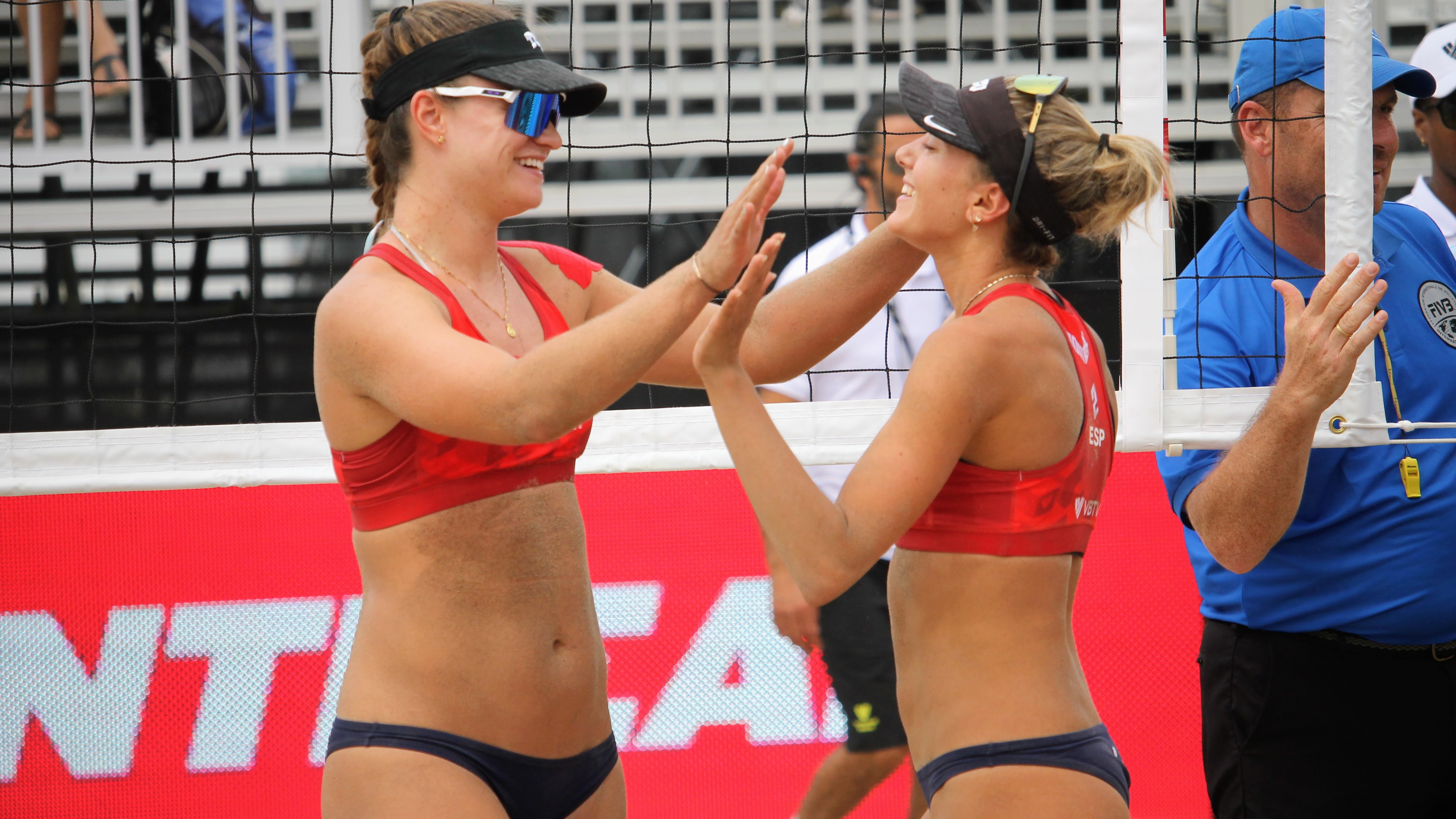
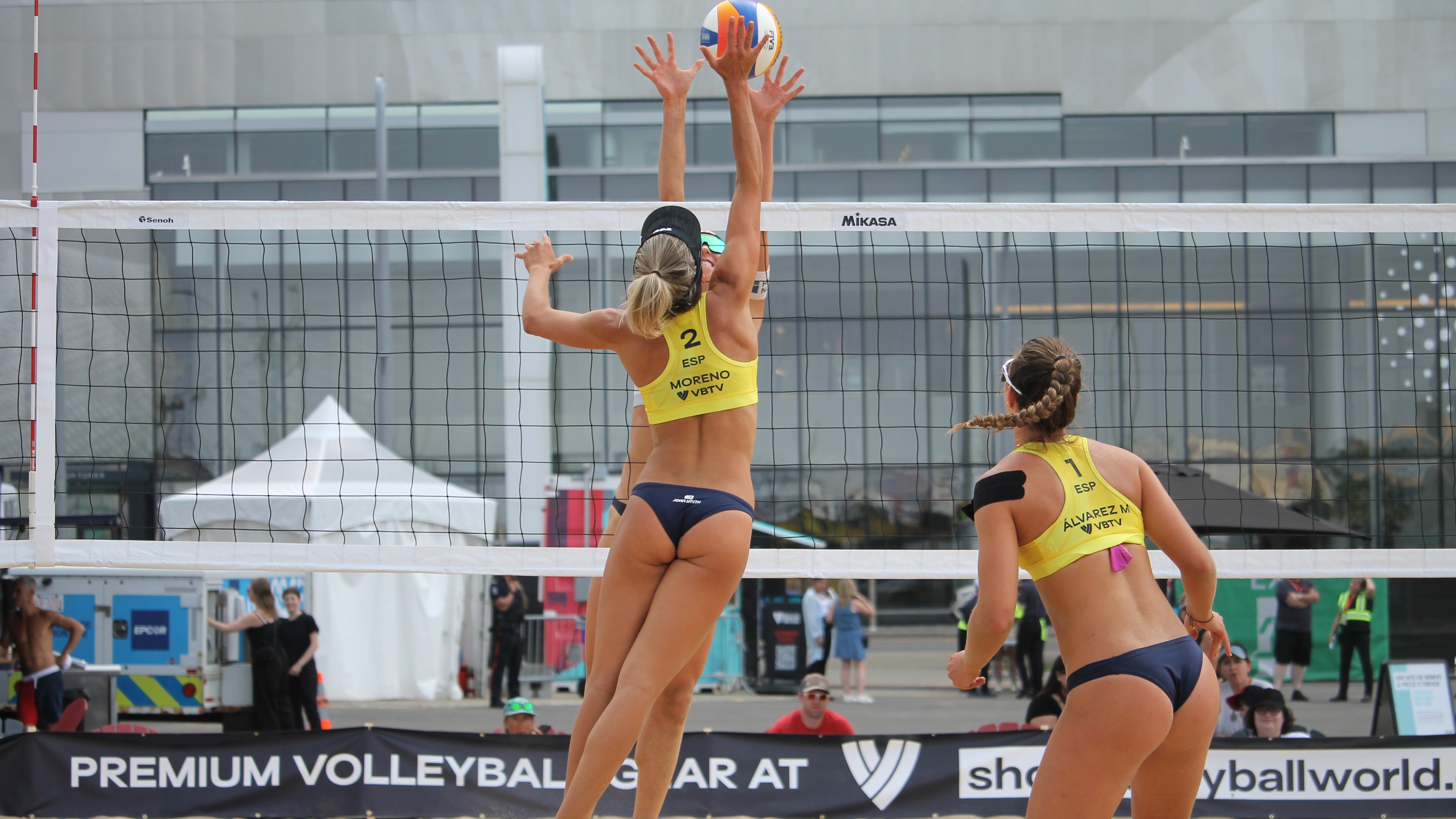
The 2022 European Under-22 champions, Álvarez and Moreno are still in the midst of their college careers at TCU (they led TCU to the semifinals of this past spring’s NCAA tournament).
When Brunner the wunderkind won her first junior world title in 2011, Álvarez and Moreno were 9 years old. When the Swiss pair set out on the pro tour together in 2016, Álvarez was just deciding to give up tennis and get serious about beach volleyball.
For them, Saturday arrived in a hurry.
Not that they took any shortcuts to the final. They beat two recent former champions en route, eliminating two-time European champions and reigning Olympic silver medalists Graudina and Samoilova in the round of 16 and former European champions and reigning Olympic bronze medalists Vergé-Dépré and Mäder in a thrilling semifinal. They lost the opening set in that semifinal 27-25, trailed late in the third set and still had the mettle to win.
When Moreno, the darting, acrobatic, seemingly spring-loaded defender, saw Brunner reading every angle and digging every ball in the final, she might well have seen a reflection of her future, polished self. Yet she could have said much the same thing about three-time Italian Olympian Marta Menegatti—who she eliminated in straight sets in a quarterfinal.

The Spanish team was in no way out over its skis. They were capable of winning. On a different day (like any of the previous three days of this tournament), they might have. It’s just that when you’re young, you have a few too many of these days—especially against the best.
All of which helps explain why Álvarez could only laugh when she and Moreno finally got their first point in the second set—after Brunner nearly saved the point with a miraculous, reaction one-arm fling to keep the ball in play.
Not long after, Álvarez was smiling again, this time after Spain’s best moment of the match. During an extended rally, Moreno made one of her familiar full-extension, over-the-head blind saves, somehow putting the ball right where it needed to be for Álvarez to react and complete an athletic spike. The point cut the deficit to 10-8.
It was as close as Spain would get but also a show of resolve from a team that left defeated but not embarrassed.
As a Swiss fan, there was something bittersweet watching the final. To be sure, the end isn’t nigh. A second Euro title cements Brunner and Hüberli’s place as Olympic contenders in 2024. It also sets them up for this fall’s World Championships in Mexico. These are good times. Beyond the immediate future, Brunner, certainly, has every opportunity to be around for Los Angeles 2028. Hüberli would be far from the oldest Olympian, if she chose to continue playing that long.
And still, time is unbeaten. Pessimistic as the thought may be, there is only one chapter left after the peak. There is only decline. Many more days like Saturday may lie between now and that reality, but it is inevitable.
Somehow, seeing the Swiss at their best only underscored that. It’s the same feeling as reaching the later episodes of a brilliant series. It has been everything you hoped. It has entertained and inspired. And it will end.
Paradoxically, it’s the team that lost decisively that buoyed me Saturday. Spain’s story is just beginning. The potential still seems limitless, the characters still emerging. And the opening scenes, in person in Edmonton and Montreal and from afar in Vienna, promise great things.
Saturday, the Swiss and Spanish occupied the same sand in soggy Vienna. But not the same moment in time. The Swiss road led to Vienna. The Spanish road leads from it.
A reflection of life. Always a reflection of life.

 Graham Hays