EDMONTON, Alberta — We don’t choose the story in which we’re cast. But we do sometimes control the script.
No one is born with great odds of becoming a professional athlete. But the odds of Esmée Böbner living out the life of an Olympic beach volleyball hopeful would have appeared particularly remote when she entered the world in the weeks before the new millennium.
She was born in Switzerland nearly eight months before the mountain resort town of Gstaad ever thought to host a professional beach volleyball tournament that grew over the next two decades into one of the sport’s signature events and a summer staple in the Alps. She was born nearly five years before Patrick Heuscher and Stefan Kobel earned bronze medals in the 2004 Olympics, the first Swiss medals in the sport (at the same Olympics in which a Swiss women’s team debuted).
She was born at an inflection point, when nothing became something. She grew up dreaming of something that previous generations didn’t even know to dream about. Half of the first Swiss women’s team to compete in the Olympics, Simone Kuhn was already 20 when she started playing on the sand. Someone called and told her she would make a good blocker. Sure enough, four years after the thought of playing beach volleyball first crossed her mind, she was a European champion and Olympian. That’s how these things begin.
Two decades later, Böbner had her sights set on the sand almost form the start. At 16, she received an invitation to train at Beachcenter Bern, the hub of Swiss beach volleyball. She didn’t need anyone to explain to her what the sport was.
“I think everyone in Switzerland starts indoor, but I knew early on I wanted to play beach,” Böbner said. “I really like the atmosphere here. I think it’s way more fun than indoors.”

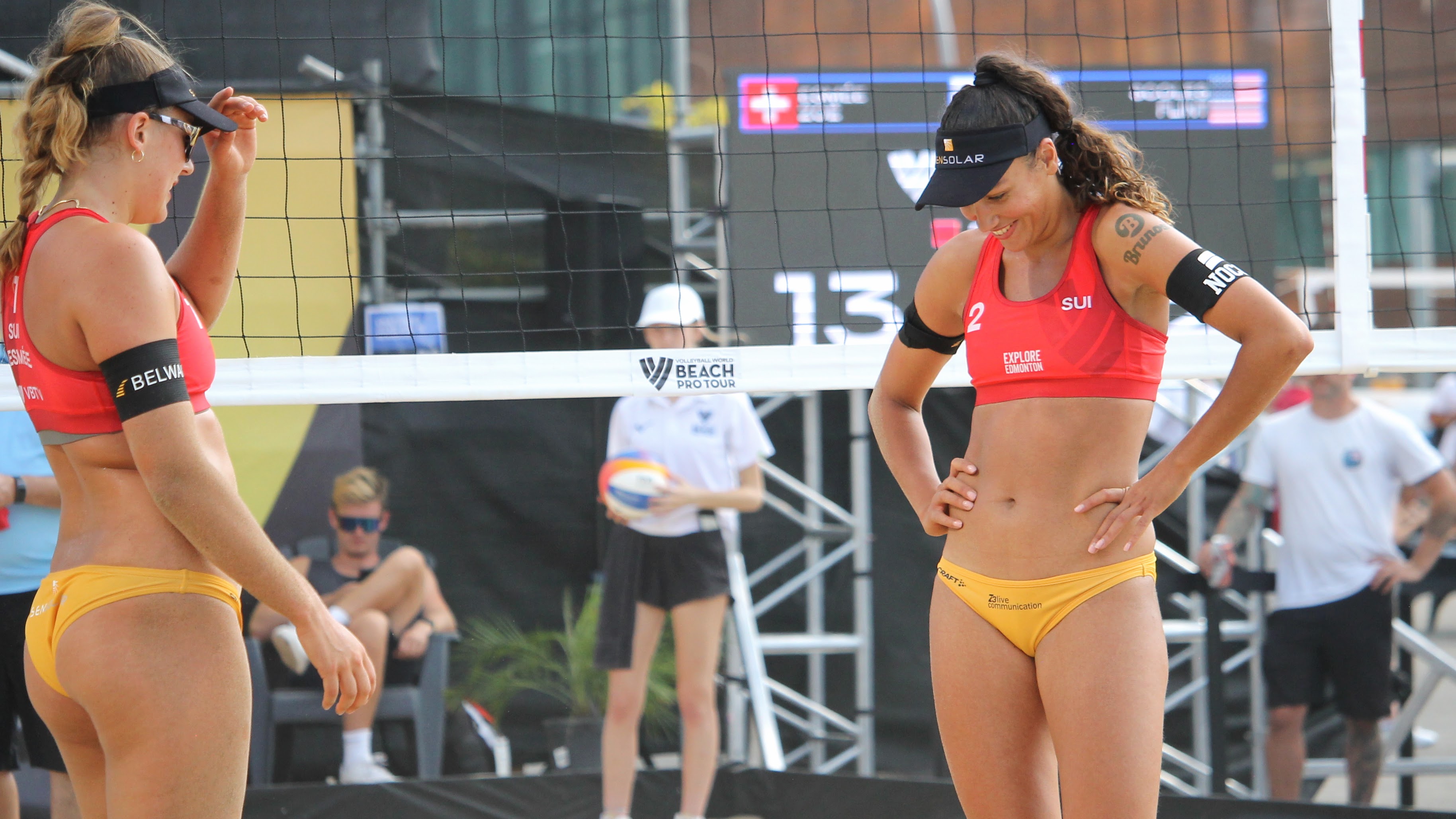
Yet sitting forlornly at one of the dozen or so picnic tables arrayed beyond the outer courts at a recent tour stop in Edmonton, she didn’t look especially happy or blessed by the fortunes of history. Head bowed, she looked broken. Like someone who had traveled nearly five thousand miles and crossed eight time zones just to be miserable and jet lagged. She and partner Zoe Vergé-Dépré had just lost to Americans Kelley Kolinske and Hailey Harward. It wasn’t so much the loss against a credible, if new, American team that rankled. It was that she lost meekly, caught up in her own frustrations as mistakes, to borrow an Alpine metaphor, snowballed.
Two weeks earlier, the Swiss had lost valiantly—and memorably—on home sand in Gstaad. Down a set and trailing by double digits against a surging German team, the Swiss duo rallied to win the second set 25-23 before falling 15-12 in the final set. The loss still stung, denying them a place in the knockout rounds. But cheered off the court by the home crowd, their resiliency said plenty about one of the most upwardly mobile young European teams.
In Edmonton, there was no such valor to be found. And Böbner knew it.
Approached before the match about speaking with Böbner when all was said and done, the Swiss coach indicated it would be no problem. After the match, the tight-lipped, pained smile on his face as he walked past said more than enough. This might not be the best day to chat, after all. The postgame team meeting stretched on and on before Böbner and Vergé-Dépré faded away into the night.
“I had a hard day and I didn’t like my attitude on the court,” Böbner recounted a day later. “I had to restart and refocus and kind of search my identity again. … I’m really happy I could reset and start a new day.”
The chemistry (or is it alchemy?) of beach partnerships isn’t easy to comprehend. Not to an outsider. But Böbner pointed out that she’s fortunate to have a partner who understands her. Someone with whom there is open dialogue and encouragement, a true partner rather than a mere colleague. That helped in Edmonton, to not be trapped in her own head. But so did some decidedly universal Hollywood inspiration. Böbner watched King Richard, the 2021 Oscar nominee about the improbable rise of Serena and Venus Williams and their father.
The improbable rise of two women who very much took control of their own scripts in life.

A day later, entering the knockout round, the Swiss played on center court for the first time in the event—evident when they prematurely blew threw the public address announcer’s solo introductions and took the court together, left to stand somewhat awkwardly through the rest of the preamble.
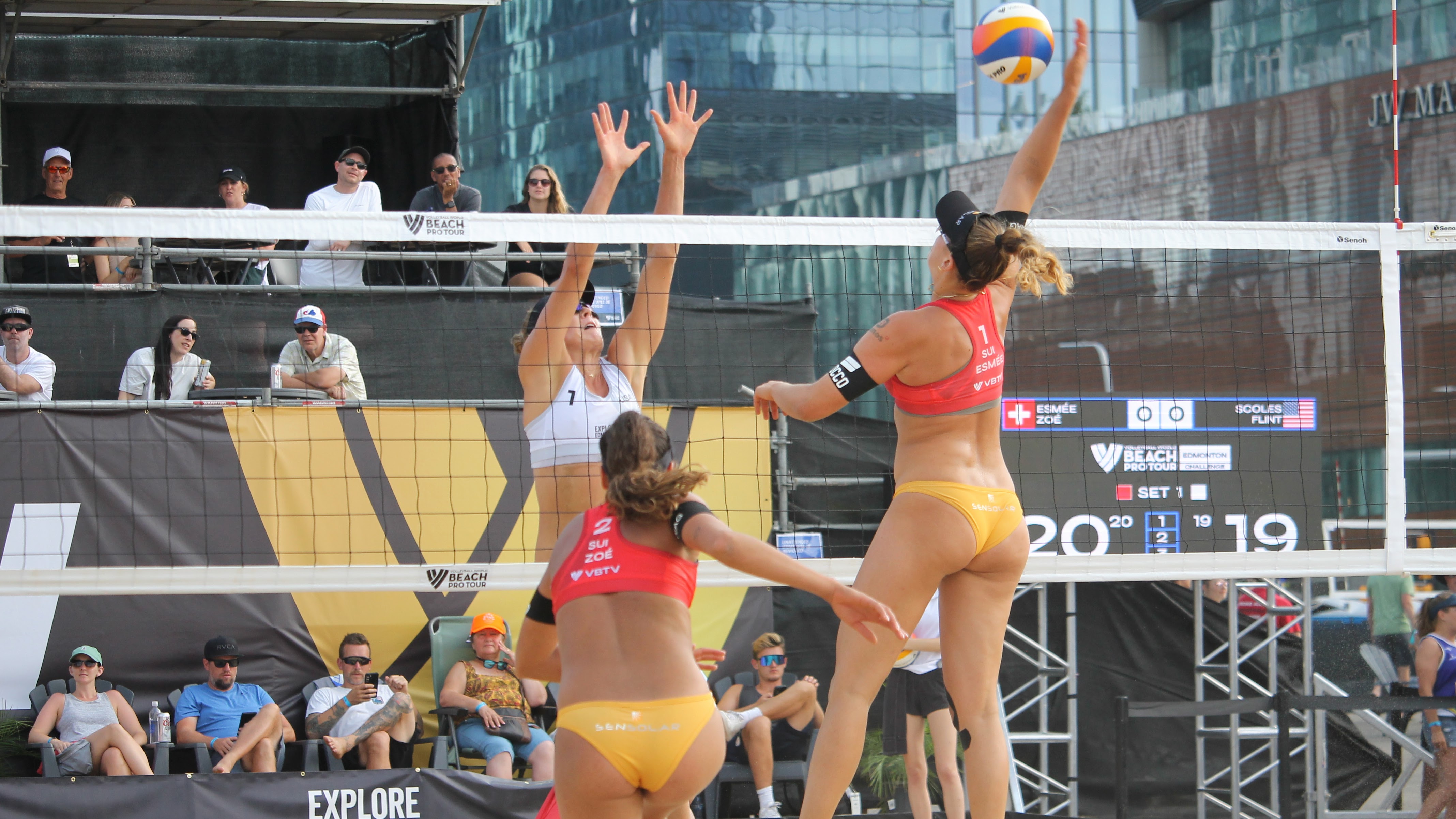
Playing the last remaining Canadian team in front of a crowd that made no secret of its rooting interest, Böbner and Vergé-Dépré won in straight sets. Böbner wasn’t perfect. The serve that can be such a weapon never quite found the mark. She made some errors. But they didn’t linger. They didn’t prevent her from doing her part on the next point. After a quick trip back to the hotel to escape the sun, they returned and beat Americans Betsi Flint and Julia Scoles in the quarterfinals. A day after despair, they earned their second semifinal berth this summer.
The Swiss were again off their game in the semifinal, losing to Italy. And then they were valiant again, dropping a three-setter against the Czech Republic for bronze, 26-24 in the second set and 15-13 in the final set of a match that stretched well over an hour.
It wasn’t a dream ending, but they played through the end of the tournament. For a young team trying to climb the ladder, pushing ahead of schedule to displace one of the established Swiss giants—reigning Olympic bronze medalists Anouk Vergé-Dépré (Zoe’s older sister) and Joana Mader or former European champions Nina Brunner and Tanja Hüberli—that itself is a victory.
Zurich to Edmonton is a long way to travel with no guarantee of anything more than a day of volleyball. Yet for Böbner, the arduous journey was from the forlorn figure at that picnic table to the fighter playing through the tournament’s final hours.
Beach volleyball has a vibe all its own—the atmosphere that first appealed to Böbner all those years ago. But it’s also a grind, a life of unforgiving travel, the finest of competitive margins and ceaseless pressure for results. It can beat you down and rob you of your identity, if you let it. If it’s your passion, and has been for as long as you can remember, it can also lift you up.
“For me, it’s not the traveling,” Böbner said of her joy. “That’s cool, but I also like to be at home. It’s the passion you can give to something. It’s important to me to keep that passion. As long as I’m having fun doing it, I think I’m the best part of myself.
“That’s really important. It’s what I enjoy about beach volleyball.”
It was her good fortune to be born at precisely the right time to live out a dream.
What she or any of us do with tomorrow is ours to decide.


 Graham Hays