“You never thought about oh my gosh we missed it in the second set? You always still believed?”
“Hmm, uh, to be honest, it was a little bit in my mind.”
Interviews in second (or third or fourth) languages are often less than revealing. It’s difficult enough for most of us to express ourselves in the language we know best, let alone find the right words and grammatical constructions to convey complex thoughts in another language. Order a meal or ask about a train schedule? Sure. Describe emotional states of existence? Trickier.
But on rare occasions that process strips away any artifice or obfuscation. All that’s left is the simple, honest truth. So it seemed with Nina Betschart’s answer above, delivered in English with an almost embarrassed grin in the obligatory postgame television interview after Saturday’s semifinal between Switzerland and Germany in the European Beach Volleyball Championships.
Betschart and partner Tanja Hüberli had just pulled off the seemingly impossible by winning five consecutive points — the first three on the brink of elimination — to complete a comeback and reach the final in Vienna, Austria.
The ensuing championship match was almost anticlimactic for the Swiss — if winning a career-defining title in front of a frenzied, partying crowd in a three-story arena whose design was part Elizabethan and part Mad Max can be anticlimactic. Betschart and Hüberli rolled over a talented but inexperienced Dutch team in the final. It was joyous, to be sure, and the celebration complete with hugs, tears, the Swiss national anthem and some impressively committed champagne consumption. Even without Americans, Brazilians, Canadians or Australians, the trophy is a big deal to lift.
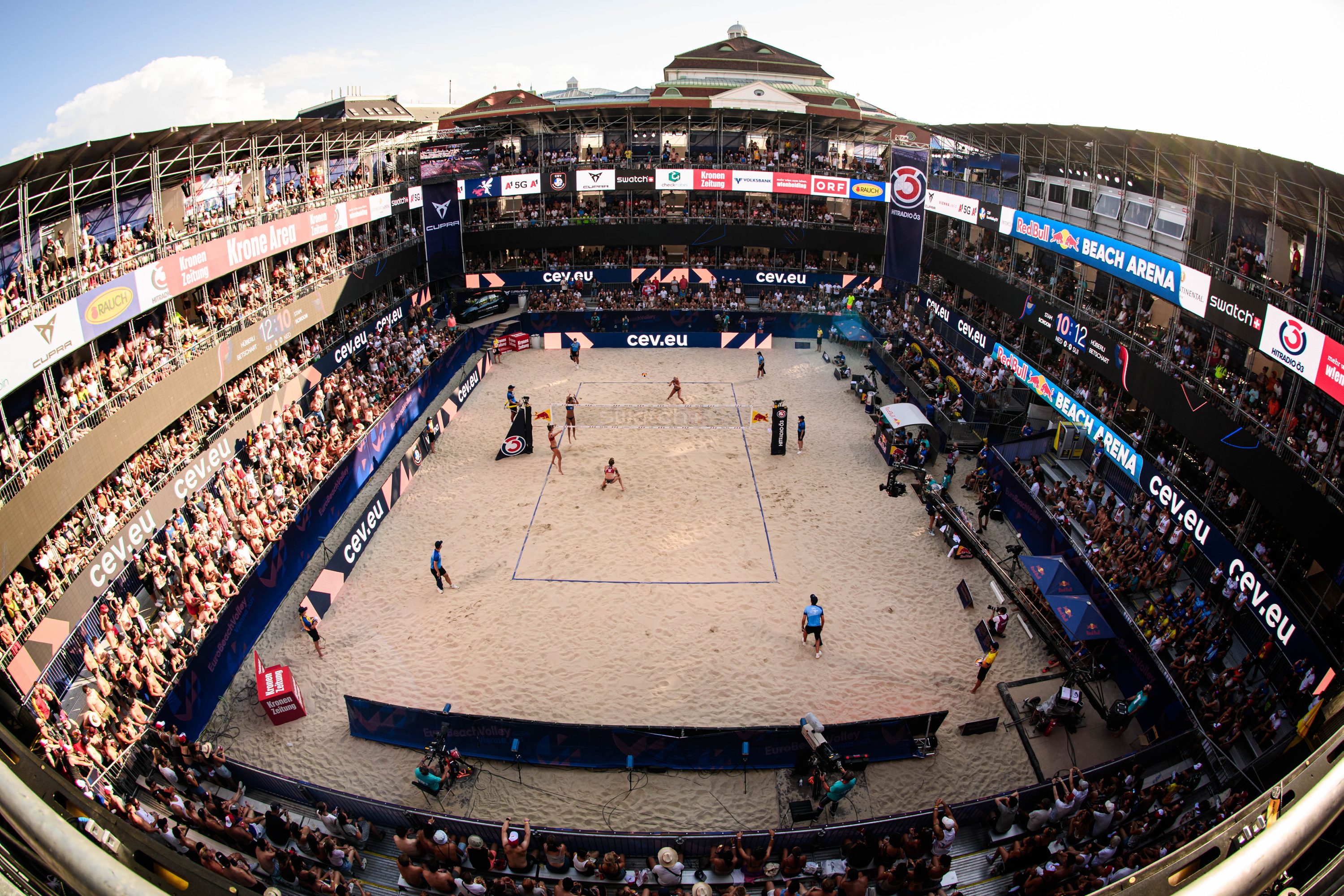
As a fan of the Swiss team, I savored those scenes. They finished second in the same event in 2018, the same year they were semifinalists in the World Championship. They are often close to trophies, but until this win, their biggest title was a 1-star event. Still, the part of the weekend that fascinates me most wasn’t the outcome as much as Betschart’s quote and those points late in the semifinal.
How often do athletes talk after a comeback about how they never stopped believing? How often do we, in turn, ascribe to them some sort of superhuman mental strength that prevents them from accepting defeat? I can’t help thinking that shortchanges them.
In a work project the other day, I tried to decide between using “courage” and “bravery” in a passage. I would have preferred bravery because I’m a sucker for alliteration, which applied in this instance. And most sources suggest they are, at least practically, interchangeable. But to me, correct or not, bravery implies acting without regard to potential consequences, whereas courage implies understanding the consequences but acting nonetheless.
Both, I’ll hasten to add, are overused in the context of sports. Still, listening to Betschart reminded me of at least the essence the debate. If someone down 14-11 in the third set really doesn’t have any doubt that she will win, it’s still a good story if she does win. It’s still a remarkable comeback. But it’s no more relatable to most of us than is world-class athleticism.
Doubting and carrying on anyway? That’s far more familiar.
At no point in my life could I jump or run like Betschart. At no point was I as fit. (Nor was I at any point willing to put the time and effort into training my lesser abilities that she has into hers.) But I think I can imagine what it was like for her when she was down 14-11 and wondering if it might all be about to go wrong again.
For the second time this month, first in the Olympics and now in the sport’s biggest continental championship, Betschart and Hüberli faced not just impending defeat but impending defeat in a distinctly soul crushing manner.
In the Olympics, it happened in a marathon third set against countrywomen Anouk Vergé-Dépré and Joanna Heidrich in the Round of 16. That pair went on to win the first ever Swiss medals in women’s beach volleyball.
Saturday in Vienna, Betschart and Hüberli didn’t finish off multiple match points in a second set against Nina Borger and Julia Sude in which the Swiss led 16-11 late. That set eventually lost and the match leveled, Betschart and Hüberli were then down 14-11 in a winner-take-all third set to 15.
They got to 14-12 when Borger’s serve down the line went just wide, their fate out of their own hands as Betschart watched and hoped the ball didn’t clip some fraction of the tape.
Survival still meant winning consecutive points while serving. That is rare enough during any stretch in match. It’s all the more daunting with a place in the final on the line.
A big dose of Swiss good fortune made it 14-13, Hüberli’s serve clipping the top of the net and dropping straight down on the German side. But the Germans still just needed a side out to win.
Sude’s first pass off the next serve was heavy. The ball drifted too far, directly over the net, and left Hüberli and Borger with equal opportunity to play it as they leapt. Hüberli made contact first with her right hand, but in doing so, she only managed to push the ball onto Borger’s hands — the German steering the ball right back over the net onto the Swiss side.
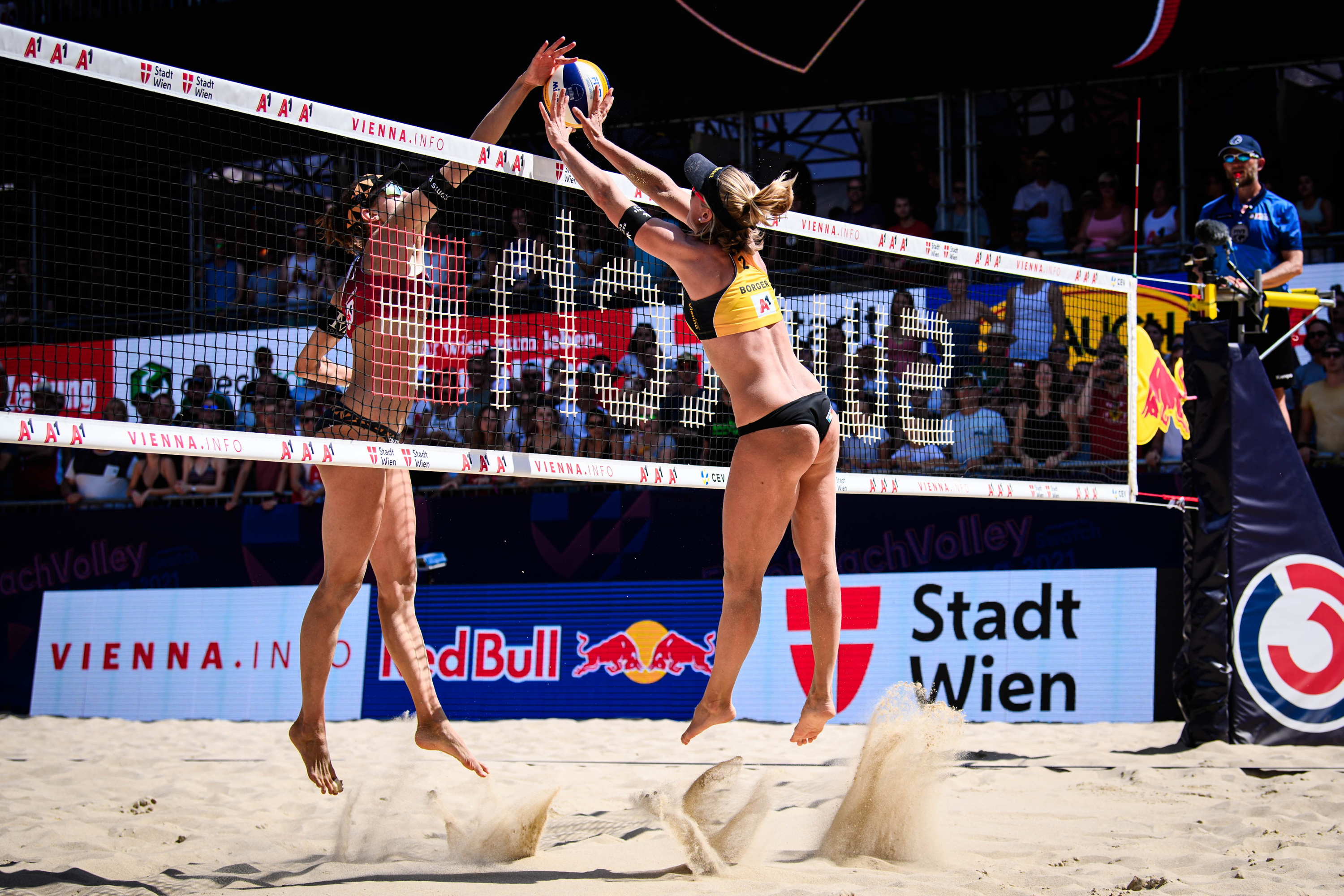
Now falling away from the net as she came back to earth, Hüberli reached out her left arm in time to pop the ball into the air. Betschart then had the presence of mind to eschew any attempt to set the ball for her partner and instead hit it over the Germans and into the empty court between them and the baseline to tie the score 14-14.
And that was only half the job done. The Swiss went on to win two more points on Hüberli’s serve. They earned another match point when Sude hit the ball wide trying to go around Hüberli’s attempted block at the net. A Betschart dig and kill provided the fifth point in a row to win the match and send the teammates tumbling to the sand in celebration.
It was an unlikely enough scenario for the semifinal of any major tournament. But again, this all came less than two weeks after Betschart and Hüberli lost in the Olympics.
And not just lost but lost to their closest rivals (the team they had in recent months at the very least caught, if not supplanted, as the top Swiss side), 23-21 in the third set. The bronze medals that Vergé-Dépré and Heidrich deservedly won in the end could well have been theirs.
Even as someone who was only ever tournament-adjacent as a journalist, I remember the temporary hollowness that accompanied the end of a World Cup or Olympics. There is an all-consuming quality to those events. The months of buildup, the travel, the deadlines and the unrelenting grind of the event itself (with plenty of amazing and memorable aspects mixed in).
Even knowing you’re staying through the final game, a luxury the participants certainly don’t have, the end comes suddenly. One day you’re in a packed stadium in Vancouver or listening to anthems in Rio de Janeiro. The next day you’re in a Hampton Inn in Hibbing, Minnesota or eating a pre-dawn breakfast in a mostly empty IHOP near the Atlanta airport. It is jarring.
For athletes, especially all of those who don’t win their final competition or realize their lifelong dreams, the sense of dislocation must be orders of magnitude more profound.
There are other championships and other goals. But on some level, Tokyo had shaped Betschart and Hüberli’s world for five years.
It must have hit Betschart and Hüberli somewhere on the flight from Tokyo to Vienna.
Forget the physical challenges posed by jet lag involved or blistering temperatures in Vienna that left the sand temperature over 100 degrees for most matches. It had to be an immense mental challenge merely to be in the right head space to compete at all. It is difficult to fathom how anyone in the Swiss position could still believe when down three points in the third set.
Which is why Betschart’s answer, perhaps without the native-language fluency to evade the question, was so wonderfully revealing.
She didn’t believe. Not entirely. Not with the unthinking, blind belief of a zealot. She knew what the most likely outcome of the next few moments was.
And she played through that doubt. That’s more impressive. Or at least more human.

 Graham Hays