
Unless this sentence somehow finds its way to someone in the Swiss volleyball community, there is a good chance you’ve never heard of Nina Betschart and Tanja Hüberli. They did something rather remarkable Saturday — decidedly early Saturday if you happened to reside in the predawn darkness of our easternmost time zone.
They won a beach volleyball match.
Maybe that doesn’t sound all that remarkable. Betschart and Hüberli win quite a lot of matches. They enter the Olympics in a good run of form and seeded seventh in the field of 24 teams.
Nor is it wholly remarkable that they won despite handing their opponents a five-point lead in the opening set. Or that they beat Germans Laura Ludwig and Margareta Kozuch after losing that first set (23-25, 22-20, 16-14).
Even winning their Olympic debut after all three sets needed extra points to settle — in blistering heat and humidity — is, at best, mildly remarkable for top-tier professionals.
What they did was remarkable because getting to the Olympics is remarkable. Any Olympics. But these Olympics more than most. On some level, everyone knows this. But we know it on a macro level, the way we know running a marathon is remarkable without knowing exactly what goes into running 26.2 miles. Saturday, I understood. After five years of web streams, scoreboard refreshes and occasional days in the hot sun — after five years of being a fan — I understood how two remarkable athletes got there.
Beach volleyball captured me in the 2016 Olympics. I was in Rio de Janeiro, which apparently is to beach volleyball what Paris is to restaurants. I also wasn’t as busy as expected as those Olympics carried on, the U.S. soccer team having bowed out in the quarterfinals and my employer sadly ambivalent about stories on Dzsenifer Maroszan and the remaining teams. Watching volleyball replays and reading stories became a routine on the long bus rides to the Maracana.
Among the first revelations was that Switzerland played beach volleyball. Yes, that Switzerland. In fact, the decidedly landlocked mountainous country didn’t just play — it had two women’s teams in Rio. Having spent one of the best stretches of my life studying in Switzerland many years ago (without ever seeing a sand volleyball court that I can recall), I couldn’t help but adopt the Swiss and their quirky mismatched marriage of geography, climate and sport.
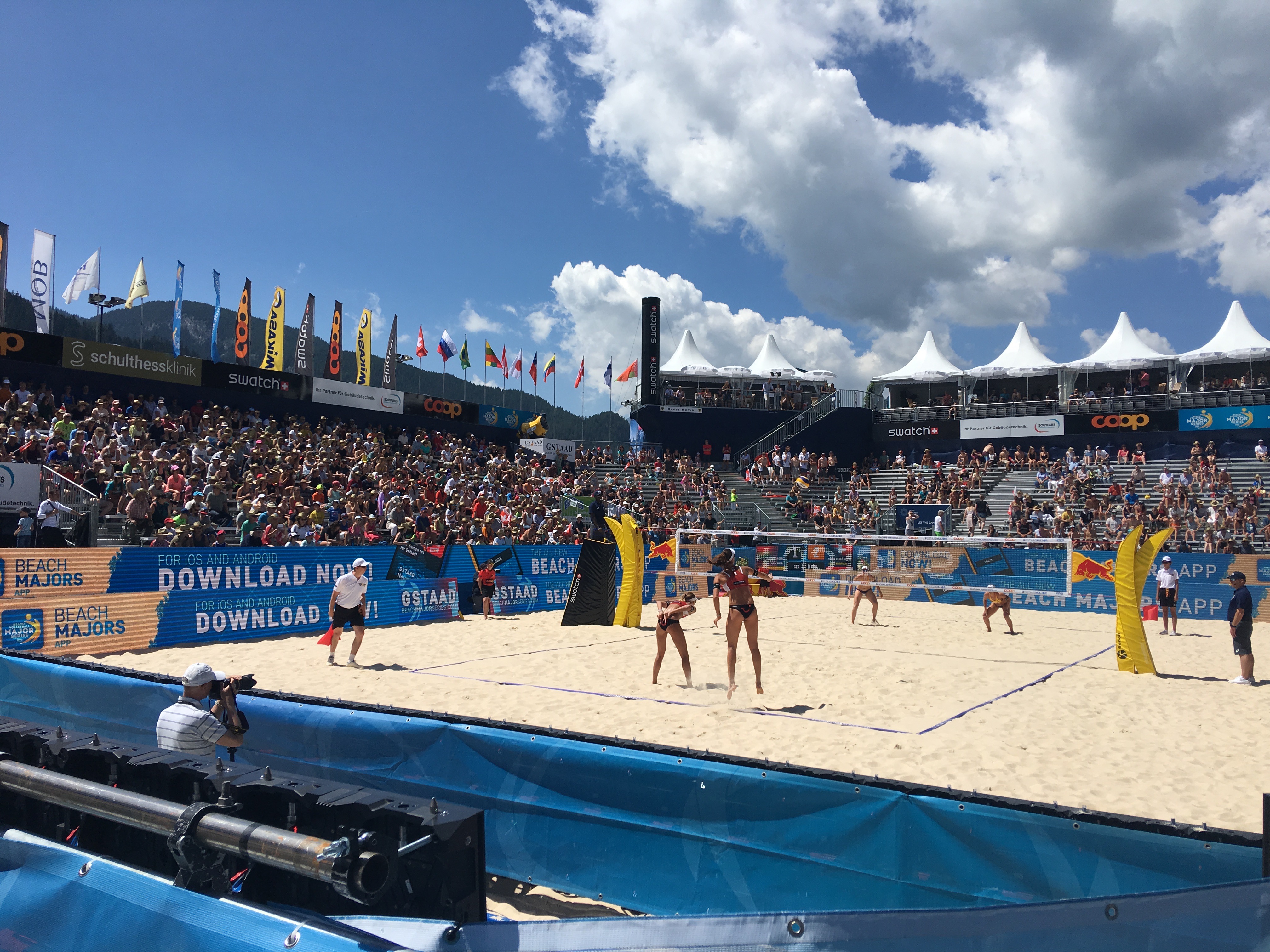
It’s not as if Switzerland is a powerhouse in indoor volleyball, which might logically feed the beach success that has seen it amass one of the best Olympic qualification records among countries beyond the obvious giants like Brazil and the United States. The Swiss are just really good in the sand.
Among my biggest regrets is I never could talk ESPN into letting me dive into the story of why. But current Swiss Olympian Anouk Vergé-Dépré once proposed (after I hijacked an interview ostensibly about Kerri Walsh Jennings’ then-latest project) that it may be a perfect storm of early success leading to locals staging the annual FIVB Major in Gstaad, which in turn birthed a generation of beach talent. (She and partner Joanna Heidrich, whose brother is also in these Olympics, also won their opener Saturday).
Stefan Kobel and Patrick Heuscher won bronze in the men’s competition in the 2004 Olympics, the best of four trips to at least the quarterfinals for Swiss men’s or women’s teams. That’s half as many as Germany, a country with roughly 10 times as many people.
“Players who were dreaming about competing internationally indoors went to beach because indoors is not that big in Switzerland,” Vergé-Dépré said. “And it’s another lifestyle indoors.”
She was laughing as she said the last bit, as you might, too, if your office was often a beach instead the fluorescent lighting and floor burns of some second-rate gym.
I still think that’s a story worth at least a few thousand words, if anyone is taking pitches.
But both Swiss teams from the 2016 Olympics broke up after the tournament, both Vergé-Dépré and Heidrich losing a partner to retirement before the two holdovers teamed up. Getting in on the ground floor as a fan of a new team was appealing, all the more after discovering Betschart. She seemed like a phenom. How else to describe someone who won junior world titles in 2011 and 2012 — when she was 15 and 16 years old, respectively, in an event that was open to players as old as 21? Sign me up.
The nuances of beach volleyball strategy are still largely beyond me. Not as much as five years ago, to be sure, but enough to leave me well aware of my ignorance. It doesn’t matter. The sport is narrative heaven. It is a perfect blend of team and individual. There aren’t any role players. There is nowhere to hide on a bad day. It’s all the spotlight and pressure of an individual sport like tennis with all the demands of the teamwork necessary in the sports I more often covered. The mental pressure of partnerships that last longer than some marriages is profoundly interesting.
The sport is full of compelling characters. Vergé-Dépré working to get a players union up and running. Humana-Paredes learning from a father who came to Canada from Chile amid the calamitous Pinochet years and helped build Canadian beach volleyball into a legitimate power. Dutch standout Sanne Keizer returning from a four-year retirement and traveling the world the past four years, often with her kids in tow, to chase another Olympic opportunity. And on and on.
No rooting interest is necessary to find much of it fascinating. But in the case of Betschart and Hüberli, it was fun to be a fan again. I root for Fulham, but that’s largely self-inflicted misery. I root for the Danish national teams in soccer, but they don’t play very often. Rooting for Betschart and Hüberli is a chance to be irrational again after years of trying to be rational (if still often wrong) about sports.

Forgive the soccer analogy in lieu of a good volleyball comparison, but Betschart is a hybrid of N’golo Kante and Julie Ertz. She’s a defensive marvel, reading plays and digging the ball. But like Ertz, she’s also coiled aggression and power waiting to be turned loose. She goes for broke, whether exploding into spikes or deftly going for the tightest of angles on fluttered cut shots.
Hüberli is like a Sam Mewis, this seemingly genial, lanky soul who transforms into a multi-faceted warrior on the court.
Plus, her mom runs a small restaurant. Or cafe. I’ll be honest, I’m not entirely sure. It’s sometimes difficult to follow social media posts in German. But come on, that’s fun.
They didn’t make it out of pool play the first time I saw them in person in Fort Lauderdale in 2017, their second year together (although they finished third in a five-star event later that year). Even my untrained eye could see a work in progress, Hüberli still just 24 and Betschart only 21. From the start, they had chemistry. The only bad body language from either was after her own mistake — never after a partner’s error. They were easy to root for that way. But each was also clearly her own worst critic, one error leading to another miscue and a set suddenly getting away from them. That changed quickly.
By 2018, they made an unforgettable run to the gold-medal match in the European Championship before finishing second.
In 2019, they made it to the semifinals of Gstaad, signaling their arrival as at least the equals of Swiss counterparts Vergé-Dépré and Heidrich (Betschart’s youth world titles came alongside Heidrich in 2011 and Vergé-Dépré a year later).
Runners-up in a recent tournament in Sochi, Russia, Betschart and Hüberli are legitimate contenders to medal in Tokyo, if not quite in the group of favorites that includes Brazilians Agatha and Duda, Canadians Melissa Humana-Paredes and Sarah Pavan and Americans April Ross and Alix Klineman. Some in Midwestern states where such things are now legal may even have placed a small wager on a medal. Out of hope if not absolute conviction.
It was a pleasure to see two athletes realize a dream Saturday morning. It made it all the sweeter to understand all the waking hours they spent earning the chance.

 Graham Hays