UNIVERSITY PARK, Pa. — Even the fog was fast Friday night, a meteorological match for No. 15 Virginia and No. 12 Penn State.
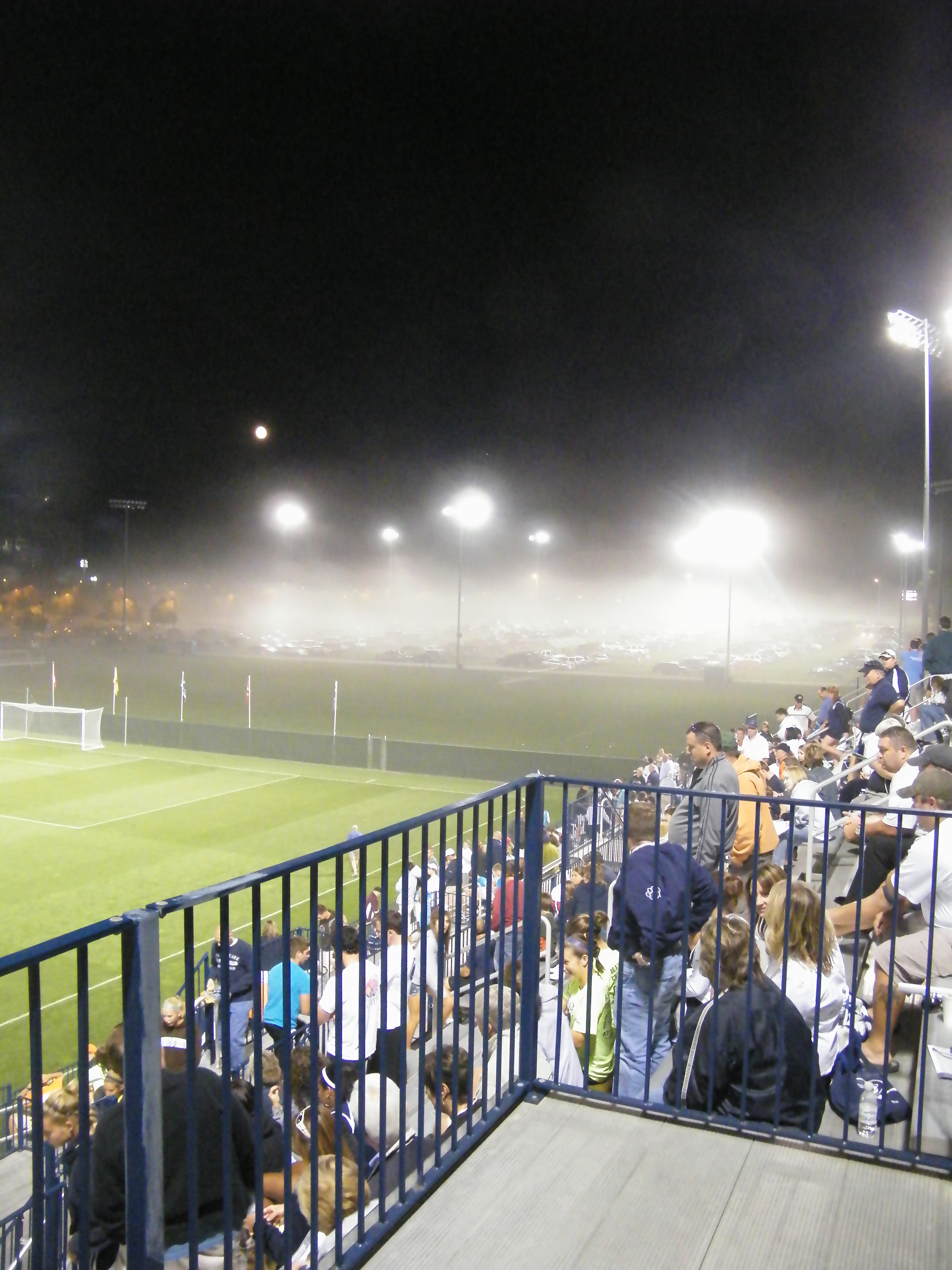
The most unexpected guest among a record crowd of 3,912 at Jeffrey Field first crept around the crossbars and drifted through the netting of the goal the Nittany Lions defended with no more than half an hour remaining in the game and the home team leading 1-0, courtesy of a Hayley Brock goal. By regulation’s final whistle it was gone, having moved from one end of the field to the other, escaped to the parking lot beyond and finally dissipated into nothingness in a matter of minutes.
And with it, the win Penn State seemed to have in its grasp.
Inches from extending its lead to two goals with barely five minutes to play in regulation when Brock slid a shot barely wide of the far post at one end, the Nittany Lions instead saw Virginia’s Lauren Alwine take a pass from Caroline Miller and slot home the equalizer with 3:04 to play. After both teams traded quality scoring opportunities in overtime, a game that promised a battle of supremacy between potential College Cup sleepers ended in a 1-1 stalemate.
“There are several ways you can look at it,” Virginia coach Steve Swanson said of the draw. “You can look at it and feel maybe you should have won it because you had some good chances to go ahead. You maybe feel like you could have lost it because they had some good chances. And then you kind of settle on the draw.
“I think probably a draw was a fair result tonight.”
But a race unwon is a race still run, and to that end, the speed of Friday’s game offered an ever better measure of what’s ahead for both teams than would have a win or a loss in the standings.
The game was, of course, a rematch of one of more curious NCAA tournament games in recent memory, a second-round game on the same field last season in which a 2-0 Penn State halftime lead became a 6-2 Virginia win, with all six Cavaliers goals coming in a 20-minute span. But even that recent history seemed to run a distant third to present and future on a night when Brock, Maya Hayes and Taylor Schram made their home debuts for the Nittany Lions.
Brock and Hayes started for coach Erica Walsh, and all three freshmen played at least 70 minutes for Penn State (redshirt freshman Tani Costa, the hero of last week’s overtime win against West Virginia, also played 49 minutes off the bench). None of the three was immune from the kind of mistakes freshmen make in August, but along with senior Danielle Toney, they did something rather notably less common for freshman in essentially dictating the pace of the entire game.
In those four players, particularly when Brock and Toney are paired at the top of the attack, Penn State has a front line that is at least as fast — if not faster — than anything even the ACC can offer.
“They were really, really fast — like a track team,” Virginia defender Morgan Stith offered with a shake of her head after playing the full 110 minutes against that speed. “Our back line, I felt like during this game did a really good job of stepping and dropping. Our back line is fast, too, so we just kind of had to be aware of the ball over the top, so that they couldn’t just run onto it.
“Florida State has some fast forwards, and North Carolina does as well. The ACC, the speed of play is so fast, so this is really good preparation for the coming season. But [Penn State is] just as fast.”
That kind of pressure takes a toll. Virginia had a slight edge in possession for the first 15 or 20 minutes of the game but gradually found itself struggling to get the ball out of its own half. Counters gave way to simply clearing the ball out for a throw or even a corner. Penn State earned eight corner kicks in the game, including the one that set up its goal when Brock redirected a ball from Costa in the 57th minute. The Nittany Lions now have 19 corner kicks through two games against top-20 programs in West Virginia and Virginia.
“I think we have a pretty fast back line and at times, they certainly caused some problems,” Swanson said. “We tried at times to just keep it a little bit and move it and get them working. But at times during the game it got a little helter-skelter because of their pressure, and I think that’s when they got us stretched a little bit and they’re looking to get in behind. So it’s tough. Yeah, I think [Brock and Toney] are as fast a tandem as I’ve seen in awhile, for sure.”
Only down a goal and having substituted an attacking player for a defender late did Virginia truly reclaim an equal share of the attack, momentum it carried after the equalizer to earn slightly more of the overtime chances and finish even in shots on the night with 20.
And yet for all the pressure Penn State applied, it created just the one goal, allowing the Cavaliers to create their own last-minutes heroics. Chalk a big part of that up to Virginia’s back line and keeper Chantel Jones, who merit their own post soon, but some of it also falls back on the Nittany Lions themselves. The track metaphor Stith brought up is going to be a common one in talking about Penn State, but passing the baton is still a work in progress.
At one point in the second half, sophomore midfielder Christine Nairn tracked back and won a ball with a sliding effort five or six yards into her own end. Yet as she climbed to her feet, she could only throw her hands in the air and shake her head as a teammate promptly booted the ball 30 yards down the field, seemingly without much in the way of a particular target picked out.
“There’s huge potential, obviously, in that tandem and some different pieces coming on,” Walsh said. “But we’ve got a lot of work to do in being less predictable and more creative in our attack.”
Nairn will obviously be a big part in supplying that creativity — the long balls are doubly dangerous in that they risk bypassing one of the nation’s best midfield playmakers. But Hayes and Schram could also be key figures, using the speed and possession abilities they possess to stretch defenses wide, putting pressure on opponents from multiple directions — the slightly more humane soccer version of the medieval practice of tying someone’s four limbs to wild horses.
Too often, Penn State seemed content to boot the ball down Route 1 and hope someone ran onto it — and those who did sometimes seemed too eager to finish on their own. It’s no coincidence that two of the team’s most memorable scoring chances in the run of play came on secondary runs with the defense already stretched — the first resulting in a penalty kick that Jones saved and the second a fantastic shot from Emma Thomson that required a quality Jones save.
“You’ve got to feel the game and you’ve got to understand when to keep possession,” Walsh said “And I thought in the first half, we didn’t do a good enough job of keeping the ball. The second half, I thought we made Virginia work a little bit more, which helped us a ton.”
Penn State had the speed to take the game to one of the ACC’s best teams for much of the night Friday but lacked the polish to finish it off. Virginia had the defense to absorb that speed and blunt most of the potential scoring chances — and the offensive resilience to find a goal when it needed it late. Nobody won Friday night but both teams showed the attributes that should allow them to win with regularity as the season continues.

 Graham Hays
One thought on “Thoughts on the Penn (State) Relays”